Full Article
about Espartinas
Residential Aljarafe town with bullfighting and wine-making tradition, home to a major monastery.
Hide article Read full article
Mornings scented with anise and olive oil
By nine in the morning, when the sun is already warming the eaves of the low houses, the smell of melted manteca drifts out from the bakeries along calle Real. In Espartinas, that scent feels like Sunday almost any day of the week: crisp tortas de aceite, dough that crumbles between your fingers, and a touch of aniseed that lingers after the first sip of coffee.
The village wakes slowly. Neighbours cross the square with a bag of bread tucked under their arm, greet the shopkeeper by name and swap a few words about whether there has been any rain over the fields of the Aljarafe. Espartinas does not reveal itself all at once. It asks to be walked at an unhurried pace, street by street, the way you peel an orange and let the fragrance gradually fill the room.
The older part of town keeps that everyday rhythm. Houses stand so close their upper floors almost touch, plant pots sit by front doors and washing lines stretch from façade to façade. Life here still revolves around small gestures and familiar faces.
The Aljarafe on the table
Early in the day, at café counters where coffee has been flowing since dawn, breakfasts are simple and filling: toasted bread topped with manteca colorá, a paprika‑rich pork spread typical of Andalusia, or good new-season olive oil. The murmur is low. Some people scroll through their phones, others discuss how the agricultural campaign is shaping up.
In many homes across the Aljarafe, gazpacho is made thick enough to eat with a spoon, prepared with day-old bread and a generous glug of olive oil. It is not a recipe exclusive to Espartinas, but it appears frequently here in summer, when the heat presses down and meals are improvised from whatever is fresh and at hand.
The land around the village has long been given over to market gardens and olive groves. In spring it is common to see bunches of wild asparagus, espárragos trigueros, in local markets. They are usually cooked simply, grilled on a hot plate or folded into quick scrambled eggs, the kind eaten standing up in the kitchen.
Wine at many tables remains straightforward table wine, poured without ceremony. It often arrives in large plastic containers bought from cooperatives in nearby Aljarafe villages. There is little fuss about it. It is there to accompany the food and the conversation.
Walking out to the old salt flats
A few kilometres from the centre, between patches of pine woodland and scrub, lie the remains of what are known as the old salt flats of Espartinas. Today the site is discreet: low walls, narrow channels half covered by earth and vegetation, and the occasional open stretch where the sun falls without shade.
For a long time there was talk of saline springs in this area and of small-scale operations that made use of that water. Not everything is well documented and the landscape has changed considerably, yet some residents still recall stories of lorries loaded with salt heading towards Seville.
The walk out there passes through old olive groves and along agricultural tracks. In certain sections the path narrows and branches brush against your arms, releasing the dry scent of rockrose and warm dust. If you do not know the area well, it is wise to have the route marked on your phone or to ask in advance. The tracks intersect frequently and it is easy to lose your bearings.
It is a landscape that feels open and quiet, shaped more by work than by spectacle. The remains of the salt flats do not present themselves as a formal monument. They sit lightly in the terrain, part memory, part ruin.
The romería of the Virgen de Loreto
At the beginning of autumn, when the worst of the heat has eased, Espartinas fills with decorated carts and horses fitted with small bells. It is time for the romería of the Virgen de Loreto, a religious pilgrimage deeply connected to the history of the Aljarafe and to the devotion shared by many surrounding villages.
The scene is distinctly local. Carts roll forward between olive trees, women wear mantilla lace veils, men dress in the traditional short jacket and high-waisted trousers of Andalusian riding costume, and loudspeakers play sevillanas almost without pause. The atmosphere is festive but rooted in custom, shaped by gestures and songs passed down over generations.
Each year there is a moment that many people wait for. Traditionally, some aircraft fly over the route and release rose petals from the air. The petals drift down slowly, settling on hats, in children’s hair or on the dusty track. It lasts only a few minutes, yet it is one of those images that stays with those who have witnessed it.
A village growing towards Seville
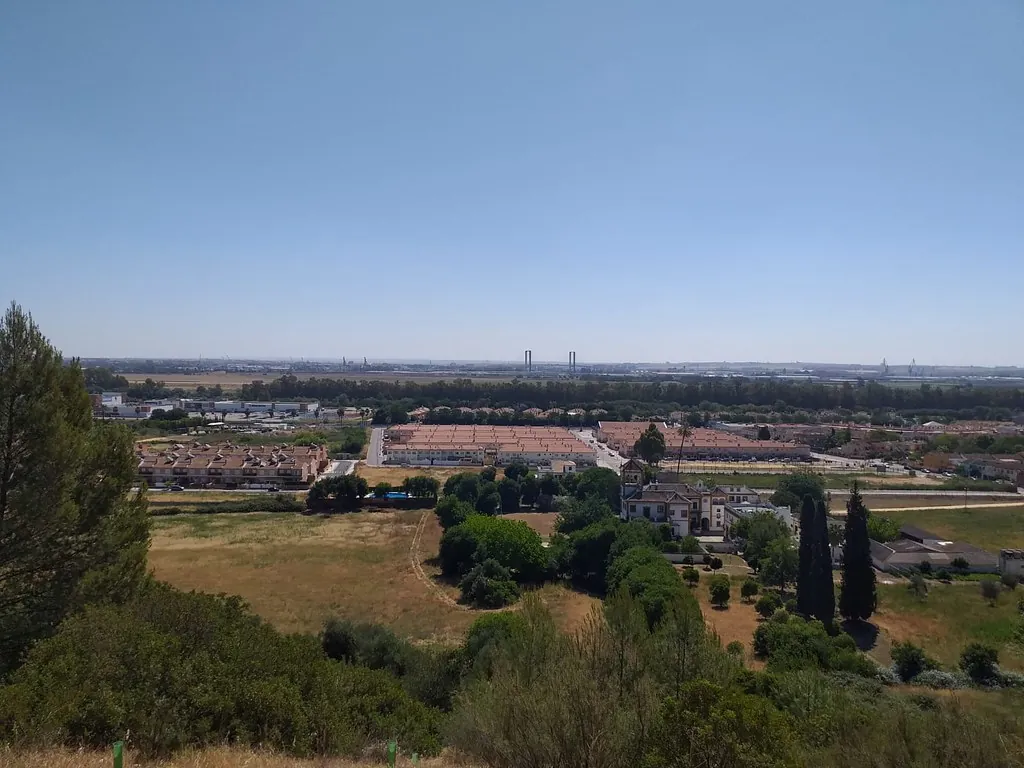
Espartinas has changed significantly in recent decades. Its proximity to Seville, just a few kilometres away, has drawn many people here in search of more space and houses with a patio. In the newer areas, housing developments and detached homes with young gardens have appeared, their trees not yet old enough to cast deep shade.
Even so, the pace in the older centre remains different. Daily life continues to unfold in the streets and small squares, in conversations that move from doorway to doorway.
As evening falls, the Parque de la Constitución becomes a natural meeting point. Retirees gather beneath the orange trees to play cards. Snatches of conversation jump from bench to bench. Children cycle round the same path again and again. When the air cools slightly, the scent of jasmine and nearby trees mingles with that of freshly opened bags of crisps.
It is in these small transitions, from heat to dusk, from work to leisure, that Espartinas feels most itself.
Getting there and choosing the moment
From Seville, Espartinas can be reached by car in a matter of minutes via the A‑49, taking one of the exits towards the Aljarafe. There are also secondary roads that cross olive groves and former agricultural estates before arriving in the village.
Metropolitan buses connect Espartinas with the city, although services are generally more frequent on weekdays than on Sundays. It is sensible to check timetables before planning a visit.
Summer here is dry and heavy, especially in July and August, when the heat shapes the day and slows everything down. Spring and early autumn tend to be more forgiving, particularly if you plan to walk out towards the countryside or coincide with the romería of the Virgen de Loreto.
Espartinas does not compete for attention with grand monuments or dramatic landmarks. Its appeal lies in quieter things: the smell of aniseed in the morning, the shade of orange trees at dusk, the memory of rose petals falling from the sky.