Full Article
about Mairena del Aljarafe
Modern residential town linked to Seville by metro, with preserved estates and a peri-urban park.
Hide article Read full article
Evenings at Ciudad Expo
Half past seven in the evening at the Ciudad Expo transport interchange. The sun is still strong over the square, but the olive trees of the Aljarafe are already casting longer shadows across the asphalt. Travellers step off the metro with the unhurried haste of people coming home from work in Seville: backpacks over their shoulders, headphones in, a slightly tired stride. Anyone approaching out of curiosity about tourism in Mairena del Aljarafe first encounters this everyday rhythm, a town closely tied to the pace of the Andalusian capital.
Mairena does not reveal itself all at once. It grew quickly towards the end of the last century, when many families looked for homes on the other side of the Guadalquivir without moving too far from Seville. There is still a sense of relative newness: wide pavements, parks whose swings have yet to creak, long streets exposed to the full force of the midday sun. The urban landscape sits alongside something older that survives at the edges: olive groves, dirt tracks, the occasional cortijo appearing between roundabouts.
The result is a place shaped by recent expansion but never entirely detached from its rural past. Daily life here is practical and residential, with Seville close enough to influence everything from working hours to transport habits.
Bread in the Air, Trains in the Distance
When one metro leaves, there is a brief silence before the next arrives. Around that time some bakeries begin to open, and the sweet smell of fresh bread mingles with the warm evening air. Many of the homes around the station are relatively recent apartment blocks, built when the Aljarafe began to fill with new housing developments.
A little further away lies PISA, the industrial estate where many local residents work. During the day it is a steady flow of cars. At night it is almost empty, streetlights illuminating rows of warehouses and wide car parks.
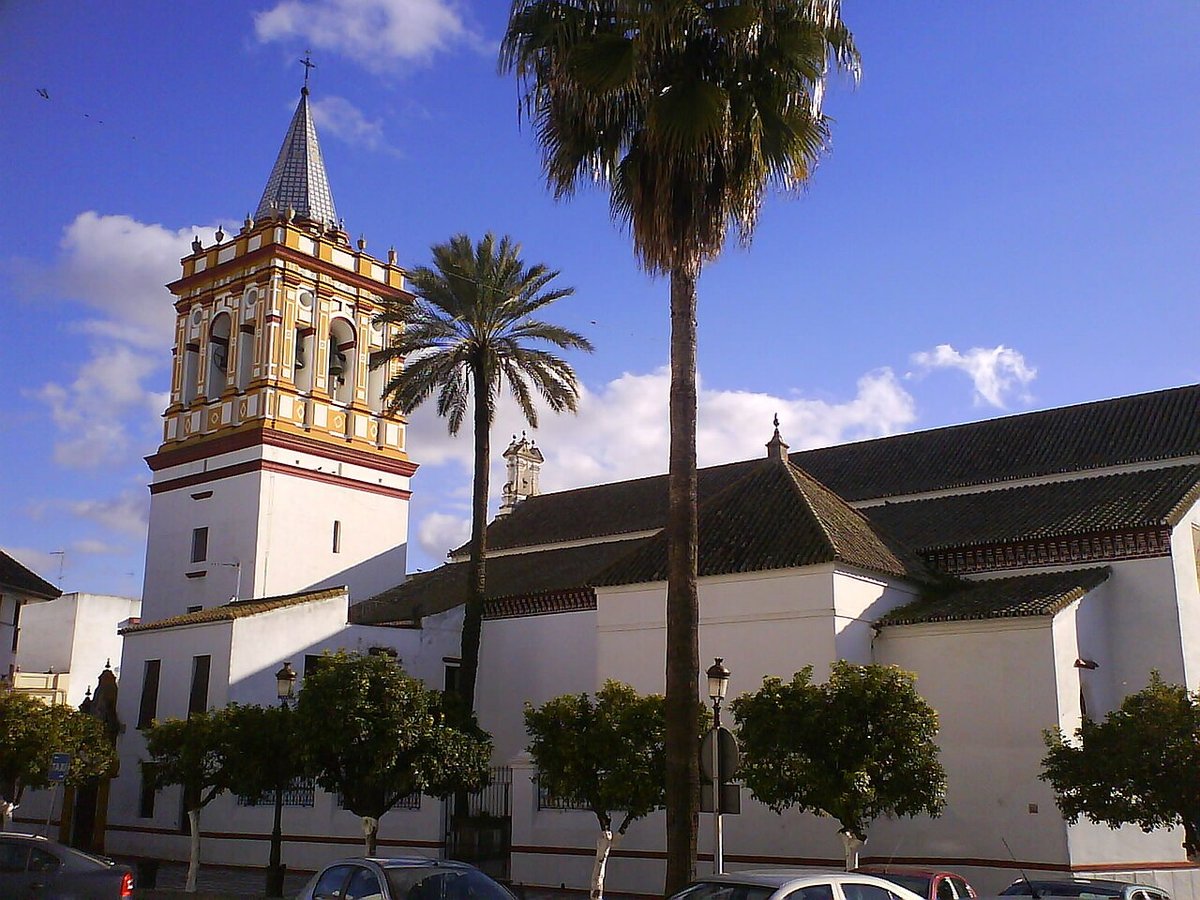
In the centre of the municipality stands the church of San Ildefonso. It was built on a site where Muslim worship once took place, a common story in many towns around Seville after the Castilian conquest of the 13th century. The current building reflects a restrained Sevillian Baroque style, typical of the wider comarca, a Spanish term for a county or district. From its steps there is a view over a patchwork of red-tiled roofs stretching across the Aljarafe, broken up by tall pines rising from residential areas such as Simón Verde, Lepanto and Ciudad Aljarafe. In these neighbourhoods the car remains part of daily life, and by May the communal swimming pools already carry the faint smell of chlorine.
Before the Urbanisations
Long before housing estates, the metro and shopping centres, this area was primarily farmland. The name Mairena is often linked to Arabic origins, as are many place names across the Aljarafe. For centuries the landscape was agricultural: olive groves, small market gardens and tracks connecting scattered cortijos.
After the Christian conquest of Seville in 1248, these lands passed into the hands of different lordships. In time they became associated with major noble houses from Seville, as happened across much of the region. Remnants of that past remain in isolated cortijos set between more recent developments: whitewashed walls, large wooden gates, curved Moorish tiles peeping out from among the trees.
The town fair usually takes place at the beginning of summer. The fairground is set up near the sports facilities, and the atmosphere feels very much like a neighbourhood gathering. Peñas, informal social groups, organise their own caseta, or marquee. The music shifts as the hours pass, and whole families move in and out of the enclosure. After midnight the sound of sevillanas, the traditional song and dance of Seville, blends with long conversations, while some children are already asleep in cars parked nearby.
This mix of tradition and modern suburbia defines much of Mairena’s character. It is a place where recent growth has not erased older customs, but instead frames them in a different setting.
When the Olive Trees Change Colour
Step away from the main avenues and it is still easy to find dirt paths threading through olive groves. Late in the day, as the sun lowers in the west, the silvery leaves begin to catch the light and the fields shift in tone every few minutes.
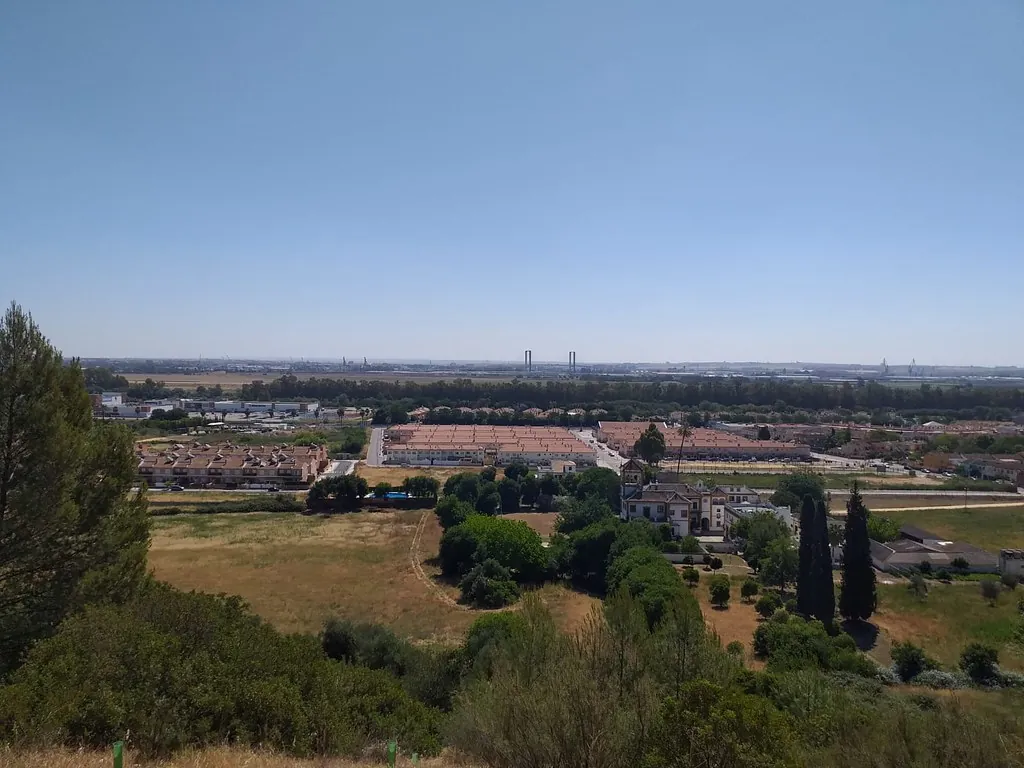
From some of the higher points in the area, small rises that barely stand out from the Aljarafe plateau, the scale of Mairena’s growth becomes clear. From above, the metro line can be seen heading towards Seville, orderly residential blocks arranged in neat grids, and beyond them patches of countryside that continue to hold their ground. More recent public buildings stand out too, their broad glass façades reflecting the colours of the evening sky.
The pilgrimage of El Rocío also has a presence here, as it does in many municipalities of Seville province. Around Pentecost, several brotherhoods from the Aljarafe set out towards the village in Huelva province that gives the pilgrimage its name. In the days beforehand it is common to see preparations under way: pressed traditional outfits, decorated carts, people organising the route with that mixture of excitement and fatigue that accompanies long pilgrimages.
These seasonal moments bring a different tempo to the town. Streets that are usually defined by commuting and school runs briefly turn their attention towards celebration and collective ritual.
Linked to Seville, Rooted in the Aljarafe
The metro connects Mairena directly with Seville, a link that has significantly shaped daily life. At peak times trains run frequently, and the journey to the city centre is short enough to make travelling between the two straightforward. For many residents it removes the need to rely on the car when moving between home and the capital.
That connection explains much about the town’s atmosphere. Mairena del Aljarafe is not isolated from Seville, nor does it attempt to compete with it. Instead, it functions as part of a wider metropolitan rhythm, with its own residential identity, its fairs and pilgrimages, its church of San Ildefonso and its olive groves still edging the horizon.
Those who come looking for grand monuments may not find them here. What emerges instead is a place defined by transitions: from field to housing estate, from dirt track to metro line, from agricultural past to commuter present. In the late afternoon, when the light softens over the Aljarafe and the trains continue their steady arrival and departure, that balance is easier to see.