Full Article
about El Cerro de Andévalo
A town with a strong cultural identity and age-old traditions such as the baile de la Jamuga; it has a rich religious heritage and a landscape of dehesa.
Hide article Read full article
Where the Song Begins
The fandanguillos of El Cerro are not learned in academies. They are passed down. Someone starts singing during the romería of San Benito and, almost without warning, half the group replies with the same verse their elders once sang. There is no choreography and no rehearsal. In a municipality of just over two thousand residents spread across several settlements, tradition moves by ear and memory. That is often the first impression on arriving in El Cerro de Andévalo.
This is not a place that announces itself with grand landmarks. Its identity is carried in voices on a dusty path, in a rhythm that is slightly drier than in other parts of the province of Huelva. The singing belongs to whoever is walking.
The Hill Before the Name
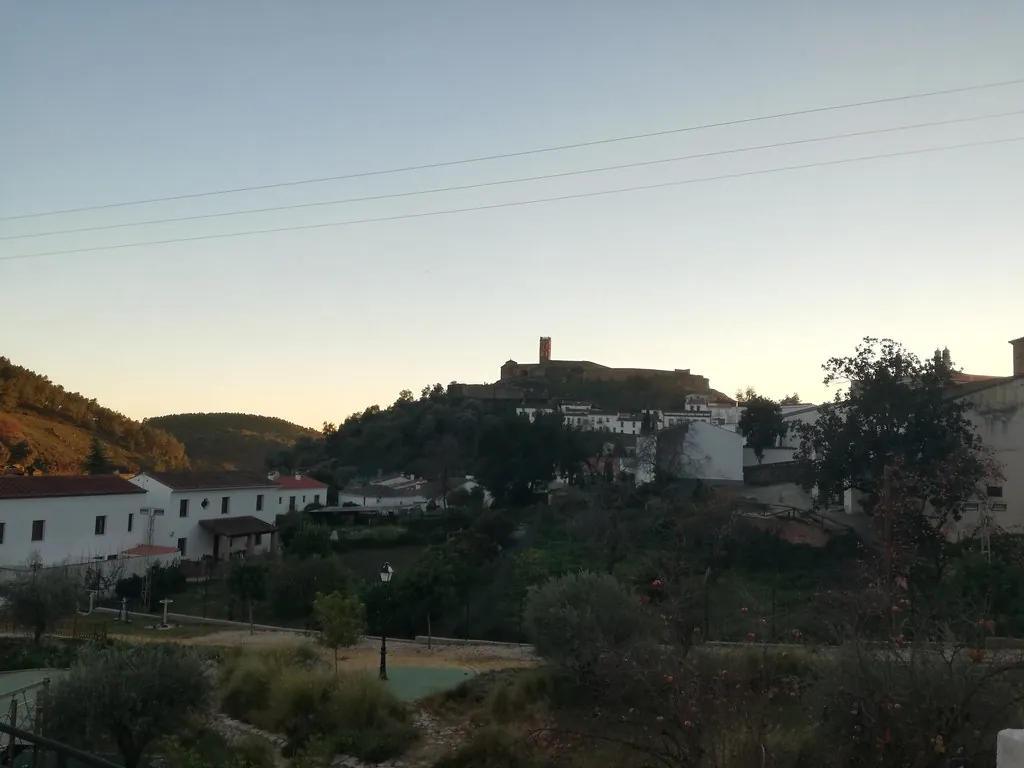
The comarca of Andévalo forms a band of rolling countryside between the mountains and the Portuguese border. Holm oaks, cork oaks, low scrub and occasional patches of olive groves shape the landscape. In the middle stands El Cerro, about 299 metres above sea level, built on a gentle rise. There was no castle and no defensive wall. The elevation itself was enough to keep an eye on livestock and watch the roads.
During the late Middle Ages the area went through periods of abandonment and repopulation. Documents from the late 14th century describe it as uninhabited, part of wider efforts to reorganise this internal frontier. Over time shepherds and small landowners arrived. By the early 16th century there was a stable community.
It was in that context that the church of Santa María de Gracia began to take shape. Work started in 1562 and is linked to Hernán Ruiz, an architect active in several Andalusian projects of the period. The building is restrained: a single nave covered by a wooden roof structure, with later alterations inside. Its importance lies less in its size than in its role. From that point on the village had a clear centre around which the houses gathered.
In the 18th century, conflicts with Portugal caused damage to the settlement. Part of the housing stock was affected. The church remained standing and the village rebuilt itself around it.
Passing Gentlefolk and Lasting Surnames
The parish archives hold small clues about who passed through. Between the 16th and 19th centuries, some marriage records refer to brides and grooms as “don” or “doña”, a courtesy title. They were not great lords. Many came from Portugal, others from different parts of the Iberian Peninsula or the wider Mediterranean, drawn by livestock farming and the commercial movement of the area.
What they left behind were mainly surnames. Some are still found in El Cerro and in neighbouring villages. They did not form a powerful elite or build palaces. Their significance lies in that modest crossing of origins which, over time, became absorbed into a fairly close-knit community.
Four Villages, One Rhythm
The municipal area covers around 286 square kilometres and is organised into several settlements: the main town of El Cerro and hamlets such as La Zarza and La Almonía, among others. Each place keeps its own chapel and festive customs.
Today the distances between them are short by car. For centuries they were travelled on horseback or by donkey. That is why the romería of San Benito Abad became a meeting point. A romería is a pilgrimage, usually to a rural shrine, that combines religious devotion with social gathering. The image of the saint is carried in procession, but the heart of the event is the journey itself.
Along tracks lined with holm oaks and scrub, the fandanguillos of El Cerro are heard. There is no stage. Whoever is walking sings. The rhythm sets a shared pace between the different settlements, a reminder that the municipality may be spread out, yet it keeps time together.
What to Notice in the Everyday
El Cerro is not explored in search of spectacular buildings. It makes more sense to pay attention to how its layout and everyday architecture have endured.
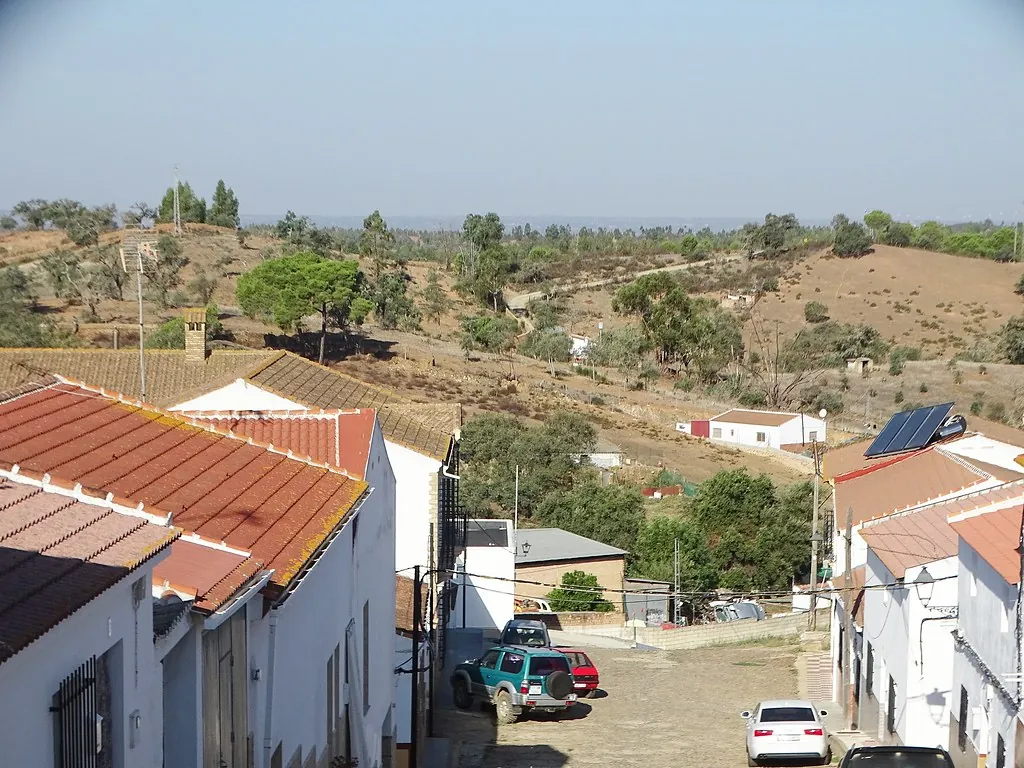
The Plaza de la Constitución is the natural starting point. Low houses, whitewashed façades and brick-framed doorways define the square. Many buildings have stone bases, a practical solution to protect walls from passing livestock, common in cattle-raising villages. The church of Santa María de Gracia occupies one side. Towards the end of the afternoon, the tower stands out sharply against the outline of the sierra.
If the church is open, usually during times of worship, it is worth stepping inside. The main altarpiece is Baroque, the result of 18th-century alterations. It is not monumental, yet the plasterwork with its vegetal motifs shows how artistic fashions of the time reached even here.
From the square, Calle Real begins. It was once a bridle path connecting El Cerro with other villages of the Andévalo. In some houses, wooden upper galleries still face south. They were used to ventilate and dry agricultural produce, a reminder that this is a working landscape.
At the end of the street there is a small elevated point overlooking the fertile plain. Today a road runs past, but the dehesa landscape has changed little: scattered holm oaks and grazing livestock. The sense is of continuity rather than transformation.
Getting There and Choosing the Moment
From the city of Huelva, El Cerro de Andévalo lies just under seventy kilometres away. The usual route follows the A-49 as far as La Palma del Condado, then continues along regional roads that cross the Andévalo. The drive takes a little over an hour at an unhurried pace.
In spring the countryside is often green and the dehesa active. Summer brings intense heat, and the streets fall quiet at midday. The municipality has basic services. For accommodation, many travellers also look to nearby towns such as Villanueva de los Castillejos.
El Cerro does not compete in scale or spectacle. Its interest lies elsewhere: in a church that fixed a centre in the 16th century, in surnames that hint at distant origins, in a pilgrimage where the road matters as much as the destination. Above all, it lives in the fandanguillos that move through the dehesa without amplification or stage, carried by memory from one generation to the next.