Full Article
about Paymogo
Border town known as the land of the wizard; a place of historic smuggling and endless pastureland where honey and gurumelos are produced.
Hide article Read full article
A slow pace by the Portuguese border
Early in the morning, when the sun is still low and filters through the holm oaks, the dehesas around Paymogo are almost silent. Now and then, the bleating of a sheep or the sharp sound of a gate breaks the stillness. This small municipality in the Andévalo area of Huelva, home to just over a thousand people, moves at an unhurried pace that becomes clear as soon as you park and begin to walk.
Portugal lies only a few kilometres away, and that closeness shows in subtle ways. Certain words sound slightly different, and some recipes blend traditions from both sides of the border. It is not something signposted or explained, but rather something that appears in everyday details.
The village centre and the church of Santa María Magdalena
In the centre of the village, the church of Santa María Magdalena stands out as the main reference point. Its tower rises above the white rooftops and is easy to spot when arriving by road. The current building sits on older foundations, probably dating back to the 16th century. Thick walls and stone surfaces take on reddish tones in the late afternoon light.
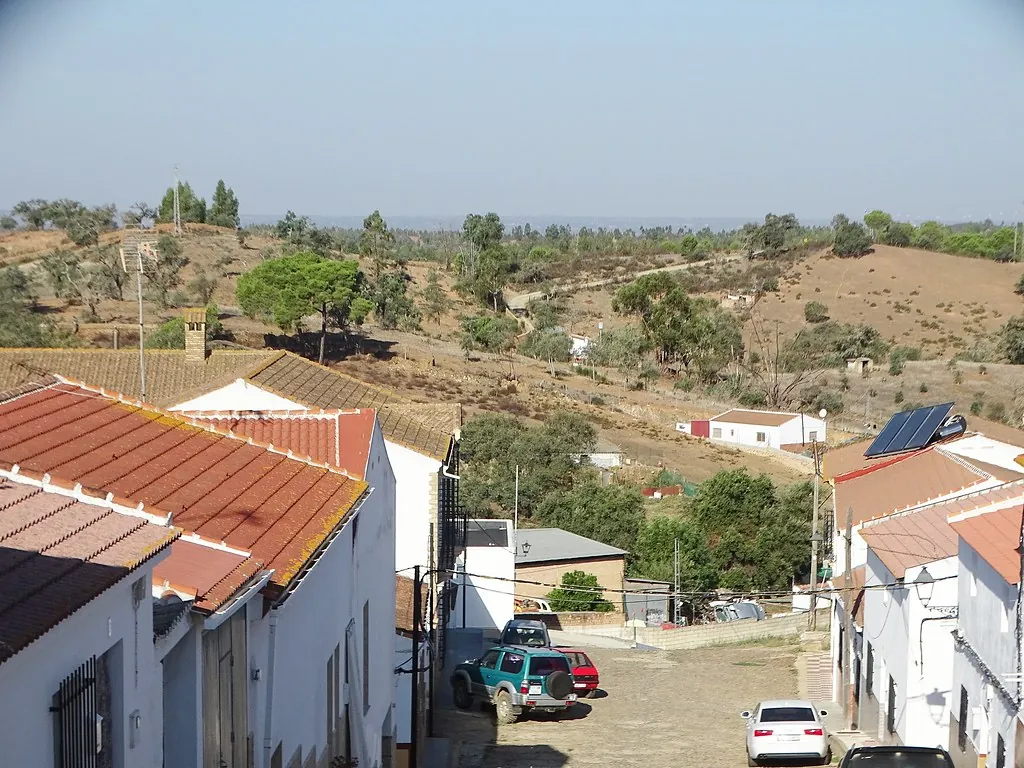
Around the church, a network of short streets spreads out, some of them cobbled. The houses keep their whitewashed façades and dark metal window grilles. In several doorways, worn tiled skirting boards are still visible, along with wooden doors that have clearly been in use for generations. This is not a monumental historic quarter filled with major landmarks. Instead, it is a calm, lived-in setting that invites wandering without a map, following gentle slopes that rise and fall between small squares.
Late afternoon is a good moment to walk here, when the heat eases and more people begin to appear in the streets.
The dehesas of the Andévalo
Beyond the village lies the landscape that defines this part of the Andévalo. The dehesa stretches out for kilometres, with scattered holm oaks and cork oaks, dry stone walls, and reddish dirt tracks running between livestock farms.
At certain times of year, Iberian pigs can be seen moving slowly beneath the trees, or flocks of sheep crossing the paths. The seasons change the feel of the land quite noticeably. In spring, grass and low flowers cover the ground. By summer, everything dries out and the scent of warm earth and scrub becomes stronger.
Several rural tracks can be explored on foot or by bicycle. Not all of them are signposted, so it is worth checking the route beforehand or following a simple track. On clear days, from some of the gentle hills, the line of higher ground marking the Portuguese border comes into view.
Rural paths and local walks
The terrain around Paymogo is rolling but manageable. Many of the paths follow old livestock routes that once connected farmhouses and estates. These are wide tracks of compacted earth, suitable for walking at an easy pace.
Autumn brings a different kind of activity. After the first rains, local residents head out into the dehesas to look for mushrooms. Níscalos appear among rockrose shrubs and under the oaks, along with other varieties. For those unfamiliar with the terrain or the species, it is better to stick to walking and observing. Each year there are warnings about confusion with toxic mushrooms.
These routes are not about reaching a particular viewpoint or ticking off landmarks. The interest lies in the gradual changes in the landscape and the quiet presence of rural life.
Food shaped by the countryside
The food in Paymogo remains closely tied to what the surrounding land provides. Iberian pork products are common, along with stews where meat is cooked slowly over time, and simple dishes that have been prepared in much the same way for generations.
In summer, people still talk about gazpacho andevaleño. This is a substantial version of gazpacho made with stale bread, pepper, garlic, and olive oil. When the weather turns colder, legume stews and other spoon dishes take over, often eaten slowly after a morning spent working in the countryside.
There is nothing elaborate about this cooking. It reflects the rhythm of rural life and the ingredients available nearby.
When to go and what to expect
Spring and late autumn are generally the most pleasant times to explore this part of the Andévalo. The countryside is green, temperatures are mild, and the paths can be walked without the intense heat of summer.
In July and August, the sun becomes strong from mid-morning onwards. During those months, it makes sense to head out early and leave walks for the cooler hours at the beginning or end of the day.
From the city of Huelva, the journey is around 80 kilometres by road. The final stretch follows secondary routes that pass through small villages and areas of dehesa, so it is best approached without rushing.
Paymogo does not revolve around large monuments or dramatic viewpoints. Its appeal lies elsewhere. It has more to do with what happens while walking slowly: the sound of animals beyond a fence, the smell of warm holm oak at midday, the orange light that lingers over the dehesas as the day comes to a close. The landscape here speaks quietly, but given time, it becomes easier to hear.