Full Article
about San Bartolomé de la Torre
A modern, dynamic town named after its watchtower; noted for its municipal park and quality of life in the Andévalo area.
Ocultar artículo Leer artículo completo
At 11:00 on a Tuesday, the only queue in San Bartolomé de la Tore stretches from the door of Panadería La Andévala to the tailgate of a farmer’s pick-up. Inside, a grandmother bags still-warm tortas de chicharrones while her grandson taps a card machine that hasn’t yet learned English. By 11:07 the loaves are gone, the shutters half-close, and the village returns to the hush of irrigated fields and cork-oil shadows. This is the entire rhythm of the place: brief flurries of yeast and conversation, then the long, slow exhale of an agricultural afternoon.
The Flat Between Two Coasts
The village sits 128 m above sea level, but feels lower. The land rolls like a gentle swell, not a hill in sight, and the horizon is stitched together by wheat stubble and the dark green blobs of holm oaks. From the single mirador beside the ruined Torre de San Bartolomé – a stump of Moorish masonry with a modern staircase bolted on – you can watch thunderstorms march up from the Atlantic thirty kilometres away while the air at your elbows stays hot and still.
That equidistance from ocean and sierra is what gives the place its mild, almost Portuguese climate. Winter nights drop to 6 °C, summer afternoons top 36 °C, yet the humidity is low enough that walking remains pleasant until about 13:30. Spring comes early (almond blossom in February) and lingers; autumn is a second, gentler spring. The only genuinely uncomfortable month is August, when even the swifts seem to sweat and half the bakeries shut so families can decamp to the Algarve or Huelva’s breezy beaches – both 40 minutes by car.
Bread, Pork and the Smell of Woodsmoke
Food here is emphatically terrestrial. There is no marina, no promenade, no fried-fish smell drifting across a plaza. Instead, the dominant aroma at dawn is oak burning under domed ovens. The village’s five independent bakeries still follow the 24-hour pan-serrano cycle: dough mixed at 22:00, shaped at 02:00, baked at 04:00, sold by 08:00. Buy a 600 g loaf (€1.80) while it’s too hot to hold and the crust flakes like good sourdough; next day it is already tough enough to slice whisper-thin for toast that tastes of camp-fire.
Pair it with local olive oil – soft, almost buttery, nothing like the peppery Tuscan styles that dominate British supermarkets – or with morcilla dulce, a sweet blood sausage flavoured with cumin and orange peel. The weekly Tuesday market supplies salad stuff if you are self-catering, but the real treats arrive seasonally: wild rabbit in rosemary and bay after the first October rains; quince paste stacked like bricks in November; and, from January to March, the prized fattened pigs whose hind legs will become next year’s jamón de Jabugo, cured in the mountain village of Corteconcepción a 25-minute drive north.
A Church, a Dolmen and the Art of Doing Very Little
Guidebooks mutter about a Visigothic capital embedded in the parish church tower and a fragmentary Bronze-Age dolmen reassembled behind the health centre. Both are worth the ten-minute detour, mainly because they force you to walk the grid of quiet residential streets where washing still hangs from first-floor balconies and elderly men polish their door-knockers with Brasso. The church interior is pure 18-century stucco and gilt; step in at 18:00 and you may catch the choir rehearsing flamenco saetas that echo off the stone like slowed-down sirens.
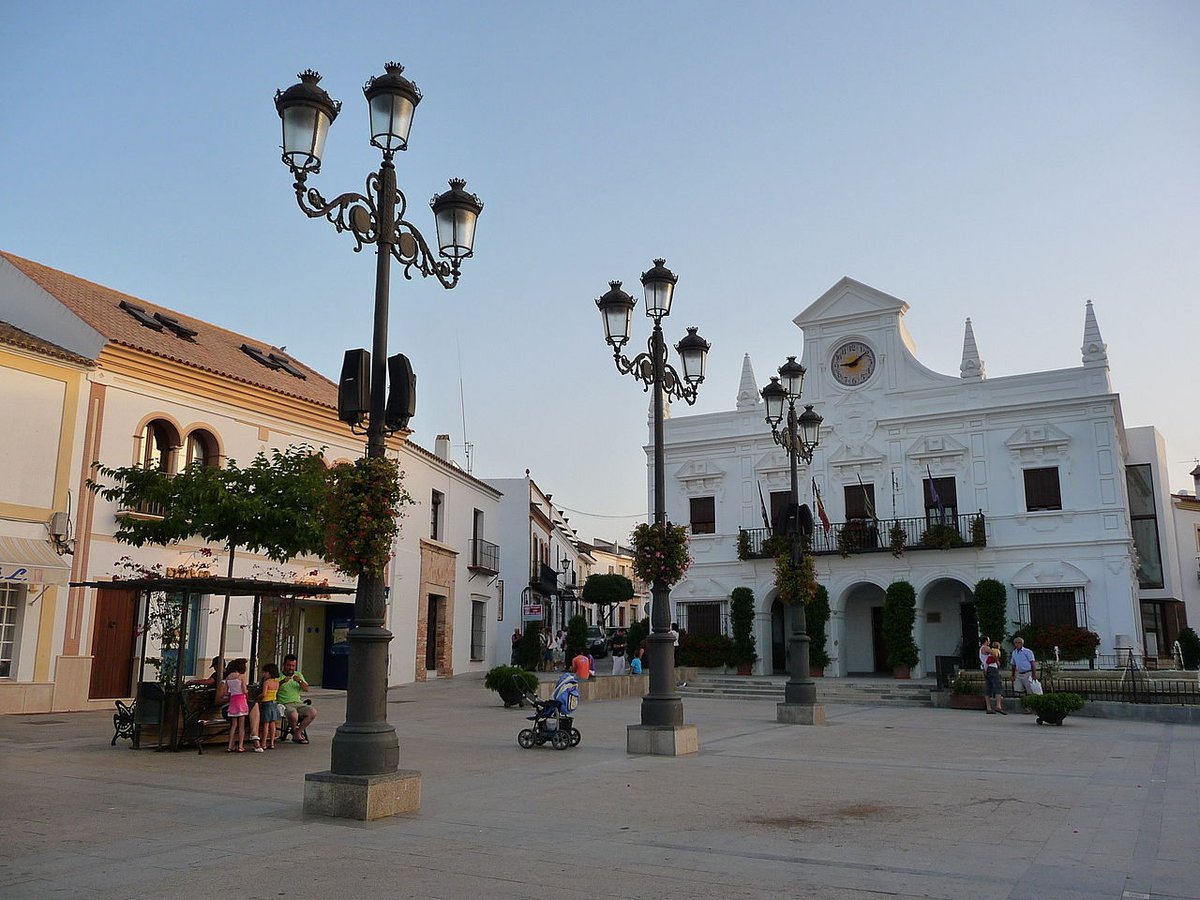
That is about it for monuments. The pleasure of San Bartolomé is the absence of itinerary. Sit in Plaza de España long enough and someone will offer directions to the nearest vineyard or warn you that the village cash machine charges €2.50. (They are right: bring euros or stop in Gibraleón on the way.)
Walking the Dehesa Without a Souvenir Shop
Three way-marked footpaths leave from the southern edge of town. None exceeds 8 km; all are flat, stony and shadeless, so set off before 10:00 or after 17:00. The most interesting is the 6 km circuit to the abandoned cortijo of El Almendro: you pass charcoal burners’ camps, herds of tawny cows whose ear-tags clink like tiny bells, and, in April, drifts of purple orchids that look faintly embarrassed to be noticed. Buzzards and Iberian magpies accompany you; very occasionally a black vulture circles overhead. Take water – there are no bars, no ice-cream vans, no branded viewpoints, just the occasional concrete bench engraved with the name of a local councillor.
Mountain-bike tyres work better than walking boots on the hard clay, but you will need your own wheels: the village hire shop closed during the 2008 crisis and never reopened.
When to Come, Where to Sleep, How to Leave
April–May and late September–October are optimum. In April the surrounding fields glow green-shot-gold; by October the light softens to honey and the night sky is sharp enough to identify Cassiopeia without squinting. August fiestas (24th–28th) are fun if you enjoy foam parties and midnight bus-station chorizo sandwiches, but accommodation trebles in price and the sole music bar pumps reggaeton until 05:00.
Rooms are limited to three small guesthouses, none with more than eight bedrooms. The pick is Casa Rural La Torre (doubles €65–€75, breakfast €7), a 19-century merchant’s house with original hydraulic tiles and a roof terrace that catches the evening breeze. Book at least two weeks ahead for spring weekends; mid-week you can usually ring the day before.
Driving is non-negotiable. The A-49 Seville–Portugal motorway is 15 km south; from there the HU-7101 spits you straight into town. Public transport means a bus from Huelva at 07:15 and another back at 19:30 – fine for a frantic day trip, useless for anything slower.
The Honest Verdict
San Bartolomé de la Torre will not change your life. It offers no Michelin stars, no ravines to bungee, no castle for dreamy silhouettes. What it does provide is a working slice of inland Andalucía where bread still costs under two euros, waitbars remember how you take your coffee, and the loudest noise at 15:00 is a tractor reversing into a crate of oranges. Spend a couple of days here and the larger questions – why you ever queued for a beach sun-lounger, for instance – tend to answer themselves. Leave before you start judging strangers for checking work email; the village has Wi-Fi, but using it after dusk feels like bad manners.