Full Article
about Villanueva de las Cruces
Small Andévalo town that keeps its rural quiet; meeting place for pilgrims and lovers of unspoiled nature.
Hide article Read full article
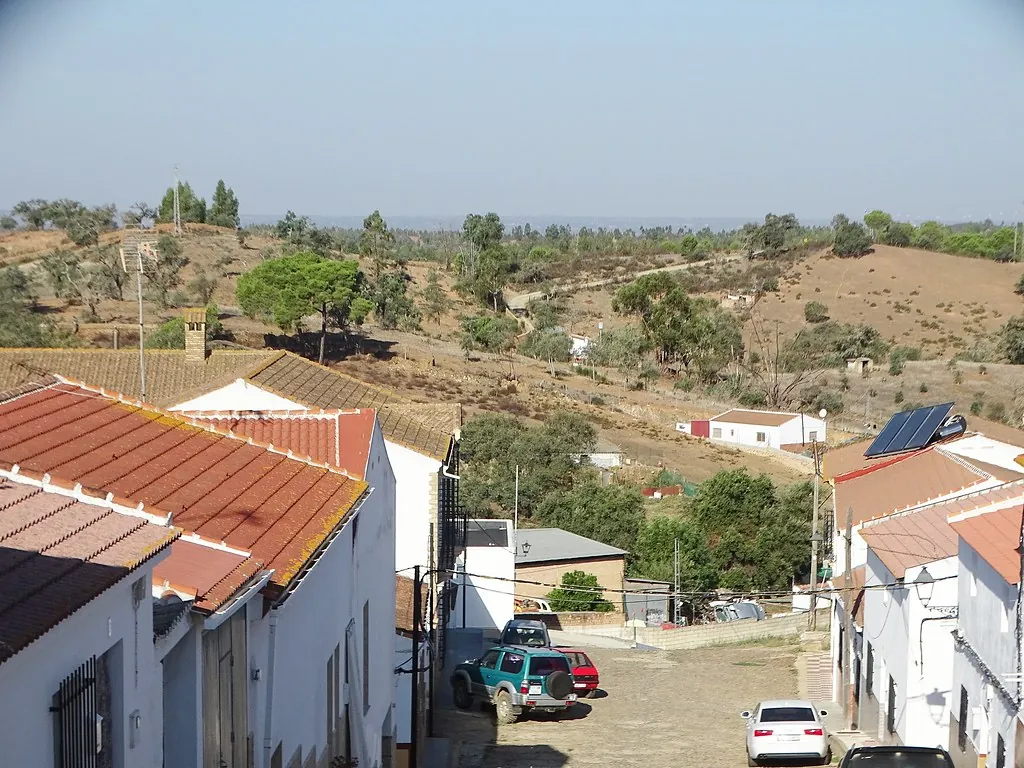
At the hour when the sun begins to brush against whitewashed walls, the church bell sets the rhythm in the centre of Villanueva de las Cruces. The sound travels along the main street and fades between low houses. The day starts slowly here. A door opens, footsteps cross hard ground and, if the breeze comes in from the fields, there is a faint scent of freshly milled olives.
Tourism in Villanueva de las Cruces does not revolve around monuments or packed itineraries. With fewer than four hundred residents, the village is closely tied to the countryside. Conversations turn to harvests, the coming weather or how the olive campaign has gone. Houses keep their iron grilles and interior courtyards where heat gathers in summer.
The parish church remains the main reference point. It was probably built in the 17th century, although renovations over time have altered its appearance. This is where festivals take shape and where informal gatherings spill out into the square, stretching the morning a little longer than planned.
Across the dehesa of the Andévalo
A short drive or walk from the village brings you into the dehesa of the Andévalo, a traditional landscape of open pastureland dotted with holm oaks. The trees stand apart from one another, with scattered olive groves and gently undulating ground that leaves much of the horizon in view. There are no dramatic slopes. Dirt tracks are mainly used to work the estates, though they also lend themselves to unhurried walks.
Clear signposting is not part of the experience. The usual approach is to ask in the village about a track leading towards nearby streams or olive-growing areas. In spring the ground fills with fresh grass and low wildflowers. In autumn the palette shifts to softer greens and branches heavy with olives.
This is working land, shaped by agriculture rather than tourism. The absence of panels or viewpoints means the landscape is taken in at its own pace, without prompts. Light and weather make the biggest difference to what you see.
Olive oil and straightforward cooking
Olive oil defines daily life. Its presence is obvious in the smell drifting from the almazaras, the olive mills, during the campaign season and equally clear in the kitchen. Many dishes start from the same base: bread, garlic, oil and, when the time comes for the traditional pig slaughter, pork.
Migas, breadcrumbs fried and served hot, appear throughout the year, as do warming soups and simple stews. This is not cooking designed to impress. It is field food, intended to sustain long days outdoors.
During the olive harvest, which usually runs from autumn into early winter depending on the year, there is more movement along the tracks. Tractors, trailers and people head in and out of the estates from early in the morning. The rhythm of the village shifts slightly, guided by the demands of the crop.
Food here reflects the agricultural calendar. Ingredients follow the seasons and the work that needs to be done. Meals are practical and rooted in what the land provides.
Watching the sky in silence
The open fields of the Andévalo hold more life than first appears. Storks perch on posts or in holm oaks, herons linger near streams when there is water, and birds of prey circle overhead, riding the thermals.
There are no formal hides or viewing platforms. One of the simplest ways to observe is to stop the car along a quiet track at dawn or towards the end of the afternoon. With binoculars and patience, movement becomes visible in the sky or among the higher branches.
Silence is part of the experience. Without traffic or large crowds, small sounds stand out: wings cutting through air, dry grass shifting in the breeze. The setting encourages stillness rather than activity.
Festivals rooted in the village
Celebrations revolve around the church and local associations. The feast of Santa María usually includes a procession through the main streets and several days of activity in the square. There is music, shared meals and gatherings that continue into the evening.
Semana Santa, Holy Week, is more restrained here than in other parts of Andalucía. The pasos, the religious floats carried in procession, are small and the route is short. People walk slowly and the atmosphere is generally quiet.
Throughout the year there are also meetings linked to agricultural work. Sometimes they coincide with the olive season and serve to show how the campaign is organised. These events are part of village life rather than performances for outsiders.
When to go and what to expect
Spring and early autumn are usually the most comfortable times to explore the tracks around Villanueva de las Cruces. The countryside has colour and temperatures make walking manageable.
Summer is intense. In July and August the heat dictates an early start and shade at midday. Winter leaves the village very calm. Some afternoons carry the smell of firewood and the silence is almost constant.
If the weather turns, options become limited. A short stroll through the streets and a visit to the church may be all there is to do. Comfortable footwear for dirt tracks is advisable, along with an extra layer when evening falls.
Villanueva de las Cruces moves to its own tempo. The landscape changes slowly and hours are measured more by light than by the clock. Those who arrive in a hurry tend not to linger. Those who stay a while begin to notice smaller details: insects humming in summer, damp earth after rain, the dry sound of holm oak branches shifting in the wind.