Full Article
about Rincón de la Victoria
Residential coastal town with long beaches and the Cueva del Tesoro, one of the few sea caves open to visitors.
Hide article Read full article
A cave facing the sea
Rincón de la Victoria developed with its gaze fixed on a single landmark: the acantilado del Cantal. In this cliff lies the Cueva del Tesoro, a marine cavity carved into rock that drops straight towards the Mediterranean. It is not an inland cave. Instead, it is a network of galleries formed when the sea once covered this stretch of coastline. Entry is from dry land, yet the route descends towards the water level.
The cave was already known in antiquity. References to Phoenician presence in the area appear frequently, and local tradition speaks of very early explorations. Today, several large chambers can be visited. Their walls show shapes worn by saltwater, alongside paintings whose dating is still debated. The interest lies as much in the setting as in the interior: an opening on the coastal front itself, in a rock face that served as a reference point for sailors over centuries.
From Phoenicians to Bourbons
Rincón de la Victoria becomes easier to understand when seen as a maritime frontier. This part of the Málaga coast was always a route of passage and also a vulnerable edge. The Phoenicians made use of natural shelters along the shoreline for fish salting. Later, the Romans established installations linked to garum production around Bezmiliana.
The Middle Ages left another visible layer in the form of watchtowers placed on promontories. The one at Cantal is associated with the Nasrid defensive network that monitored possible incursions from the sea. Centuries later, under the Bourbon monarchy, the fortress of Bezmiliana was built to strengthen coastal surveillance. The building still stands and reflects a long period when this strip of the Mediterranean faced attacks and landings.
Roman remains also appear in Torre de Benagalbón. Archaeological work there has documented late-period mosaics and structures linked to an agricultural villa near the coast. It is not a monumental site, though it helps show continuous occupation of the territory.
The present-day town took shape much later. At the beginning of the 16th century, Berber raids devastated much of the Málaga coastline and caused a sharp drop in population. Christian resettlement followed decades afterwards. For a long time, the area functioned mainly as a section of the route connecting Málaga with the villages of the Axarquía.
The current name is relatively recent. Until the mid-20th century, the settlement was more closely identified with the old Rincón de Bezmiliana. The reference to la Victoria was added later, linked to devotion to Málaga’s patron saint.
Work shaped by the sea
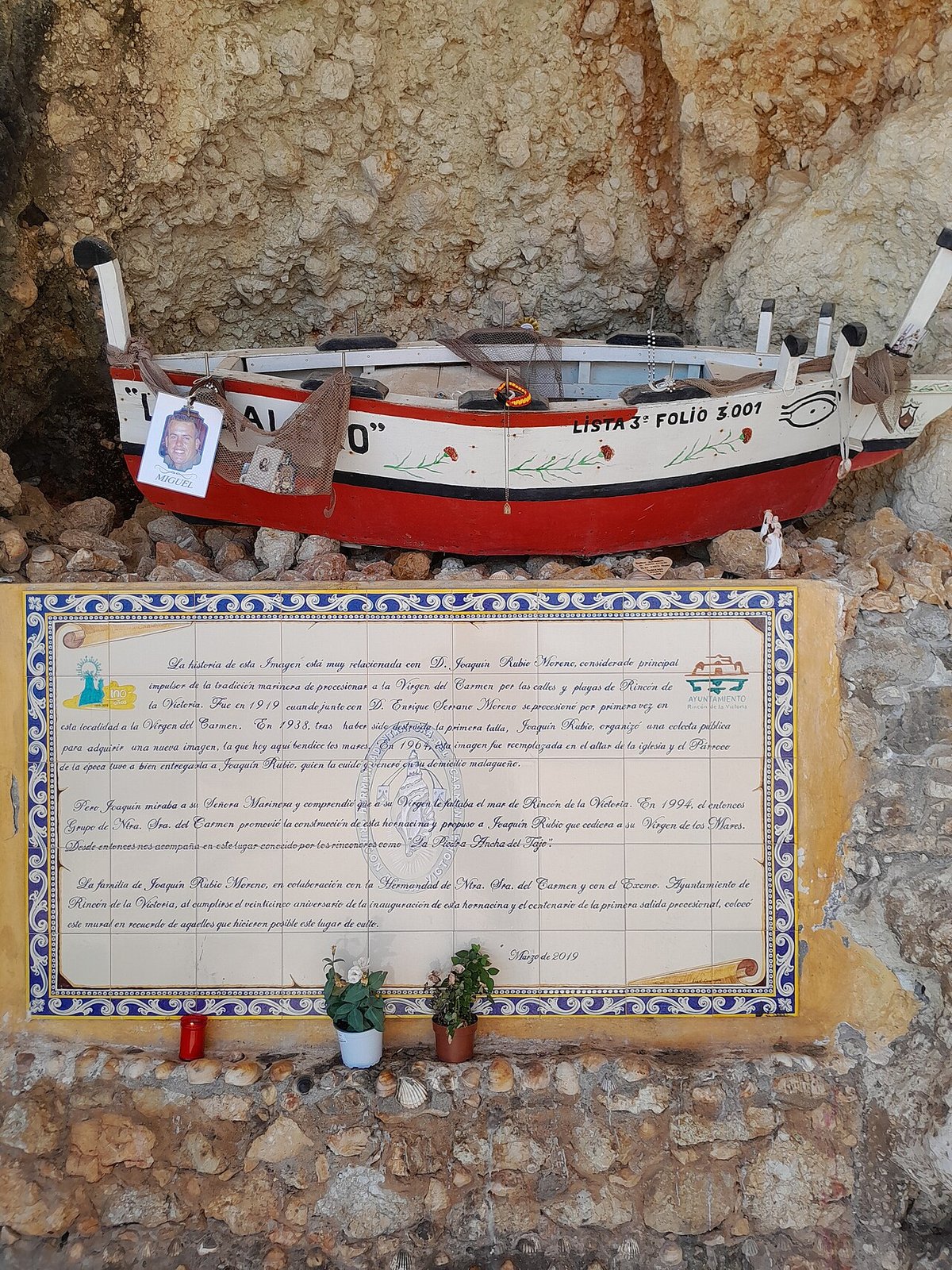
Here, the sea was more than a view. It defined daily labour across generations. On the municipality’s beaches, jabegas can still be seen. These traditional boats from the Málaga coast carry painted prows with a protective eye, a motif that recalls very old traditions from the eastern Mediterranean.
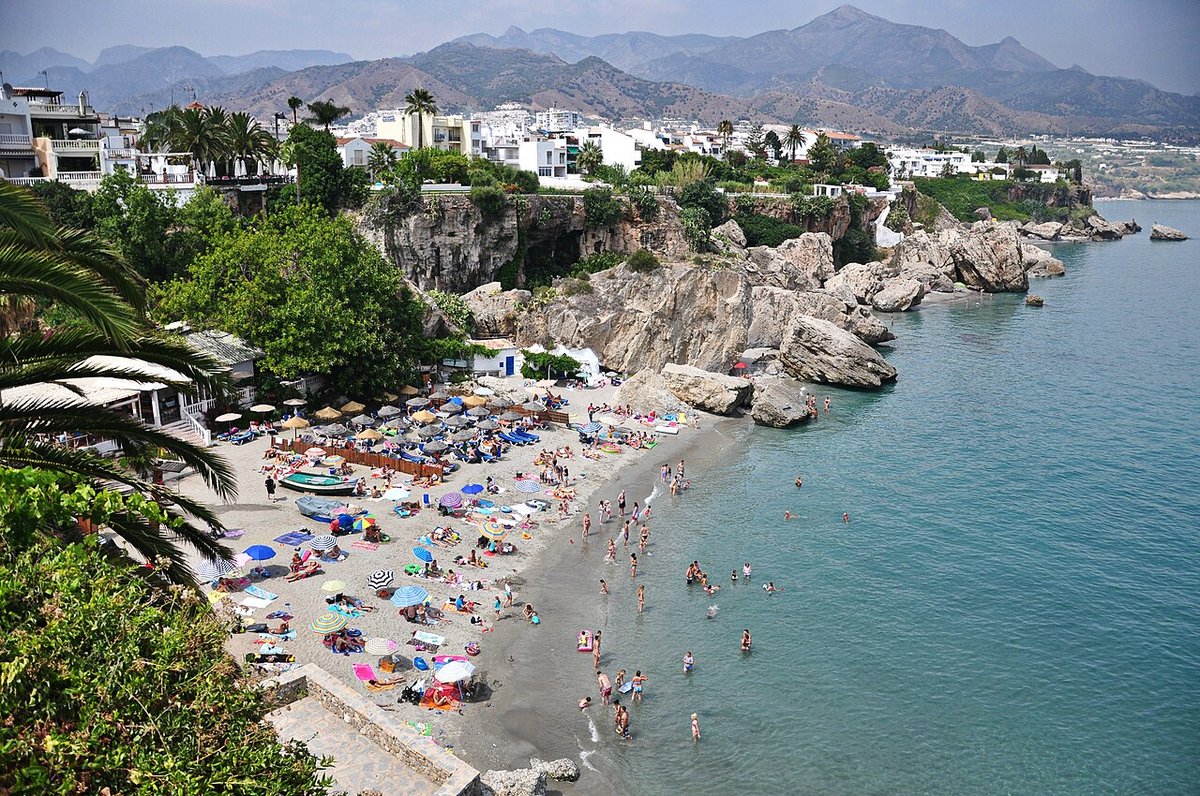
Small-scale fishing also left customs that remain visible in parts of the shoreline. In Cala del Moral, it is still possible to see fishermen repairing nets or preparing small boats that head out at first light. These scenes are less common than they once were, yet they offer a clear sense of how this economy functioned before the urban growth of recent decades.
Local cooking reflects that maritime life. Gazpachuelo malagueño, a hot fish soup thickened with mayonnaise, is said to have originated on board fishing boats. Other dishes come from inland areas of the Axarquía, where vineyards and small kitchen gardens shaped everyday food.
Walking the line of the Cantal
Between Rincón de la Victoria and Cala del Moral runs a seafront walk that follows the route of a former coastal railway inaugurated at the beginning of the 20th century. That line connected Málaga with Vélez and other points in the region. It closed in the 1960s, though its path remained as a natural corridor between the sea and the cliff.
One of the most recognisable stretches is the tunnel cut through the rock of the Cantal. It is now used by pedestrians and cyclists. On the far side, the path continues close to the Mediterranean for several kilometres. The route is straightforward and allows a close look at the rugged relief of this coast, which was poorly suited to agriculture and for centuries proved more useful for fishing and surveillance than for cultivation.
Anyone interested in the watchtowers can continue along the coastline towards Torre de Benagalbón. From certain points, the spacing between towers becomes clear. They stand close enough to have allowed visual signals to pass from one to another in times of danger.
When the town gathers
The annual rhythm still follows dates linked to the sea and local devotion. In mid-July, the maritime procession of the Virgen del Carmen usually takes place, a tradition deeply rooted in fishing communities along the Málaga coast. The image is carried on a boat while other vessels accompany it near the shore.
At the beginning of September, a romería dedicated to the Virgen de la Victoria is organised. It sets out along a route associated with the celebration and brings together residents for a day marked by tradition and shared movement.
These events, like the cave, the watchtowers and the old railway line, reflect how Rincón de la Victoria has long been shaped by its position on the edge of the sea.