Full Article
about Baena
Oil and drum town with a striking Iberian and Roman archaeological legacy, set between farmland and hills, its historic center a maze of winding streets.
Ocultar artículo Leer artículo completo
The drum corps starts tuning at 03:30. By dawn on Good Friday, two thousand judíos in velvet robes and mediaeval helmets have turned the main street into a thunder tunnel that can be felt in the ribs three blocks away. Welcome to Baena, a work-a-day hill town in the province of Córdoba that treats noise, olive oil and family pride with equal reverence.
A town that climbs its own hill
Baena sits 405 m above the surrounding sea of olive trees, a limestone ridge pushed up from the plain like a ship’s keel. The Romans spotted the defensive value first, the Moors refortified it, and the Christian conquerors simply swapped crescents for crosses. What remains is a place that still climbs its own gradient every morning: housewothers haul shopping up stepped lanes only 1.8 m wide, while delivery vans inch downhill in reverse because meeting something coming up is impossible.
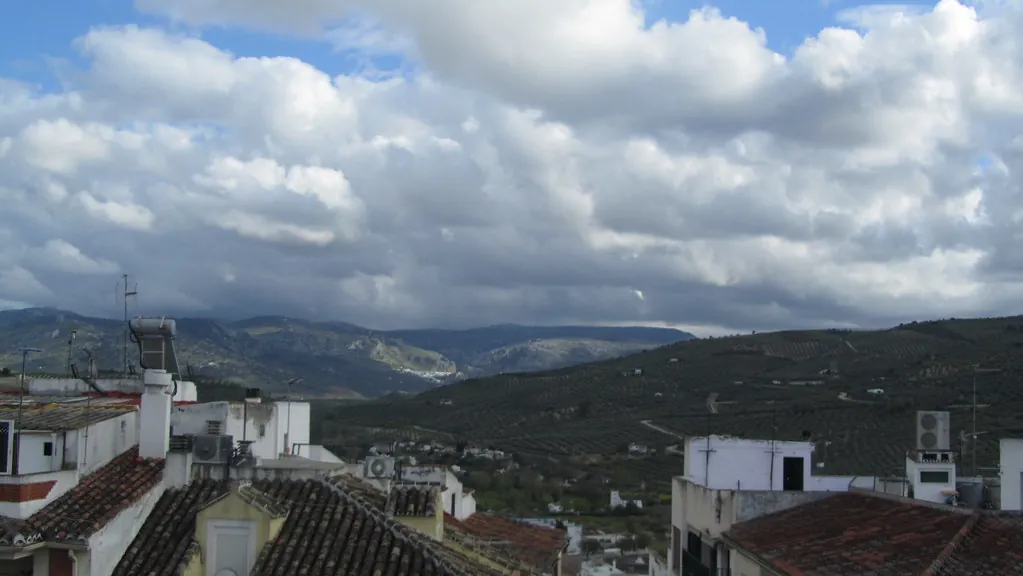
Park on the ring-road (plenty of space, no fee) and walk. The first five minutes are gentle, then the calle Real tilts to 12 % and keeps going. Whitewash glares back at the sun, wrought-iron balconies nudge overhead, and every doorway smells either of ground coffee or frying olive oil. Halfway up, the 15th-century tower of Santa María la Mayor appears like a waypoint in a video game; use it to gauge progress. If the legs hold out, the ridge-top plaza rewards with a 270-degree sweep of the Subbética hills, every slope quilted with the silver-green that earns Córdoba province the nickname “the olive garden of Spain”.
Liquid gold and other exports
There are 18 million olive trees within a 15 km radius. Baena’s cooperative alone presses 6.5 million kg of oil each winter, enough to fill an Olympic pool with extra-virgin Picudo and Hojiblanca. The Museo del Olivar y el Aceite, tucked into a former granary, explains why the stuff tastes of fresh grass and pepper: the harvest begins in October while the olives are still green, and the mills run cold so the volatiles stay in the juice. Entrance is €4 and the 25-minute audiovisual comes with three thimble-sized tastings; swallow, don’t sip, unless you want a throatful of cough-inducing polyphenols.
For the full production line, drive five minutes out to Núñez de Prado. The family has milled since 1795 and the present owner, 69-year-old Rafael, still gives the tour himself. You’ll see stone presses last turned in 1985 and the modern centrifuges that now spin 3,000 litres an hour. The visit ends in a stone cellar where oil is decanted into unlabelled green bottles; tourists pay €9 a litre, half the London deli price. Ring ahead in winter – if no group has booked, Rafael locks up and goes pruning.
Layers older than the oil
Baena’s hill is a layer cake. At the bottom sit Iberian stones, then Roman mosaic, then Moorish wall, then Renaissance palace. The Castillo is little more than a keep and a stretch of battlement, but it is free and open at weekends from 10:00. Be on the ramparts before the coach parties from Granada arrive; the view eastwards shows the sierra chalked against the sky like a child’s drawing of a dragon’s back.
The real history lesson lies four kilometres west at Torreparedones, a site shared with neighbouring Castro del Río. A gravel track leads to a car park that rarely holds more than four cars. Pick up the €2 leaflet and you can pace out a 2,300-year-old Iberian sanctuary, a Roman forum and a Visigothic basilica without anyone blocking the shot. Take water – there is no café, and summer temperatures sit in the mid-thirties from May onwards.
Eating on Spanish time
Everything except the castle shuts between 14:00 and 17:30. Plan lunch early or late, or you will be left circling the plaza with a rumbling stomach. Bar La Plaza does a tortilla de patatas the size of a tractor wheel; a wedge, served warm, costs €3.50 and counts as late breakfast, early lunch and afternoon snack. Across the square, Cafetería Cristóbal fries churros on Sunday mornings – dunk them in the thickest hot chocolate this side of Madrid and watch grandparents play dominoes with the intensity of chess grandmasters.
Evening meals start after 20:30. Locals begin with a glass of fino and a plate of marinated olives, progress to salmorejo (a thicker, creamier cousin of gazpacho topped with diced ham), then choose between braised oxtail or berenjenas con miel, aubergine chips drizzled with dark honey that somehow taste both savoury and like pudding. House wine is uniformly drinkable and rarely tops €12 a bottle.
Drums, crosses and flower-smothered squares
If you must experience Semana Santa, bring ear-plugs. The tamborada begins at 03:30 on Good Friday and the drumming does not stop for twelve hours. Balconies along Calle de la Cruz rent for €80 a head; downstairs the narrow canyon amplifies the beat to 120 dB, louder than a jet take-off. Children under ten routinely burst into tears; British teenagers think it’s brilliant.
May brings the Fiesta de las Cruces, when neighbours compete to drape entire façades in carnations and jasmine. The scent drifts uphill for a week and the plaza feels like an outdoor florist. September’s feria is smaller, mercifully quieter, and centred on sherry, fried fish and flamenco sung until the police shut it down at 04:00.
Getting there, getting out
Baena sits 55 km southeast of Córdoba on the A-45, a 45-minute drive if you avoid the morning haul of trucks heading for Málaga. There is no train. One early-morning bus leaves Córdoba at 07:15 and returns at 14:00; miss it and you are stranded. A hire car is less bother and lets you thread the olive groves afterwards – the mountain town of Priego de Córdoba is half an hour south, and Granada an hour beyond that.
Stay overnight only if you like towns that fold in on themselves after dark. The single three-star hotel, María Luisa, is clean, central and charges €65 for a double with breakfast; there are a handful of casas rurales in the lower lanes where English is spoken slowly but kindly. Book Easter week early or rooms triple in price and disappear.
Baena will not dazzle with palaces or beaches. It offers instead the small pleasure of watching a place work at being itself: tractors rattle down lanes designed for mules, grandmothers argue over whose olives yield the finest oil, and every viewpoint ends with a horizon of silver trees that have outlived every empire. Come for the liquid gold, stay for the lunchtime hush when even the swallows seem to pause – and leave before the drums start.