Full Article
about Castro del Río
Birthplace of olive-wood crafts and a Cervantes stage, its historic quarter keeps the medieval layout and walls.
Hide article Read full article
Where olive wood becomes a craft
Castro del Río has the kind of story that sounds like a tall tale at first. Someone from the town mentions, between sips of a drink, that rocking chairs made here once ended up in the White House. Made from olive wood. It feels like local myth. Look into it, though, and it is not so far-fetched.
Tourism in Castro del Río does not revolve around a busy square full of terraces or shops selling souvenirs. The past shows up in workshops, in fragments of wall tucked between houses, and in habits that are still alive because the town has never rushed to replace them.
Olive trees define the surrounding countryside, and in most places that means oil. Here, part of that wood takes another path. It becomes furniture. You arrive and can still hear saws in some workshops. This is not staged for visitors. It is simply the work that has always been done.
Olive wood is tough and unpredictable. Dry it badly and it cracks. Cut it too quickly and it twists. That is why many artisans continue in the same way as their parents or grandparents. Slowly, without mass production. The result is a craft tied closely to the rhythm of the material.
One local sums it up neatly: in Castro del Río, the olive tree gives oil, but it also gives a trade.
A castle above a bend in the Guadajoz
The old quarter climbs. Streets slope upwards, turn sharply, and press houses close together. Then the castle tower appears, rising above everything else.
The fortress is medieval, and it shows. It is not vast, and it is not filled with open rooms. Still, the tower and sections of the enclosure remain, enough to understand why this spot was chosen. From above, the setting becomes clear.
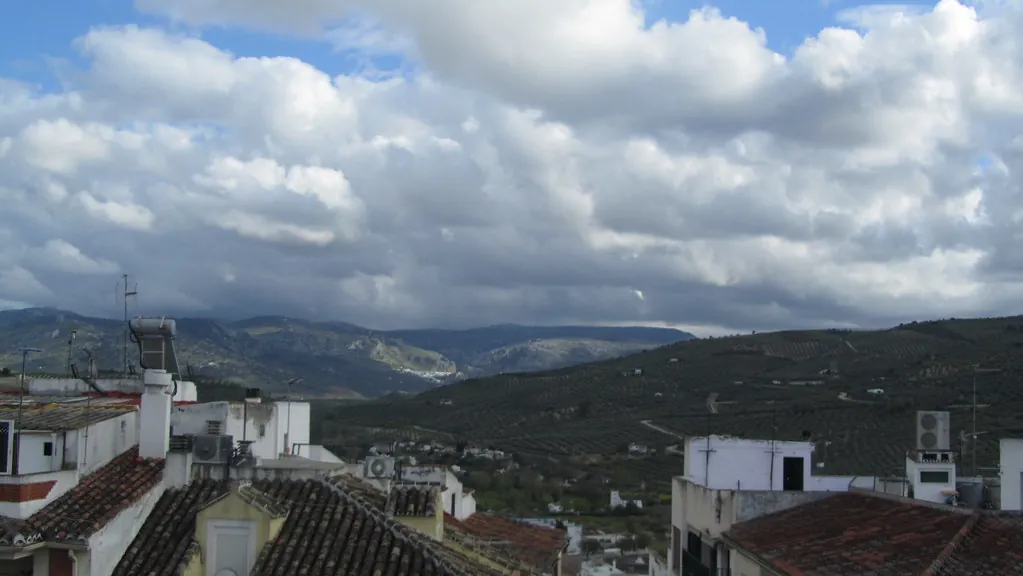
The river Guadajoz curves around the town in a wide meander. From that height you can see the water tracing its arc, with the houses stepping down the hillside towards it. It is a simple view, but it explains the place better than any signboard.
There are also stretches of wall with several towers still standing. Some reveal themselves almost by accident, appearing between houses as you walk without a plan. The sense is not of a preserved complex set apart, but of something woven into daily life.
A circular space with an unusual past
One building in Castro del Río tends to catch people off guard. It looks like a miniature bullring. Round, built in stone, with tiered seating.
It is a reñidero de gallos, a cockfighting ring, often cited as one of the oldest in the country. Today it remains as part of the town’s history rather than an active venue. More than anything, it is a reminder of a form of entertainment that was once part of local life.
Step inside and the small size of the arena makes it easy to imagine how it functioned. It does not take long to grasp the scale of what happened there. In a quiet town surrounded by farmland, it speaks of a past that can feel distant now.
From public granary to everyday meeting place
Opposite the main church stands a building that for centuries served as the pósito, the public granary. In practical terms, it was a communal store of grain.
In difficult periods, what was kept here could decide whether a winter was manageable or not. It worked like an agricultural bank. Wheat was stored and then lent out when needed, supporting the community in uncertain times.
Today the building has a different role. Inside there are books, computers, children doing homework, older residents reading the newspaper. Its function has changed, but it remains part of everyday life.
There is something appealing about places like this, where a historic structure has not been frozen as a display but continues to be used in a way that fits the present.
Food and a walk along the river
The cooking in Castro del Río follows the line of the Córdoba countryside. It is food built around long stews and dishes that suit days spent working outdoors. You will come across rabo de toro, substantial albóndigas, and generous flamenquines. At certain times of year, traditional sweets appear, made for specific moments and gone again once the season passes.
This is not a place aiming for a modern food scene. It is straightforward cooking, done well when it lands in the right hands.
After a substantial meal, the best plan is to walk. Paths follow the course of the Guadajoz and loop around the town. It is not a demanding route, more a long stroll through olive groves and open land.
As you move away, Castro del Río shifts into view as a whole. The castle sits above, the houses step down the slope, and the river marks its curve. There is a point where everything aligns: the meander, the hillside, and the cluster of buildings anchored to the rock.
From there, the layout makes immediate sense. And on the way back into town, a simple idea settles in. Castro del Río does not try to impress. It carries on as it always has, and that, in itself, is what makes it worth the time.