Full Article
about Nueva Carteya
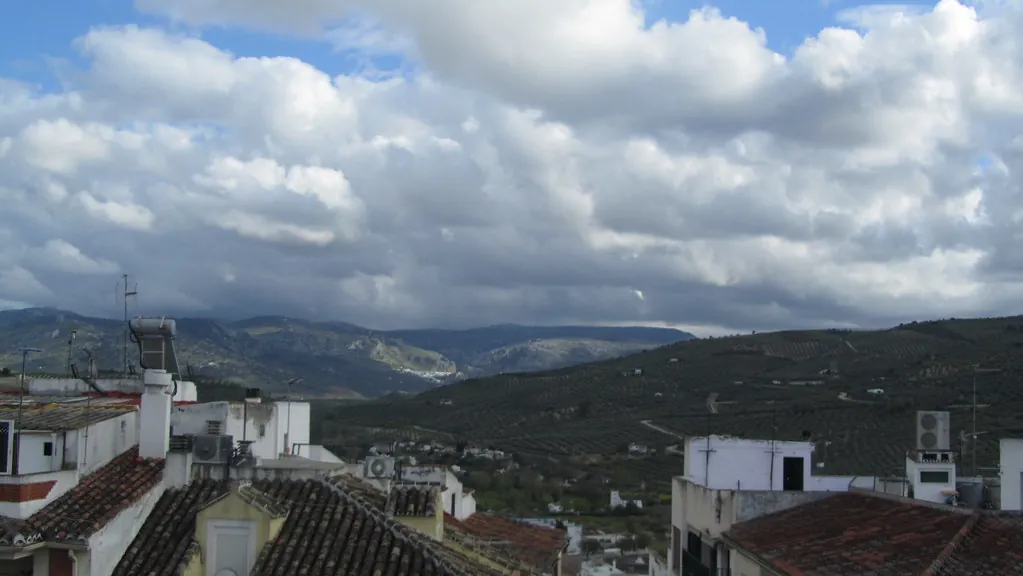
A town built around olive groves, set on a hill ringed by a sea of trees, with a lookout giving wide-ranging views across several Andalusian provinces.
Hide article Read full article
A planned town in the Cordoban countryside
Nueva Carteya’s layout is its first clue. At 454 metres above sea level, in the middle of the Campiña of Córdoba, its streets form a strict grid. This order is deliberate, a contrast to the more common, tangled street plans of the region.
The design traces back to the clergyman Diego Carro. In the early 19th century, he drafted a plan for a new settlement, placing the square and the church at its centre. The main streets were marked out between late April and early May of 1822. The town was built to a blueprint, not by accretion.
That rational plan sits on land with a deeper past. Roman and Visigoth remains have been found in the surrounding fields, evidence of earlier use of these rolling hills long before the 19th-century streets were drawn.
Cerro del Higuerón and traces of earlier settlements
The cerro del Higuerón rises just outside town. It’s a modest hill, but its position commands the immediate landscape: the Guadajoz river plain and the streams coming down from the Subbética.
That vantage point explains the ceramic fragments and other remains found there, dated roughly from the 1st to the 7th centuries. It is not an official site; there are no panels or explanations. You go for the geography. From the top, the logic of settlement here is visible: water, fertile land, open sightlines.
The walk from town takes about half an hour. It’s a direct way to leave the geometric streets and see the older setting that attracted people here centuries before Nueva Carteya existed.
San Pedro Apóstol and local traditions
The parish church of San Pedro Apóstol was part of Diego Carro’s founding plan. Built in the settlement’s early years, it has the simple, solid character of a community church. Its tower defines the main square. An expansion in 1960 added space but kept its restrained overall form.
A short walk from the centre brings you to the ermita de San Pedro. This small chapel is likely older than the town itself, usually dated between the late 17th and early 18th centuries. It houses the image of the Virgen de los Remedios, the local patron saint.
Her romería happens on the last Sunday of April. The image is brought into town in a procession that functions as much as a community gathering as a religious act.
Life among olive groves
Olive groves define the municipality. The gentle hills are covered in orderly rows of trees, a landscape of modern, mechanised farming.
The local rhythm follows the olive harvest, typically from autumn into early winter. Then, tractors and trailers move constantly along the roads, taking the fruit to cooperatives where it is pressed into oil within hours.
This is not a postcard of ancient, gnarled trees. It is a working picture of how agriculture functions here now.
Everyday life beyond tourist routes
Nueva Carteya operates outside of tourism. Daily life is based on farming, local shops, and municipal services.
Activity concentrates in the central streets and the main square, where the grid plan is most evident. The Paseo de Diego Carro, built in the 1930s, is still a common place for an evening stroll.
In the Plaza Marqués de Estella, a covered market from the 1920s continues its weekly role. Stalls sell produce and clothing. The scene is routine, unchanged for decades.
Getting there and when to go
The town lies just over fifty kilometres from Córdoba. The drive usually passes through Baena via local roads.
Bus connections with the provincial capital exist but are not frequent; checking schedules beforehand is necessary.
Spring is often the most agreeable season. Fields between the olive groves are green, and temperatures are mild for walking. Summer heat here is intense, shifting most outdoor activity to early mornings and evenings.
The town’s grid can be walked in an afternoon without hurry. For a wider sense of place, the track to the cerro del Higuerón or the agricultural lanes show how this planned town fits into its older rural context.