Full Article
about Castellar de la Frontera
Split into two parts: the old fortified village inside a medieval castle, one of Spain’s most beautiful towns.
Hide article Read full article
Castellar de la Frontera has two distinct faces. One sits high on a hill, inside a medieval castle reached by a narrowing road with barely any room to park. The other lies below, in the newer settlement where almost everyone now lives. The castle is what draws most visitors. The newer village is what explains the place.
The Castle Above
The drive up is short, though the road tightens towards the end. Just before the entrance there is a dirt clearing where people usually leave their cars. It makes sense to stop there and continue on foot. Once inside the walls, the streets are simply too narrow to move around comfortably by car.
From that open space, the Guadarranque reservoir comes into view. It is artificial, yet from above it looks like any natural lake, stretching quietly between the surrounding hills.
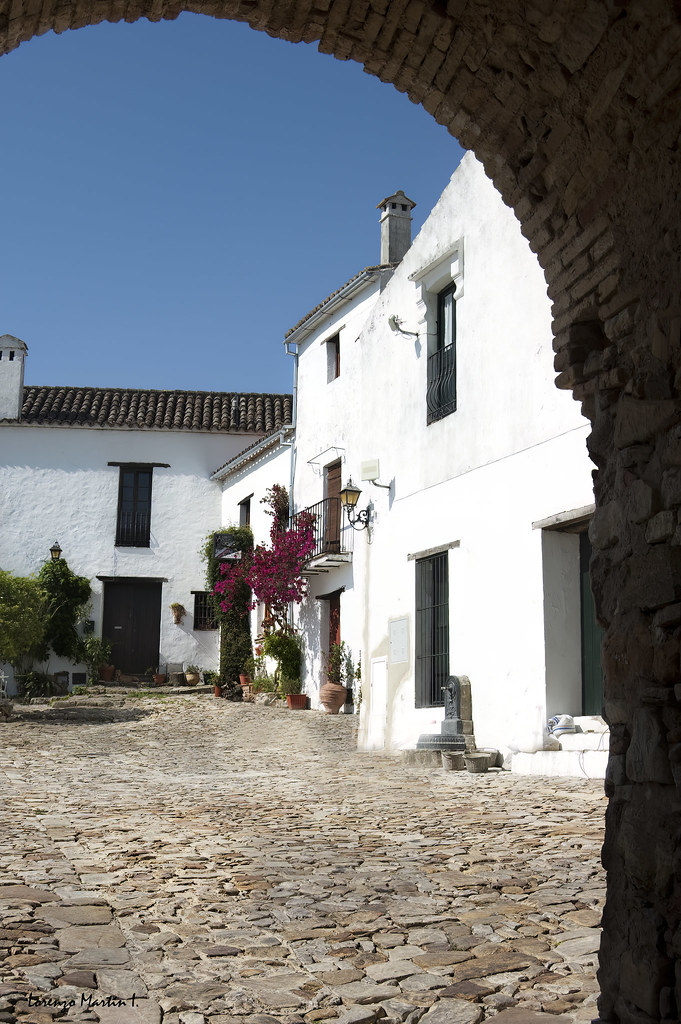
The castle dates back to the 12th century. What stands today is a mixture of periods: Almohad walls, later buildings and more recent alterations layered together. The Iglesia del Divino Salvador was open on arrival. It was empty, with a lingering smell of old incense. A small notice indicated that Mass is usually held on Sundays.
At the so called Balcón de los Amorosos, the view opens onto the reservoir and the cork oak covered hills. A story is attached to the spot, telling of two Moriscos who threw themselves from this point. Whether it has any historical basis or was invented for the sign is unclear. What is certain is that the balcony is fully exposed to the wind.
A wooden staircase leads down from part of the walls. It creaks underfoot. In one of the houses, marked by a blue door, a German man sells stone necklaces. He says he has lived there since the late 1990s. In summer, he remarks, the place becomes a zoo. At other times, it is calmer.
The castle enclosure is not large. An hour is enough to walk its lanes, pause at the viewpoints and step into the church. By mid morning it begins to fill up, so arriving early makes a difference.
The Village That Moved
Back down the hill lies Castellar Nuevo, where most of the municipality’s population now lives.
There is no historic quarter here. The village was built in the 1970s, when the creation of the reservoir forced the relocation of the old settlement. Straight streets, white houses and administrative buildings define the layout. It feels organised and functional.
Older residents still refer to that period simply as “el traslado”, the relocation. The word carries weight. It signals a break between what was and what replaced it.
On a square overlooking the sierra, a bench offers a clear view of the hills. A man walking his dog asks whether the visit included the castle. He worked on the dam when it was being built. Before, he says, this was countryside. Now it is the village, gesturing to the houses around him. He points towards the hills and mentions wild boar, though hunting is not what it once was. Then he carries on.
The contrast between the two Castellar settlements is stark. Above, stone walls and narrow alleys shaped by centuries. Below, a planned town from the late 20th century. Life continued, just in a different place.
Eating in Castellar
In Castellar Nuevo, the food follows the patterns of this part of Andalucía. Meat features heavily, with game appearing when in season, alongside produce from the surrounding countryside.
The wild boar stew is often mentioned and is said to appear on some menus in summer. On this occasion it was not available. The meal ended up being a montado de lomo, a small sandwich made with pork loin, and a beer. It was fine. The bread stood out more than the pork.
Another local reference is torta de chicharrones. Here it is usually sweet, despite the name suggesting savoury pork crackling. It remained untried. A jar of heather honey was bought instead from a village shop. It is said to come from the nearby hills, where heather blooms in spring.
Food here does not aim to impress visitors. It reflects what is available and what people eat day to day.
Walking Among Cork Oaks
One of the marked trails in the area is the senda del Vencejo. It runs for just over five kilometres and takes roughly an hour and a half if walked at a steady pace.
The path begins near the castle. It descends at first, then climbs again, winding through cork oak woodland. Some trunks show stripped bark, evidence of recent cork extraction. This landscape is part of Los Alcornocales, known for its cork forests, though a single walk is enough to grasp the character of the terrain.
The trail reaches a small viewpoint with benches facing the reservoir. It is a simple spot to stop for a while before turning back the same way.
There are other signposted routes in the area, focused on old mills, butterflies and different paths through Los Alcornocales. One walk, however, already offers a clear sense of the setting: rolling hills, water in the distance and cork oaks stretching across the slopes.
A Place Explained by Its Divide
Castellar de la Frontera is best understood by seeing both parts. Visit the castle early if you want to avoid the crowds that gather later in the morning. The enclosure can be explored without rushing.
Then head down to Castellar Nuevo. That is where daily life unfolds, where the relocation of the 1970s still echoes in conversation, and where the practical reality of the municipality takes shape.
It is not a theatrical reconstruction of the past. The old village remains above, within medieval walls, while the present settled below decades ago. Few places present that separation so plainly.