Full Article
about Niebla
Historic walled town on the Tinto River, once the taifa capital; its fortress and castle host a major theater festival.
Hide article Read full article
At five in the afternoon, March light strikes the Almohad walls and the stone turns a fleeting peach colour. From the Puerta de Sevilla, the river Tinto looks like a copper mirror, where herons sometimes settle among the poplars on the bank. This is when Niebla stops being a name on a map and becomes something tangible: the cold face of a tower beneath your palm, the damp scent rising from the riverbed, wind slipping through the battlements.
Within the Almohad walls
According to the chronicles, Alfonso X entered Niebla in the 13th century through the Puerta de Sevilla. By then the town had already accumulated centuries of history. The church of Santa María de la Granada was built over the former mosque, and in certain corners that layering is still visible. Columns that do not seem to belong to the same period, arches that shift in shape from one section to the next. Inside, the air often carries the smell of wax and cold stone. When the church is open and there are few visitors, a slow walk is enough to notice how footsteps echo beneath the vaults.
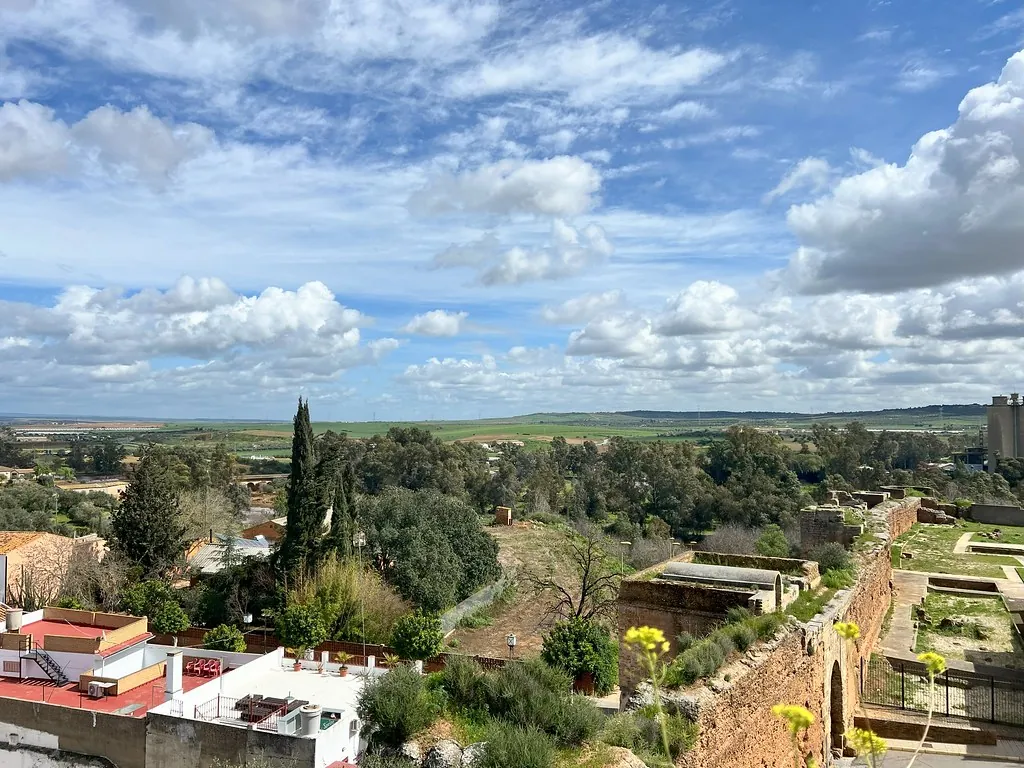
Close to the wall stands the castle of the Guzmanes, overlooking the edge of the river. It is not an enormous fortress, yet it holds the dense quiet of very old buildings. From the main tower the outline of Niebla becomes clear: reddish rooftops, the bell tower of San Martín rising above the houses and, beyond them, the fields of El Condado changing colour with the seasons. In spring the green stretches almost without interruption. In summer the earth turns more ochre and the air lifts a fine dust.
The sense of enclosure is constant. The walls do not simply frame the historic centre, they define it. Streets twist within their perimeter, and the gates mark the points where town and countryside meet.
The River Tinto, slow and copper-toned
The river Tinto runs alongside the walls with an unusual calm. Its reddish hue is not a trick of the light but comes from minerals carried from the mining basin upstream. For that reason it is often described as a natural laboratory. For years, researchers have studied here how certain microorganisms survive in extreme conditions.
Early in the morning, when mist clings to the surface, the old bridge appears to float on a rust-coloured cloud. The structure visible today has undergone repairs over the centuries, yet the crossing at this point is very ancient. It is worth walking across slowly and then turning back: the full sweep of Niebla’s walls draws a firm line against the curve of the river.
Near the riverbank, several dirt paths follow the meanders. In spring the margins fill with poppies and wild mustard. Sturdy footwear is advisable, as the ground can be damp and in some stretches the path narrows between brambles. The atmosphere shifts with the seasons. Spring brings softer light and fresh growth; summer strips the landscape back to earth and heat.
Flavours rooted in the countryside
In local kitchens, plants gathered from the fields still find their way onto the table. Tagarninas, a wild thistle that grows among wheat fields and hedgerows, are one example. They need careful cleaning because of their spines, then are often cooked in scrambled eggs with a little ham, a dish closely tied to agricultural work and the rhythms of the land.
With the first rains, gurumelos appear in nearby pinewoods. This mushroom is highly sought after throughout the province. In some homes it is stewed with pulses, in others simply grilled with olive oil and salt. The preparation tends to be straightforward, allowing the ingredient to speak for itself.
Another dish frequently seen here is habas enzapatás, broad beans cooked slowly with aromatic herbs such as poleo, a type of wild pennyroyal. These are recipes rarely measured with precision. Each family has its own method, and explanations often end with a shrug and a comment that it is done by eye.
During Semana Santa, the week leading up to Easter that is marked across Spain with religious processions, the scent in the streets changes. In many houses pestiños and other fried sweets are prepared in pans of hot oil. The aroma of honey and anise drifts from open windows while processions move through the narrow streets. The setting within the walls intensifies the feeling of closeness: sound carries, incense lingers, and footsteps echo against stone.
Theatre nights and late-summer fairs
When summer arrives, the castle takes on a different role. For years it has hosted a theatre festival that fills the courtyard with rows of seats and voices late into the night. The heat of the day is slow to fade, and the stone walls return the actors’ lines with a particular resonance. Darkness settles gradually over the towers while the performance continues under the open sky.
Towards the end of August come the fair days dedicated to San Bartolomé. The market area fills with casetas, temporary tents used for music and socialising. As night falls, the air carries the smell of albero, the sandy earth used in many Andalusian fairgrounds, and of frying food. Conversations stretch across the squares until the temperature drops a little and the pace eases.
These seasonal moments shift the mood of Niebla. At one point it is a quiet walled town defined by stone and river. At another it becomes a gathering place, animated by theatre, music and shared rituals.
Walking the perimeter
The wall is what truly defines Niebla. It encircles the historic centre for several kilometres and preserves many towers of varying sizes. Some sections can be explored from within, others are best contemplated from below, with storks settled on top.
Climbing one of the accessible stretches helps in grasping the scale of the place. From above, the river curves around the town on one side, while on the other, roads lead out towards the fields of El Condado. The relationship between settlement and landscape becomes clear. The walls are not an isolated monument but part of a broader setting shaped by agriculture and water.
If visiting in spring, weekdays are quieter. At weekends there are many day trips from Seville and Huelva, and the streets around the main gates fill quickly. On a Tuesday morning, the rhythm is different. A neighbour crosses the square. A shutter opens with a brief rattle. The scene settles back into its usual pace, contained within the Almohad stone and edged by the slow, reddish flow of the Tinto.