Full Article
about Trigueros
Town in the countryside known for the Dolmen de Soto and the San Antonio Abad festival; rich farming history and prehistoric heritage.
Hide article Read full article
Where the road turns inland
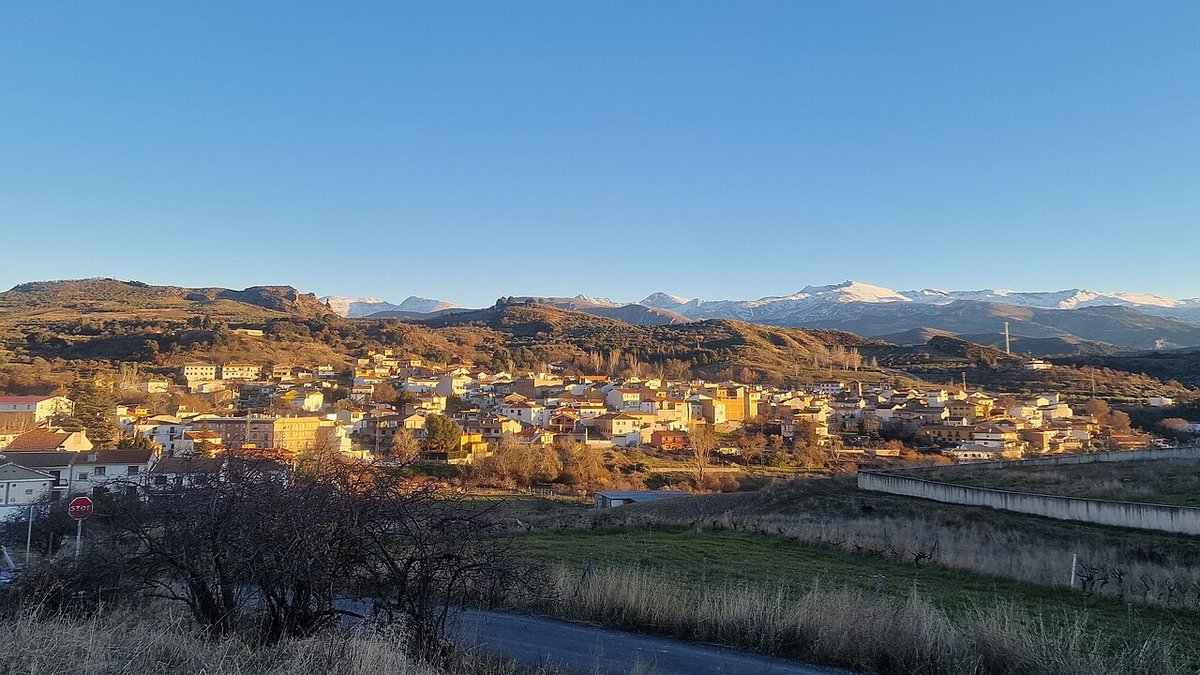
You know that moment on a road trip when you switch off the motorway radio because the landscape demands your attention? That’s the turn-off for Trigueros. The sea vanishes, the air gets drier, and suddenly you’re in the middle of the Condado de Huelva, with fields that look like they go on forever. It’s a proper gear change.
The town appears without much fanfare. It’s not tiny, but it has that stretched-out, unhurried feel of a place where people work the land. You park, you walk, and the rhythm is immediately slower.
A church with a past it can't hide
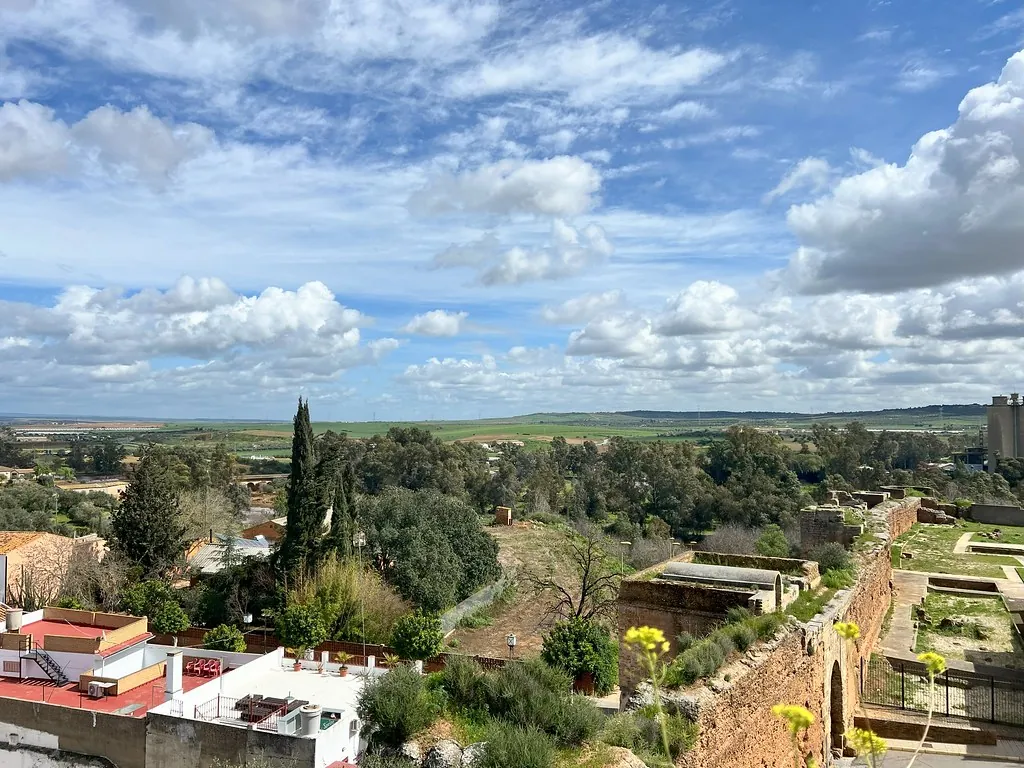
Everyone ends up in the main square, looking up at the church of San Antonio Abad. It’s big, sure. But what got me was finding out it’s built on top of an old fortress that basically fell down in the 1755 Lisbon earthquake. They just… rebuilt on top.
Once you know that, you start seeing it. The walls are thicker than they need to be for a church. Some corners look like they were meant for looking out from, not praying in. It feels less like a designed building and more like something that evolved, layer by layer, because it had to.
The Dolmen de Soto: where you automatically lower your voice
A short drive out of town is the thing that really puts Trigueros on the map: the Dolmen de Soto. Calling it a ‘stone circle’ doesn’t cut it—this is a massive corridor tomb, one of the biggest around.
You duck inside and two things happen: the temperature drops, and everyone starts talking in whispers. Nobody tells you to; it just feels right. Standing between stones that were dragged here before anyone wrote anything down does something to you. It’s humbling in a very quiet way.
They usually have someone there to explain how it all worked. Listen to them. Otherwise, you’re just looking at rocks. With the context, you’re peeking into a community meeting from five thousand years ago.
Eating like someone's abuela cooked for you
The food here doesn’t do fancy presentations. It does choco con papas. Don’t let the simple name fool you—it’s cuttlefish and potatoes in a broth so good you’ll use half a loaf of bread to mop it up. It tastes like the Atlantic, just without the sand.
This is also jamón ibérico country. You won't get a dramatic carving show; you'll get a plate of slices that speak for themselves. If you're here in spring and see gurumelos (a type of wild mushroom) on a menu, order them. Grilled or in a stew, they taste of the pine forests nearby.
It's all straightforward, filling stuff. The kind of meal where you push your chair back afterwards and think, "Yeah, that hit the spot."
When the calendar takes over
Trigueros can feel sleepy, but pick your date right and it's a different story. In mid-May for San Isidro, people who've moved away flood back home. The plaza fills with tents, music spills out everywhere, and it feels less like a festival and more like a massive family reunion where you just happen to know everyone.
Summer brings the Romería de San Benito. This is the big one—horse-drawn carriages, traditional outfits, the whole town seemingly involved in this pilgrimage on wheels. You don't just watch it; you get absorbed by it.
And if you come in February for La Candelaria, you'll find streets lit by bonfires and neighbours sharing food around them. It's not marketed as an 'experience'. It's just what they do.
A note on timing
Come in August if you enjoy feeling like an ant under a magnifying glass. The heat is serious business here inland, and life retreats into shade-cooled rooms until evening.
Spring is kinder—everything's green and there's more life in town. February has its own charm with those candela festivals. Whenever you roll in, do one thing: find somewhere serving choco con papas. Don't overthink it. Just order it.
Trigueros isn't going to blow your mind with world-famous sights. It's more subtle than that. It's where you spend an afternoon poking around an ancient tomb, eat a meal that sticks to your ribs, and drive away feeling quietly content. Sometimes, that's exactly what you needed