Full Article
about Villalba del Alcor
A Condado town with a curious fortress-church; land of wine and deep-rooted religious traditions in the countryside.
Hide article Read full article
A village that chose to stand still
On the side wall of the church of San Bartolomé there is a marble slab with letters barely two fingers high. It dates from 134 BC. A Roman legionary fixed it there to thank the goddess Juno Regina for returning him home alive. No one has moved it since. Villalba del Alcor has spent two thousand years as a place people pass through, yet it has remained firmly in place.
That sense of continuity runs quietly through the village. There are no grand displays around the stone, no protective case or explanatory panel. It simply shares the same air as the neighbours who walk past it, as it has done for centuries. Its presence feels less like a monument and more like something folded into daily life.
El Condado from above
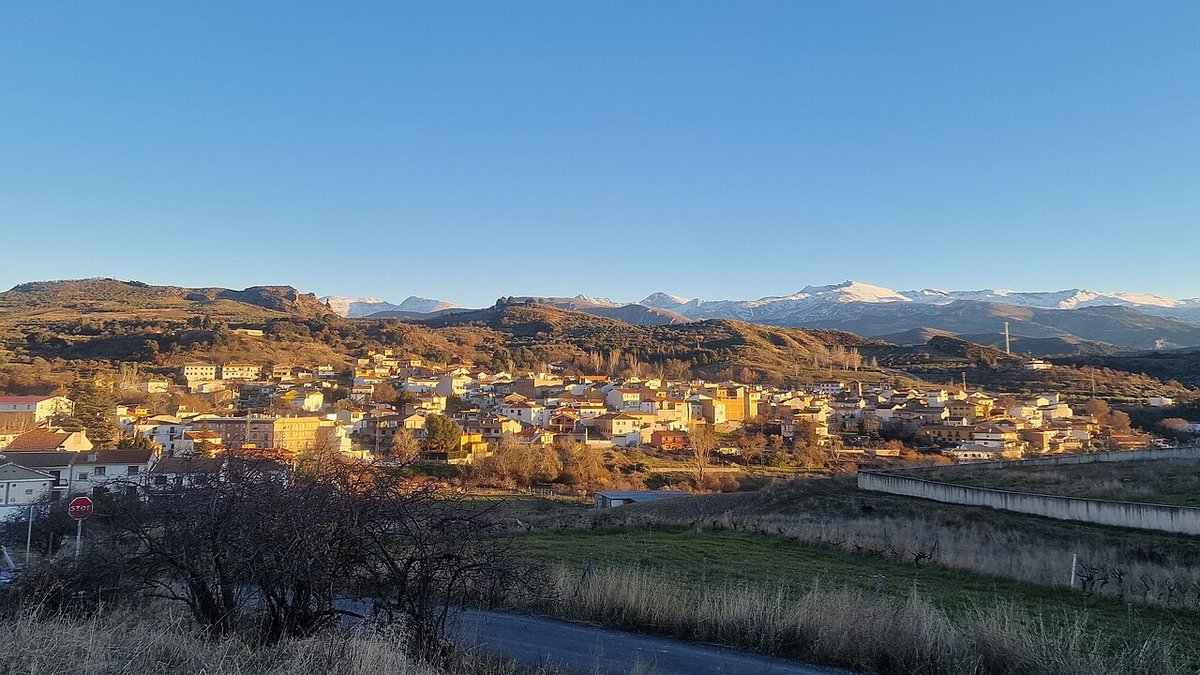
From the A-49, Villalba appears like a chalk-coloured stronghold perched on a rise. It sits in the centre of El Condado, a gently rolling region between Huelva and Seville where Iberian pigs are raised outdoors and houses are painted white to endure the heat of summer. The village stands around 140 metres above sea level, a height that once made it useful as a lookout point.
That vantage point shaped its early purpose. First it served to watch over convoys transporting Roman minerals towards the Guadalquivir. Later it became part of a defensive line between the Christian kingdom of Niebla and the Nasrid territory of Granada. Its position mattered long before the village took on its current form.
The Christian conquest came in 1253, when Alfonso X el Sabio crossed the Arroyo Giraldo and acquired the settlement from the soldiers who had taken it months earlier. It was not an epic battle, but a formal exchange that redrew the map. From then on, Villalba passed into the hands of the Crown, later into those of nobles who speculated with its land, and eventually to the farmers who cleared ground among holm oaks to plant vines.
Churches and convent traces
The parish church of San Bartolomé presents a neoclassical façade, with Corinthian columns and a triangular pediment, yet it still preserves the crossing from an earlier 16th-century structure. Inside, beside the Gospel side, lies the Roman slab. Anyone wishing to see it up close can do so once mass has finished. The quiet around the stone speaks more clearly than any recorded explanation.
Partway between the village and the road stands the hermitage of Los Remedios, patron saint of Villalba. Built in the 17th century, it is made of red brick and topped with traditional curved tiles. It has a single nave and a bell gable that seems suited to small bells and large celebrations. Each September, the image of the Virgin is taken out in procession, carried down to the stream and then brought back uphill with singing. The romería lasts until sunset behind the eucalyptus trees. Afterwards there are the remains of migas, wineskins left aside, and the shared sense that another year has passed.
The religious calendar continues to shape the rhythm of the place. On 24 August, the feast of San Bartolomé, there is a night procession and convent sweets are sold at the church door. These moments draw together traditions that have been handed down rather than reinvented.
Eating from the land
In El Condado, the pig is more than an industry, it is a way of life. In Villalba it is eaten in full. Ham appears at breakfast, cuts such as presa at lunch, and other parts go into stews. One dish that regularly returns to the kitchen is carrillada. It is made from Iberian pork cheeks, stewed with tomato, local red wine and a touch of paprika, left to soften slowly over hours. It is not always written on menus. The custom is to ask what is available and take what comes.
Wine arrived with force in the 19th century, when landowners cleared the dehesas and planted vines on terraces that had previously grown wheat. Fewer wineries remain active today, though many homes still keep a container of must for celebrations. It is part of the same domestic continuity seen elsewhere in the village.
Sweets reflect a convent legacy. Pestiños are prepared at Easter, and roscos de vino accompany coffee. There is also a pumpkin sweet taught by the nuns of San Juan Bautista before their convent closed. These recipes have moved from religious kitchens into family ones without much ceremony.
A walk without a plan
Villalba can be crossed in twenty minutes if the route is direct, or stretched into an hour if there is time to pause. Calle Real climbs from the road up towards the church. Halfway up sits the square, with its brick town hall and ironwork, and the gathering places where conversations unfold each day. By mid-morning, people come together there as they have done for years.
The houses still show practical details from another time. Tall wooden gates and stone base courses protect the walls, designed so that horses could shelter from the sun without brushing against them. These features remain part of the streetscape rather than museum pieces.
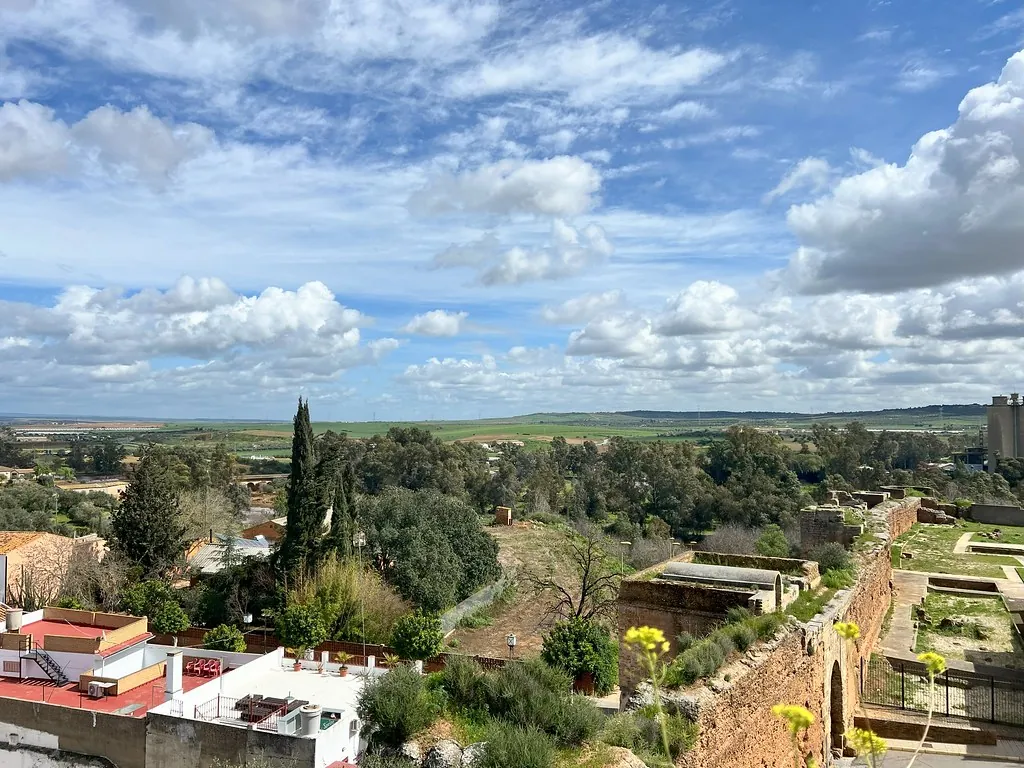
Continuing uphill leads to a viewpoint. It is a simple place: a low concrete wall and a metal panel indicating which towns lie in the distance. To the west, the Guadalquivir can be made out. To the north, olive groves stretch across the province of Seville. Wind rises from the dehesa and carries the scent of heather and livestock. There are no barriers or schedules. The spot is there to be used for as long as the breeze allows.
Getting there and choosing the moment
Villalba del Alcor lies about 45 minutes from Seville via the A-49, with a direct turn-off leading into the village. There is no train station and public transport is limited, so it is best reached by car or by arranging a lift locally.
Spring is the most comfortable season, when the ground smells of rosemary and the days grow longer without the intensity of summer heat. August pushes temperatures close to 45°C, and daily life slows well into the afternoon. In December, fog settles among the poplars by the stream and the village seems to hover above it.
Timing a visit with local festivities changes the atmosphere. Late August brings the feast of San Bartolomé, with its evening procession and sweets at the church entrance. September sees the romería of Los Remedios fill the road with carts and voices, echoing across the same hillside that has watched centuries pass without moving.