Full Article
about Teba
Historic town dominated by the Castillo de la Estrella and known for its link to the Scottish knight Sir James Douglas.
Hide article Read full article
A village that takes its time
Some places make sense within minutes. Teba does not. You climb up to its castle and suddenly Scotland appears in the middle of Málaga. It sounds unlikely, but it is tied to a real story. In Teba, a Scottish knight died while carrying the heart of his king. It feels like fiction, yet it happened here, among scrubland and olive groves.
When the wind moves across the Castillo de la Estrella, it brings the scent of the hills. Rosemary, dry earth, warm stone. From the road, the village can seem quiet and plain. Up there, it becomes clear there is more going on beneath the surface.
The castle that spreads like a stone district
The walk begins near the cemetery car park. It takes about twenty minutes to reach the top. The path is wide and easy to follow, though it climbs steadily. In summer, that incline is felt.
At the summit, the space opens out. The castle covers a vast area, larger than many old town centres in nearby villages. Long stretches of wall, towers and the remains of rooms are still visible. It has not been rebuilt for display. What you see is the stone as it has survived over time.
That gives it a certain appeal. Moving through broken walls and open spaces helps you understand the scale of the place without needing explanations.
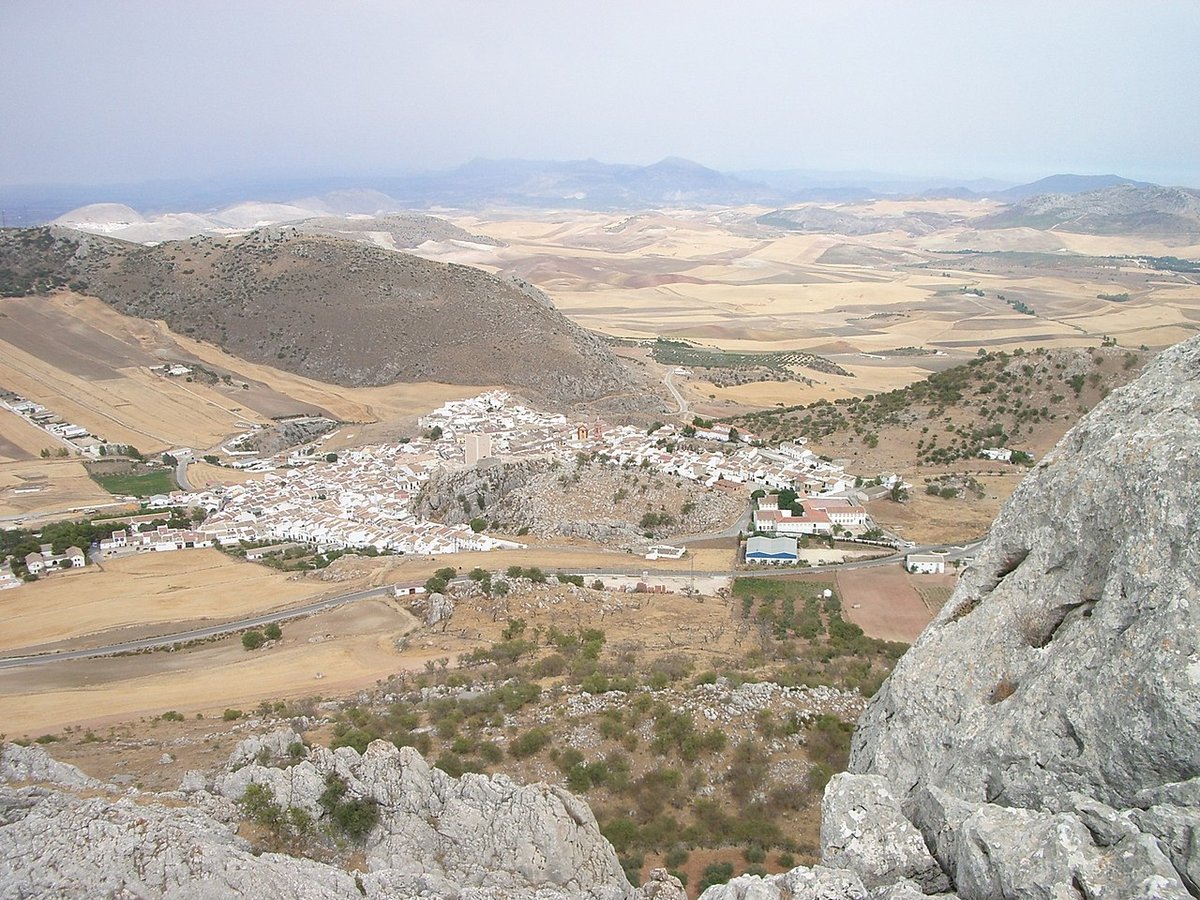
The views do the rest. All around lies open countryside, olive groves and low hills stretching out in every direction. On misty days, the landscape turns into a grey sea.
It is common to spot paragliders in the sky here. This range is known among those who practise the sport. On some weekends, colourful canopies drift above the hills, adding movement to the stillness.
Porra tebeña and cheese from the hills
Coming down from the castle usually brings on hunger. It is almost inevitable.
In the main square, porra tebeña is easy to find. It is similar to gazpacho but thicker, made with bread, tomato and a generous amount of olive oil. It is eaten slowly. In hot weather, it goes down easily.
Sometimes it comes topped with egg or ham. It is also common to pair it with local goat’s cheese. This is strong, cured cheese that lingers on the fingers long after eating.
The payoya goat is common in this area. In spring, there are often gatherings or fairs dedicated to artisan cheese. The dates do not always line up, but if one happens to coincide with a visit, it is worth a look.
A Scottish story that still echoes
The story of the Scottish knight appears throughout the village. It shows up on information panels, in street names and in everyday conversation. From time to time, Teba hosts events that recall that medieval battle.
During those days, bagpipes can be heard, tartan fabrics appear and Scottish flags are displayed. It is an unusual sight in an inland village of Málaga.
What stands out most is the atmosphere. Locals dress for the occasion, children run across the square and the story is retold again and again. Historical precision is not always the priority, but the connection to the story is clear.
Walking out into the sierra
For those who like walking, there are several simple routes around Teba. Some begin near the ermita de la Virgen de la Cabeza. The landscape mixes traces of the past, abandoned farmhouses and low vegetation.
The paths are generally easy to follow. Even so, carrying water is important. The sun here is direct and persistent.
Another well-known spot is the Tajo de Torró, a steep rock face where climbers are often seen. Even without climbing, it draws attention. Watching someone suspended against the rock tends to hold the gaze.
There is also a via ferrata relatively close to the village. Those who have tried it tend to speak well of the views from above.
A place that grows on you
Teba is not a polished destination. Its streets are not packed with shops, and the squares are not overflowing with terraces. It feels quieter, even austere at first glance.
Yet something about it lingers. The sheer size of the castle, the unexpected Scottish connection in the middle of Andalucía, and the wide, open landscape that seems to go on without end.
A simple way to approach it is to head up to the castle in the morning, when the sun is still manageable. Then return to the village and take time over a meal in the square. If there is still energy left, a short walk in the surrounding hills rounds things off.
In a few hours, the place starts to make sense. And there is a particular satisfaction in leaving with the feeling of having come across somewhere that rarely appears on standard itineraries. Sometimes that is what stays with you the longest.