Full Article
about El Palmar de Troya
The province's youngest municipality, world-famous for its Palmarian Church basilica.
Hide article Read full article
The Village Everyone Has Heard Of, Somehow
El Palmar de Troya is a bit like that relative nobody mentions at a family gathering until someone says, “What about the one who became a pope?” Then everyone knows exactly who you mean. This small village in the province of Seville, with just over 2,000 inhabitants, has more history than first meets the eye, although much of its fame is linked to a basilica that rarely appears in mainstream guidebooks.
Set in the Sevillian countryside, El Palmar de Troya does not overwhelm with monuments or dramatic scenery. It is not trying to impress. Yet its name often rings a bell, even for people who have never set foot here. The reasons lie both in its recent past and in a religious complex that stands just outside the urban centre.
A Place That Was Born Twice
Approaching from Utrera, the landscape is flat and open. The first thing to break the horizon is a tower. It is not enormous, but in the middle of the countryside anything that rises a few metres above the fields draws the eye. This is the Torre de Troya, a watchtower usually dated to the late 14th century. It once formed part of a network of defensive lookout points that monitored the territory.
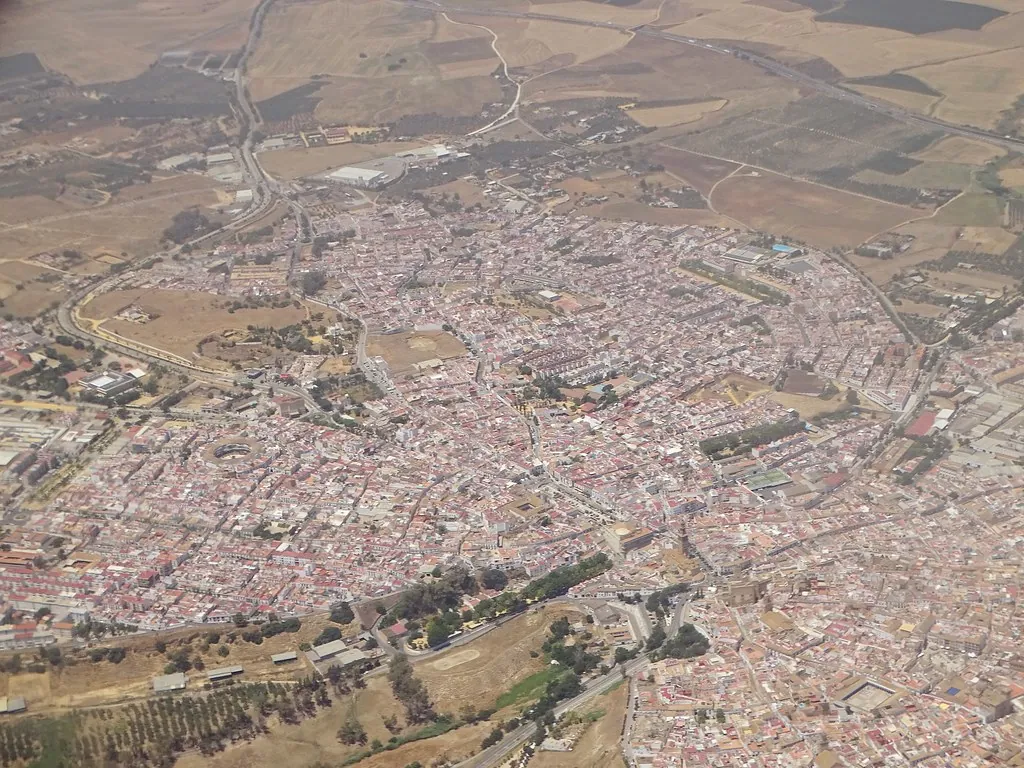
Today it overlooks a village that, for centuries, did not formally exist as a municipality. El Palmar de Troya is one of the youngest municipalities in the province of Seville. It separated administratively from Utrera relatively recently, and there is still a sense of a place defining itself. Some streets feel new, with modern houses lining them. Yet there are also small squares where neighbours sit and chat as if it had always been this way.
That mix of recent growth and long-standing rural life shapes the atmosphere. The setting is unmistakably campiña, the agricultural plain typical of this part of Andalucía. Wide skies, cultivated fields and a pace of life that shifts with the seasons.
Fields, Tracks and Open Sky
The countryside around El Palmar de Troya is part of everyday life. The Vía Verde that connects with Utrera passes through here. Like many vías verdes in Spain, it follows the route of a former railway line that has been converted into a broad path for walking and cycling. It is not especially long, but it offers enough distance for a relaxed morning outdoors, surrounded by fields.
There are also paths near the Torre del Águila leading out into the open land. These are simple routes, more suited to a gentle stroll than to serious hiking. Expect dirt tracks, crops on either side and a lot of sky overhead. Shade is scarce, so water and a hat are always wise in this part of Andalucía.
The appeal is not dramatic scenery but space. The sense of being in an agricultural landscape that continues to function as it always has, with cultivation shaping both the view and the local economy.
Cooking from the Land
Food in El Palmar de Troya reflects what the land provides. Tagarninas, wild asparagus known as espárragos trigueros, and chard appear regularly in local cooking. On a modern urban menu they might seem unusual, yet here they are part of the traditional repertoire.
One of the dishes people mention is tagarninas stewed with chickpeas. It is not a showpiece for photographs, but after a couple of spoonfuls its staying power becomes clear. This is cooking that developed from necessity and familiarity with local ingredients rather than from presentation.
When the season arrives, the area is also associated with mosto, young wine. There is no elaborate ritual attached to it. A simple glass, unhurried conversation and a flavour that reflects the vineyards that have existed around here for a long time.
Local traditions include the romería of the Virgen del Carmen, celebrated in late spring. A romería is a pilgrimage-style festivity, usually involving a procession to the countryside. It is curious to find one dedicated to a Virgin with maritime associations in the middle of agricultural land, far from the sea. Yet traditions travel, and each place adapts them in its own way.
Between Two Worlds
Conversations with residents often reveal another aspect of local life: many people are connected to the world of travelling fairs. Work linked to assembling stalls, rides and temporary structures means moving from one town to another as the season progresses. As a result, at certain times of the year the village takes on an unusual rhythm. Trailers appear, dismantled frameworks are stacked, and preparations begin for the next stop on the circuit.
Then there is the other story that inevitably comes up. On the outskirts of the village stands the basilica of the Iglesia Palmariana. It is a large complex, with domes and walls that surprise when seen rising from the middle of the countryside. It does not form part of the usual tourist circuit, but its presence explains why the name El Palmar de Troya sounds familiar even to those who have never visited.
The complex has given the village a distinctive place in contemporary Spanish history. Whether viewed with curiosity or scepticism, it is part of the identity of the area. The contrast between the quiet agricultural setting and the scale of the basilica is striking.
When the Village Fills
For those who want to see El Palmar de Troya at its most animated, Semana Santa is a good moment. Holy Week processions here are not staged with visitors in mind. They are rooted in the local community. Streets fill with neighbours, many of whom have known each other all their lives. When a float passes and the band moves away, a hush lingers in the air.
At other times of year, the rhythm is different. Life settles back into its usual pace. Fields stretch out around the village, daily routines take over, and the atmosphere is calm.
El Palmar de Troya is not the most beautiful village in Andalucía, nor does it claim to be. There are no grand monuments or sweeping landscapes. What it offers instead is something less polished. It does not feel like a backdrop arranged for visitors. It feels like a working village in the Sevillian countryside, with a story that has taken a few unexpected turns.
That alone makes it stand apart.