Full Article
about La Lantejuela
Known for its inland-lake complex that draws migrating birds to the open farmland.
Hide article Read full article
A flat landscape shaped by wind and grain
Tourism in La Lantejuela starts with its setting. This part of the Campiña sevillana is an open agricultural plain with barely any variation in the terrain. The land stretches out in long, uninterrupted lines of cereal fields, and the wind moves freely across them. For generations that steady wind was put to use through mills that ground the harvest.
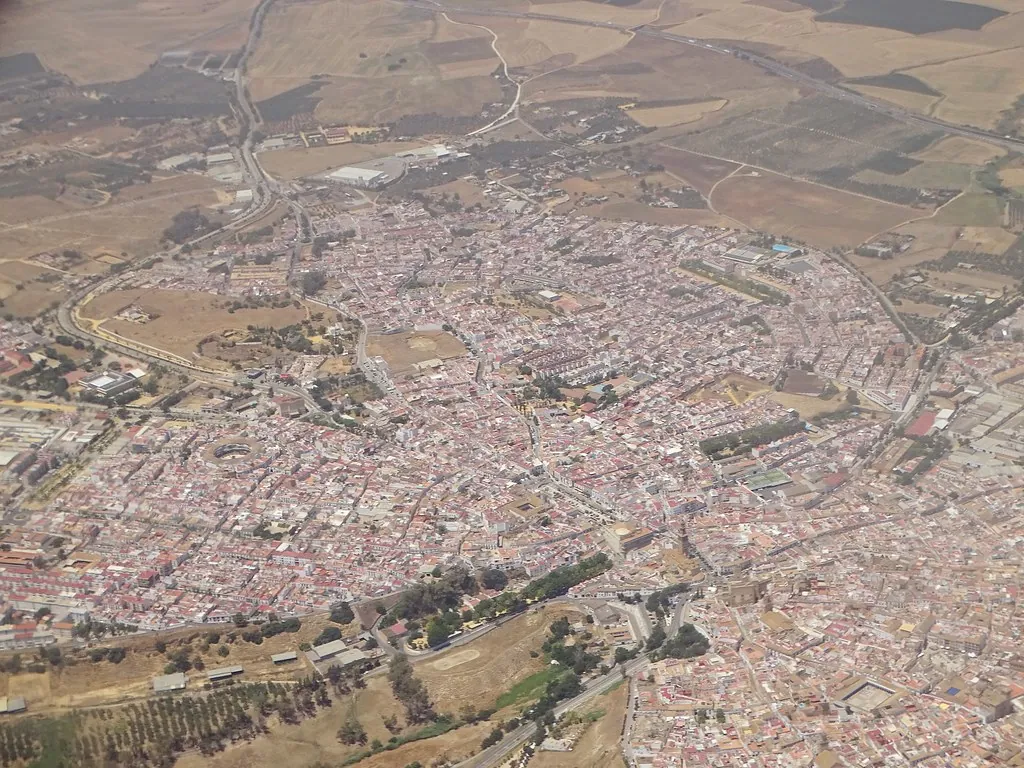
The village lies a little over seventy kilometres from Seville, rising quietly from the middle of this flat landscape. Around four thousand people live here. At first glance, the surroundings may seem uniform, but that impression shifts once the water appears. In a region where surface water is scarce, the presence of lagoons changes how the land is understood.
Lagoons that redraw the map
Around La Lantejuela there is a small system of endorheic lagoons: Gobierno, Ballestera, Verde de Sal and Calderón Chica. These are closed basins where water collects without flowing out to the sea. In a typical year they retain water for much of the calendar, which is unusual in this part of the Sevillian countryside, where summer tends to dry up streams and channels.
The slightly saline character of the water shapes the wildlife found here. The lagoons act as resting points for migratory birds and as breeding grounds for certain species. Flamingos can often be seen at particular times of year, along with black-winged stilts, avocets and different types of duck. The white-headed duck, which is scarce on the Iberian Peninsula, has also been recorded here on several occasions.
One edge of the lagoon complex has a bird observatory that allows visitors to get closer without disturbing the wildlife too much. Even without any background in birdwatching, it is enough to stop for a while and look carefully. The activity across these wetlands becomes clear quite quickly, from birds feeding to others moving across the water.
A village shaped by the countryside
For centuries, La Lantejuela depended administratively on Osuna. The area was largely made up of scattered agricultural holdings such as cortijos, traditional rural estates, and working farmhouses linked to cereal cultivation. Over time, a more defined urban centre began to form, eventually becoming an independent municipality well into the nineteenth century.
That relatively recent development is still visible in the layout of the village. Streets are straight and fairly wide, and low-rise houses dominate. Many of them include a patio or a small back garden. This reflects a way of life closely tied to farming, where domestic space was organised with agricultural work in mind.
At one of the central points stands the parish church of the Purísima Concepción. The current building comes from relatively recent renovations carried out on an earlier structure, although some older devotional pieces remain inside. As in many villages across the Campiña, its importance lies less in architectural grandeur and more in its role within everyday local life.
In the surrounding area, a few traditional windmills still stand. They are a reminder of how the constant air currents across these plains were once harnessed in a practical way, long before modern machinery took over.
Serrín, colour and the Virgen del Carmen
The rhythm of the village shifts noticeably during the romería of the Virgen del Carmen, usually held around mid-July. A romería is a traditional pilgrimage-style celebration common in many parts of Spain, often combining religious devotion with a strong social element.
In La Lantejuela, the streets are covered with dyed sawdust, known as serrín, arranged in colourful patterns. Residents prepare decorated carts that move through the village before heading out towards the lagoon area. The procession becomes both a visual and communal event, linking the urban space with the surrounding countryside.
This is a celebration shaped mainly by local participation rather than outside tourism. Groups organise their own spaces to eat and spend the day together, creating an atmosphere that feels collective and familiar. It reflects a type of festivity still preserved in many parts of rural Andalucía, where the emphasis is on shared experience rather than spectacle.
Walking the edges of water and field
The village itself can be explored quite quickly. The more distinctive experience lies in the paths that run around the lagoons. These routes can be followed on foot or by bicycle, crossing farmland and areas of low scrub. The contrast between cultivated land and wetland is constant, and it gives the area a rhythm that changes with the seasons.
Spring is usually the most rewarding time to visit. The fields turn green and bird activity increases around the lagoons. In summer, conditions are much drier and hotter, which is typical of this part of the Sevillian countryside. The lagoons remain a point of interest, though the surrounding landscape takes on a harsher tone.
Reaching La Lantejuela involves leaving the main motorway that crosses the region and continuing along local roads that cut through fields of cereal and sunflower. There are no major tourist infrastructures around the lagoons. That absence is part of the appeal. What stands out here is the contrast: a wetland environment appearing unexpectedly in the middle of an otherwise dry agricultural plain.