Full Article
about Benalúa de las Villas
A farming town among olive groves and hills, it keeps its rural charm and countryside and hunting traditions.
Hide article Read full article
An unexpected stop in Los Montes
Some places feel like those small neighbourhood workshops where something is always being fixed. They make little noise beyond their own walls, yet inside there is constant movement. Benalúa de las Villas has that quality.
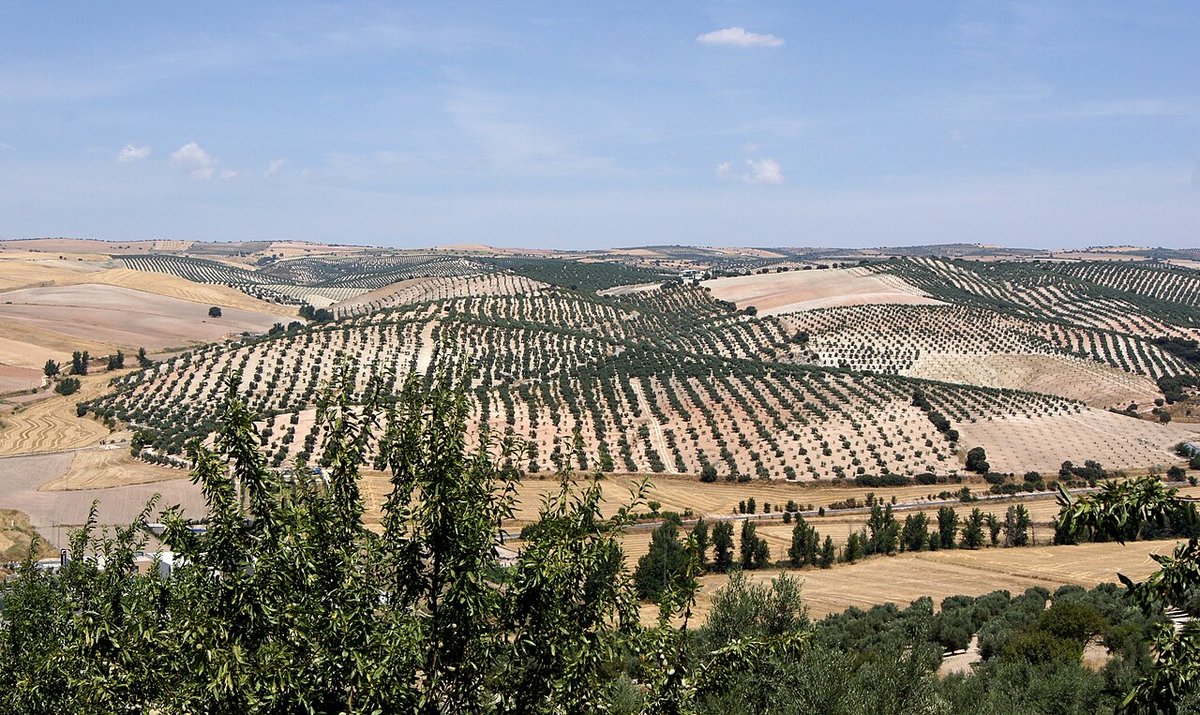
It appears almost without warning along a secondary road in the comarca of Los Montes, in the province of Granada. For miles beforehand, the view barely changes: olive trees and more olive trees, stretching across the hills as though a green carpet had been rolled out over the landscape.
Then the village comes into view, gathered on a modest rise. Just over a thousand residents live here. The streets are short and often steep enough to slow your pace. Life remains closely tied to the countryside. It shows in the trailers parked by houses, in conversations about the harvest, and in the faint smell of firewood that drifts through the air as evening falls.
Benalúa de las Villas does not announce itself with grand landmarks. It reveals itself gradually, through daily routines and small details.
A village shaped by habit
Walking through Benalúa is a bit like opening a drawer filled over many years. Nothing seems arranged for effect, yet everything has its place.
The streets are narrow and quite sloped. Whitewashed houses line the way, with green or blue doors and iron balconies where someone waters pots early in the morning. The layout does not follow a clear grid. Instead, the houses appear to have settled wherever there was space, as if a puzzle had been assembled without checking the picture on the box.
At the centre stands the Iglesia de la Encarnación. It is understated in style, with a tower visible from several points around the village. Around the small square beside it much of local life unfolds. Conversations linger here, neighbours meet, and celebrations that mark the calendar take place in this shared space.
There is no sense of a stage set. What you see is simply how the village functions from one day to the next.
Olive groves without end
Step beyond the built-up area and the scenery barely shifts. Hill after hill is planted with olive trees. The effect is orderly, almost rhythmic, with rows of low trees repeating across the slopes.
In winter, this landscape fills with movement. The olive harvest, known in Spain as the campaña de la aceituna, transforms the atmosphere. It feels a little like moving house, when everyone is busy at once. Tractors pass along the tracks, trailers piled high with olives roll by, and people move in and out of the farms. None of it is staged for visitors. It is simply work being done.
From some of the higher points, on clear days, distant mountains can be made out to the east. Occasionally the white outline of Sierra Nevada appears on the horizon, faint and thin, as though sketched in pencil against the sky.
The overall impression is of a landscape shaped by repetition and patience. Olive trees dominate both the view and the rhythm of life.
Along the farm tracks
There are no waymarked routes every few metres. Instead, the paths around Benalúa de las Villas are traditional agricultural tracks. Farmers use them to reach their land, and residents walk them to stretch their legs.
These are straightforward routes, running between olive groves and small cortijadas, rural clusters of houses linked to farming. Some seem almost suspended in time: a few homes grouped together, a shared yard, old machinery resting against a wall. They are places where work follows a logic quite different from that of a city.
The appeal lies in their simplicity. You walk between rows of trees, occasionally passing a farmhouse or a patch of open ground. The land rises and falls gently. There is little in the way of signage or interpretation, only the practical layout of working countryside.
For anyone interested in photography, autumn dawns have a particular quality. The light arrives low across the hills, the olive trees shift in tone, and the fields begin to stir as the day’s activity starts.
Olive oil at the centre of everything
In Benalúa de las Villas, olive oil is not a slogan. It is part of everyday routine. Many families are directly connected to the olive groves and to the local almazaras, the mills where olives are processed.
When the harvest is under way, it is possible to observe the process up close. Olives arrive at the mill, are cleaned, and are eventually transformed into intensely green oil that appears in nearly every dish.
The local cooking follows the same line. It is hearty food, designed for people who have spent the morning working outdoors. Migas, a traditional dish based on fried breadcrumbs, simple stews, embutidos from the matanza, the annual pig slaughter, and plenty of bread for dipping are typical. The flavours are direct and filling, closely linked to the land surrounding the village.
Nothing feels elaborate. Meals reflect the agricultural setting and the demands of physical work.
When to visit
The most revealing time to approach Benalúa de las Villas coincides with activity in the fields. In late autumn the olive trees are heavy with fruit and the pace of the landscape changes. Movement increases, tractors become a common sight, and the whole area seems to operate at a faster rhythm.
Summer brings a different kind of life. The fiestas patronales, the village’s patron saint festivals, fill the calendar, and squares become busy at night once the heat eases. Even so, to understand how the place truly functions, it is worth seeing it when the olive harvest is in progress and residents are moving constantly between village and grove.
Benalúa de las Villas does not attempt to draw attention to itself. It resembles those rural homes where a chair sits by the door and someone watches the afternoon pass. Arrive with curiosity and a little time, and a clear picture emerges of how life unfolds in this part of Granada, without excess or ornament.