Full Article
about Dos Torres
A noble town born from the union of two historic quarters, it keeps granite doorways and a beautiful arcaded main square in the north of the province.
Hide article Read full article
A landscape that explains the town
Dos Torres, in the comarca of Los Pedroches, makes more sense when seen through its landscape. This is dehesa country, with widely spaced holm oaks, granite underfoot and livestock farming that has shaped life in the north of Córdoba for centuries. The present-day town grew out of two separate settlements, Torremilano and Torrefranca, which functioned independently for a long time. They were administratively merged in the 19th century, although the two neighbourhoods and traces of their old rivalry are still noticeable.
That dual origin helps explain much of the town’s layout. Dos Torres preserves a notable group of traditional Pedroches architecture, with well-aligned stone houses and broad squares that hint at a past as a place of some local importance.
The towers behind the name
The municipality takes its name from the towers of its former parish churches. In the old Torremilano, the tower of the church of Nuestra Señora de la Asunción stands at the highest point of the town. Built in granite, its solid appearance recalls the defensive role that many parish towers had in this part of the peninsula during the Late Middle Ages. It was less a fortress than a lookout in an open, sparsely populated landscape.
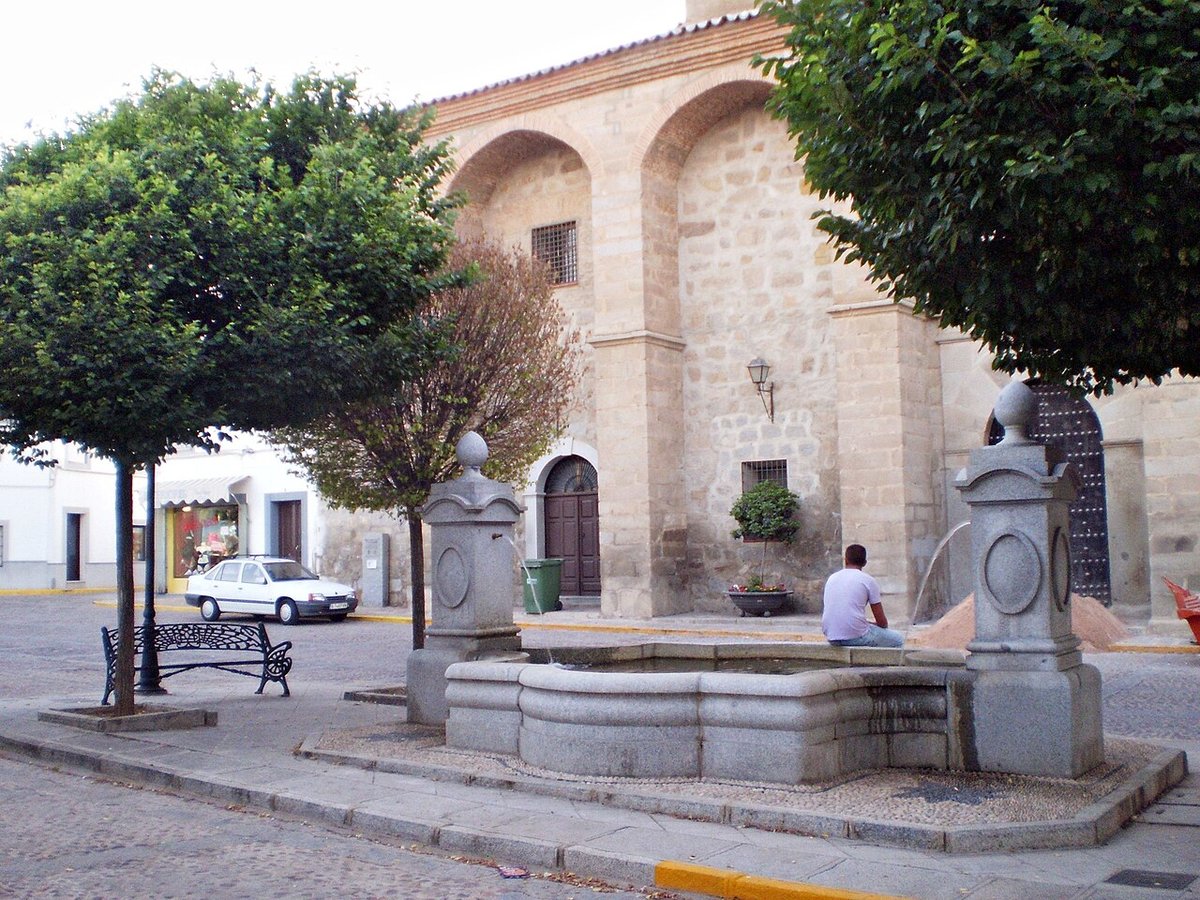
In the Torrefranca quarter, the historic reference point is the church of Santiago. The original tower has been partly absorbed into later buildings, so it is not easy today to distinguish it clearly among the houses that grew up around it.
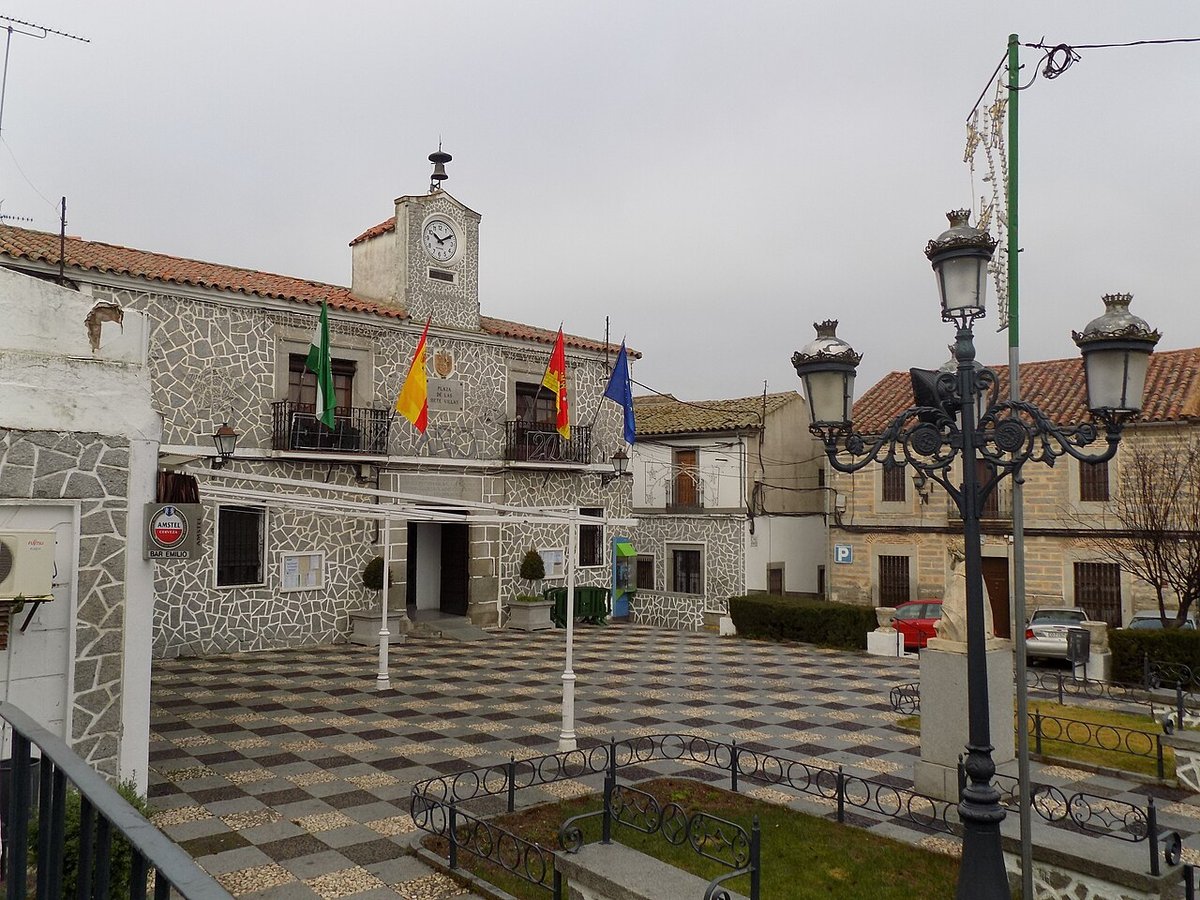
The union of the two settlements brought tensions that lasted for quite some time. Torremilano had held greater administrative weight, and that hierarchy did not disappear overnight. The current town hall occupies a historic building on the main square, with a Renaissance-style doorway that recalls the period when these towns formed part of a network of municipalities with their own jurisdiction in the area.
Granite and everyday architecture
One of the most recognisable features of Dos Torres is its use of local granite. It appears in walls, in the lintels of doors and windows, and in many paved surfaces. Traditional houses have thick walls designed to soften the extremes of the climate, very dry summers and winter days that can be cold at this altitude on the Pedroches plateau.
Roofs rest on wooden beams, often made of holm oak, and south-facing corridors or galleries are common. These building solutions answered practical needs, drying produce, ventilating interiors and making the most of sunlight during colder months.
The church of Santiago, in the former nucleus of Torrefranca, combines late Gothic elements with later additions. The building has served different purposes over time, yet it retains part of its original structure along with several items of interest inside. Parish archives from churches like these, when preserved, are often a valuable source for reconstructing the demographic history of towns across the comarca.
The so-called Pozo de la Nieve
Some distance from the town centre lies a place known as Pozo de la Nieve. The name can be misleading. It is in fact a structure carved into the rock that for years was interpreted as a very old religious building, possibly from Late Antiquity. Some researchers have linked it to a small early Christian basilica, although its exact interpretation remains a matter of debate.
The space has a cross-shaped plan and a fairly stable interior temperature, something that likely influenced its popular name. For a long time it was known mainly to shepherds and people working in the countryside, who used it occasionally as a shelter.
Archaeological work carried out decades ago uncovered several construction elements that help to explain the site, although it remains quite simple in terms of visitor infrastructure. It is best approached with time and care when moving around the area.
Hermitages around the outskirts
Within the municipality there are several hermitages scattered around the surrounding countryside. Many were built between the 16th and 17th centuries, at a time when these small chapels marked routes, entrances to the town or shared spaces used by the community.
Among the best known are those dedicated to the Virgen de Loreto, San Sebastián, San Antonio, the Santos Mártires and the Cristo de la Misericordia. Some stand on slight rises from which the gently rolling landscape of Los Pedroches can be seen, with the dehesa stretching out around the town.
Several of these hermitages still host romerías or local celebrations throughout the year. The one dedicated to Loreto, at the beginning of May, usually brings together residents from across the municipality as well as nearby towns.
Getting there and when to go
Dos Torres lies in the north of the province of Córdoba, within the comarca of Los Pedroches.