Full Article
about La Puebla del Río
Guadalquivir balcony and gateway to Doñana, with strong bullfighting and rice-growing traditions.
Hide article Read full article
A Settlement Shaped by the Guadalquivir
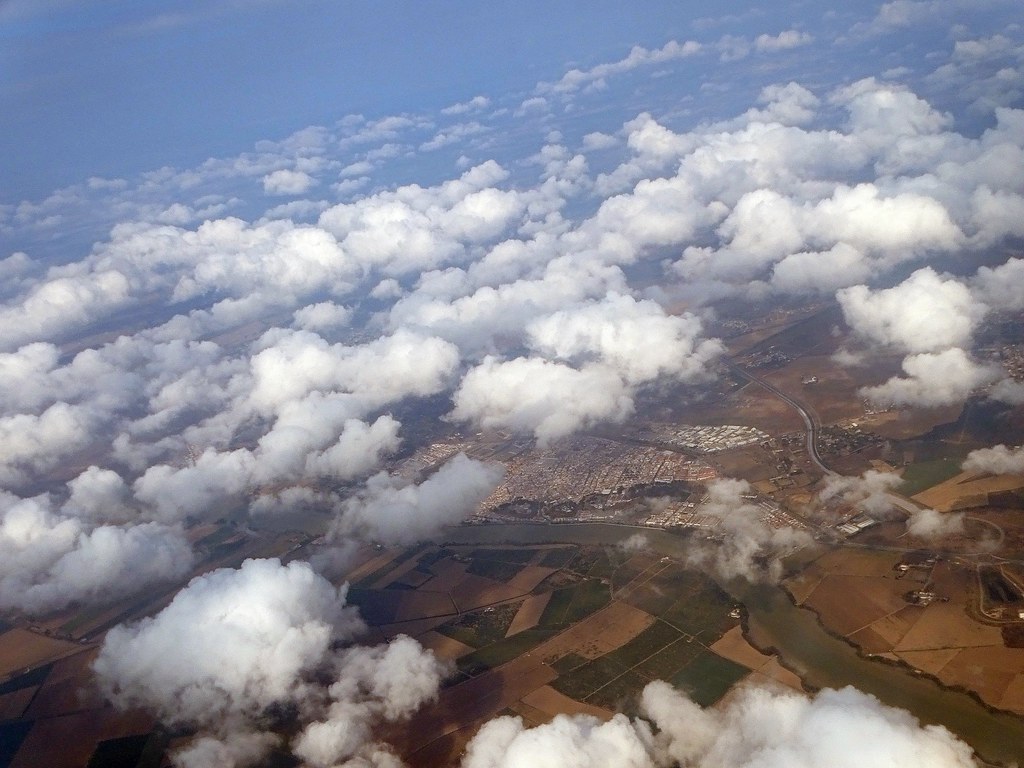
Tourism in La Puebla del Río makes most sense with a map of the Guadalquivir in hand. Just before the river opens out into the marshes, it draws one of its last great meanders here. On this slightly raised bank, a puebla was founded in the mid-13th century as part of the reorganisation of the territory following the Castilian conquest.
The choice of location was practical. From this point it was possible to control river traffic heading towards Seville and to monitor a stretch of water that for centuries served as both transport route and natural frontier. La Puebla has never turned its back on the river. Its history, its economy and much of its landscape depend on it.
That relationship with the Guadalquivir still defines the town today. The river is not simply a backdrop but the reason this settlement exists in precisely this spot.
Watching the River: Torre de la Guardia and the Parish Church
Close to the riverbank stands the Torre de la Guardia. Its origins date to the Late Middle Ages and it is generally understood as part of a system designed to control the river channel. That interpretation fits the historical context: for centuries the Guadalquivir functioned as a commercial highway leading directly to Seville.
The tower is austere and solidly built, more functional than decorative. From the top, when access is possible, the logic of its position becomes clear. The curves of the river are easy to trace, as are the low-lying marshlands and, to the north, the line of the Aljarafe. It is a place conceived for surveillance rather than display.
A short distance away stands the parish church of Nuestra Señora de la Granada. The present building reflects several construction phases between the Middle Ages and the early modern period. Its tower shows a notably expressive Andalusian Baroque style. In parts of the walls, reused materials from earlier periods can still be seen, a common feature in churches built over older structures.
Inside, the church preserves processional sculptures that remain important to local religious life. Brotherhoods continue to maintain a calendar of observances that plays a visible role in the rhythm of the town. For visitors unfamiliar with Spanish tradition, these brotherhoods are lay religious associations that organise processions and festivities, particularly around Holy Week and other key dates.
On one side of the historic centre stands the ermita of San Sebastián. The chapel is linked to an old devotion within the municipality. San Sebastián has traditionally been invoked in times of epidemic, a pattern found in many Andalusian towns.
Streets That Lead Down to the Water
The old quarter retains an irregular layout that likely developed in response to the terrain and to gradual expansion over time. Many of the streets slope down towards the river, a reminder that the Guadalquivir was once a place of work as well as transit.
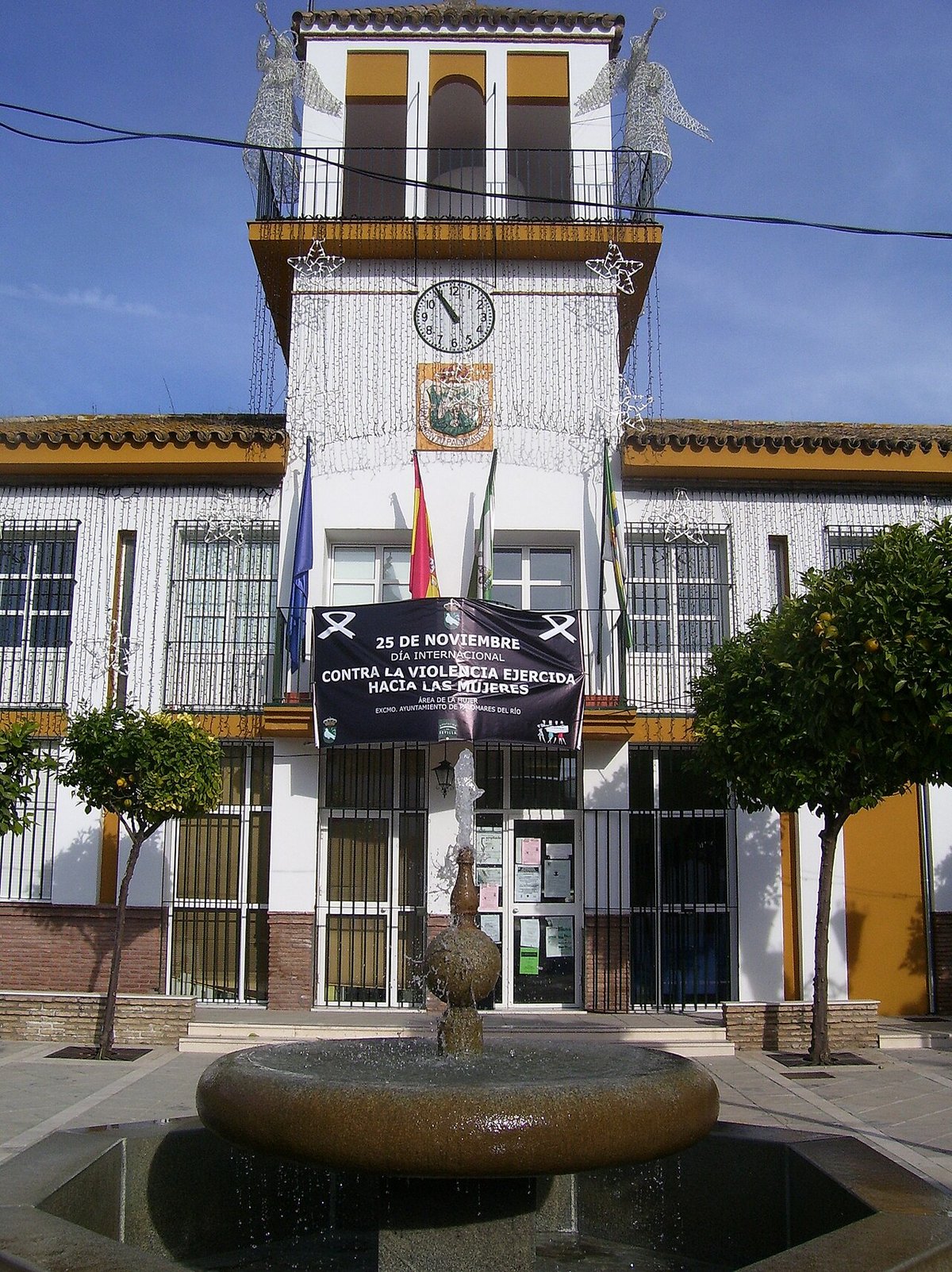
The main square brings together several institutional buildings constructed or remodelled in the modern era. From there, narrow streets branch off, lined with one- and two-storey houses. Interior courtyards are common, as are whitewashed façades that respond to the climate more than to any decorative ambition. The architecture reflects practical adaptation to heat and light.
Walking through this part of La Puebla del Río does not reveal grand monuments at every turn. Instead, it offers a sense of continuity between past and present. The urban fabric remains closely tied to the river and to the agricultural land that surrounds the town.
Cooking Between River and Rice Fields
Local cooking mirrors the immediate surroundings: river, marshland and rice fields. Rice appears on many tables, often combined with small game or species associated with the Guadalquivir itself.
One of the most characteristic ingredients is the red swamp crayfish, cangrejo rojo. It has been present in the rice fields of the lower Guadalquivir for decades and gradually found its way into popular recipes. Its abundance in the paddies made it a natural addition to local dishes.
Another traditional ingredient is albur, a river fish that for a long time formed part of everyday eating in this area. The cuisine remains straightforward, shaped by what the environment provides rather than by elaborate techniques.
Sweets tend to be simple and closely linked to local celebrations or home cooking. Many are made with lard, almond or caramelised sugar. They reflect a domestic tradition rather than a formal pastry culture.
The Landscape of the Marshes
Leave the built-up area and the scenery changes quickly. La Puebla del Río sits right on the edge of the Guadalquivir marshes, a flat and open territory strongly marked by rice cultivation.
Roads and agricultural tracks cut across kilometres of paddies that transform with the seasons. In the early stages they appear as sheets of water. Later they turn an intense green as the rice grows. When harvest approaches, the fields shift to golden tones. The visual effect depends entirely on the agricultural cycle.
This area also forms part of the eastern edge of the surroundings of Doñana. At certain times of year it is relatively easy to spot water birds, storks or herons in the channels and flooded fields. Many visitors are drawn by this landscape of marshland reshaped by farming. It is a setting where natural and agricultural environments overlap.
Getting Oriented in La Puebla del Río
La Puebla del Río lies a short distance from Seville and can be reached by road in under half an hour from the city, depending on traffic.
The town itself is easy to explore on foot. A practical approach is to leave the car on the broader avenues in the upper part of town and walk down towards the centre and the riverside area.
The urban core can be seen at a relaxed pace over the course of a morning. Those interested in the surrounding natural environment should allow extra time to follow the tracks that lead out towards the rice fields and marshes. Out there, beyond the last houses, it becomes clear why this settlement stands at this particular bend of the Guadalquivir.