Full Article
about La Guardia de Jaén
Ancient fortified town near Jaén with a strategic castle and a Dominican convent.
Hide article Read full article
Always Uphill
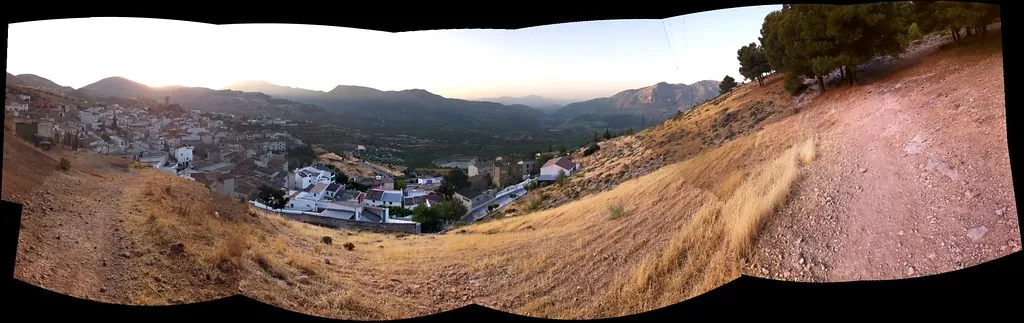
Park near the square and start walking. In La Guardia de Jaén, you are always going uphill. The old quarter sits at around 645 metres above sea level, and the castle rises higher still. From wherever you leave the car, allow about ten minutes at a steady pace to reach the top.
In summer, shade matters. The streets are narrow and the sun is relentless, so it is worth choosing the side with a sliver of shadow. The layout is simple enough: white houses, the occasional façade bearing a coat of arms, and lanes that tend to end in a slope. Pavements, where they exist, are not always in great condition, and the ground is stone. Comfortable shoes make the climb easier.
This is not a place of grand boulevards or long lists of sights. La Guardia de Jaén feels like what it is, a small town close to Jaén city, where daily life continues at its own rhythm. The detour makes sense for one main reason, and it is visible from almost anywhere as you look up.
What Remains of Mentesa Bastia
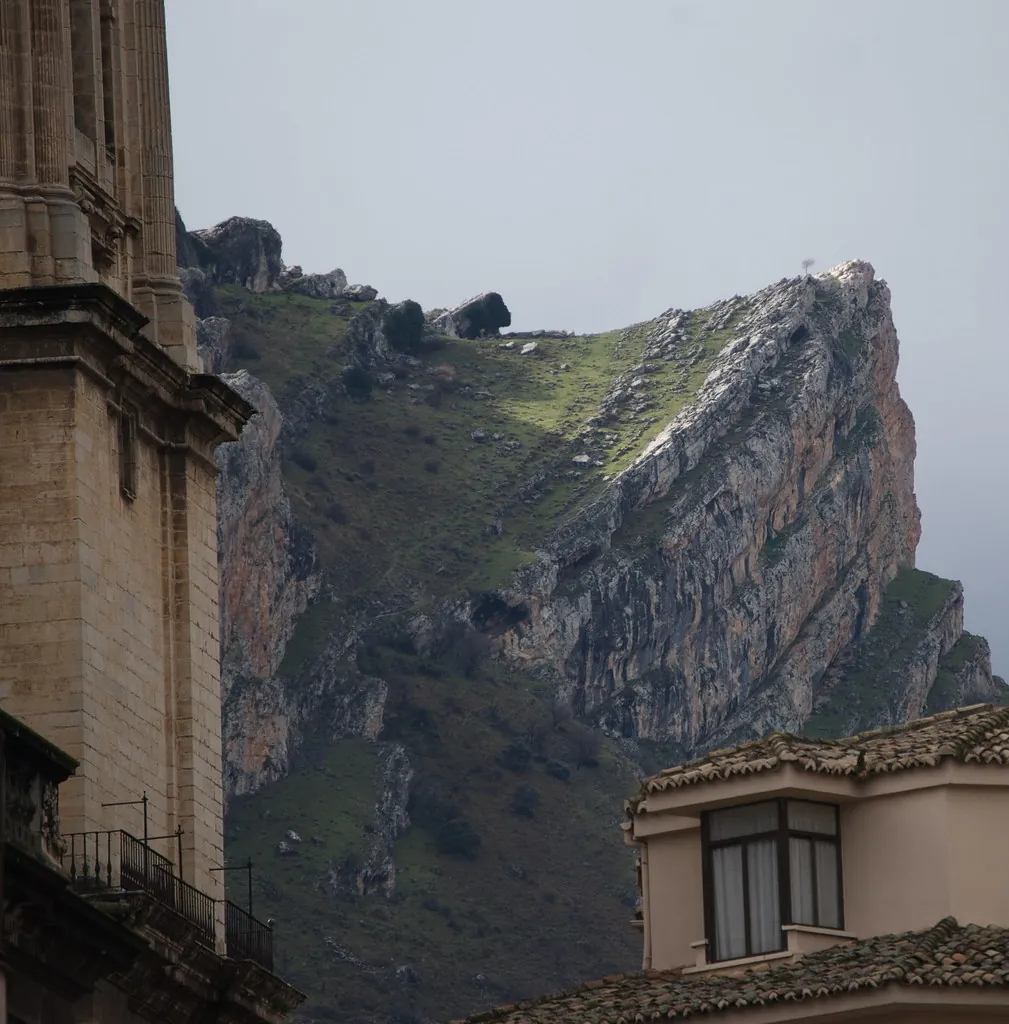
The castle is the real draw. Do not expect a complete fortress. What survives are a couple of towers and stretches of wall. Even so, the ascent is worthwhile for the view alone.
On one side lies the valley of the Guadalbullón, packed with olive groves that roll across the landscape. On the other rises Sierra Mágina, which in some winters keeps snow well into spring. The contrast between the ordered geometry of the olives and the rougher outline of the mountains gives the setting its character.
The keep, or torre del homenaje, is usually dated to the Andalusí period. Later alterations were made when the site had already lost much of its military importance. Today it can be visited at certain times, although these vary depending on the season, so it is sensible to check in advance.
Down below, the former convent of Santo Domingo now serves as the town hall. From the original complex, the Renaissance cloister remains and little else. Nearby stands the 16th-century Iglesia de la Asunción. Its main altarpiece aims for monumentality, although it inevitably feels modest if you have just visited the cathedral of Jaén. Taken on its own terms, it reflects the ambitions of a small town with an eye on larger models.
The rest of La Guardia de Jaén is less about individual monuments and more about atmosphere: whitewashed houses, steep streets and the constant sense of height. Almost every turn seems to involve another incline.
Eating Like a Local
In the village bars, you will often come across guiñapos. These are flat cakes made from flour, filled with cod and clams. They are substantial and inexpensive, the sort of food that can see you through half a morning. One is usually enough.
Migas with pomegranate appear when the fruit is in season. In colder months, potato stews heavy on garlic are common. This is not a place of long menus or elaborate presentation. It is working food that over time has become typical local fare. If you are not particularly hungry, asking for half a portion is a sensible move.
On the square there is a fountain where you can refill your bottle. The historic fountain of María Magdalena is no longer here; it is now in Jaén city, in the Diputación. What stands in La Guardia de Jaén today is a replica. The water runs cool, which is welcome after the climb.
Do not expect souvenir shops or rows of boutiques. What you find is what you would expect in a small Andalusian town: a bakery, a pharmacy and bars. Little else.
When the Town Fills Up
In August, La Guardia de Jaén changes. Many people from Jaén city come up during those days, and the centre fills, especially around the patron saint festivities and the procession of the Virgen. Parking becomes more complicated, and the usually quiet streets feel busier.
In spring there is typically the romería of San Marcos, held in the countryside. A romería is a rural pilgrimage and celebration, and here the atmosphere is more relaxed. Families gather outdoors and the focus shifts away from the steep lanes of the old quarter.
In winter, around the feast of San Sebastián, there is a fair with stalls selling homemade sweets. It is a smaller-scale event, but one that draws people together during the colder months.
Semana Santa, Holy Week, follows the pattern seen in many towns across the province of Jaén. There are processions, marching bands and crowded streets as soon as evening falls. During those days, moving around the centre by car is difficult.
Walking It Off
Several marked routes run around the town. The Ruta del Castillo is the shortest. In less than an hour you can walk from the urban centre up to the castle and back again.
The other routes begin a little further away, and it is advisable to approach them by car. The Ruta de las Fuentes passes between olive groves and old wells. The Ruta de las Eras mentions Roman remains, although what survives amounts to little more than scattered stones. Expectations should be kept in check.
The so-called Ruta del Renacimiento links churches and historic buildings within the town itself. If you stop to read the information panels, you could easily spend a couple of hours following it.
Water is essential. In summer there is almost no shade, and temperatures easily exceed 35 degrees. In winter, the wind that comes down from La Loma can be biting. Spring is usually the most manageable season for walking.
A Practical Plan
If you arrive in the morning, it pairs well with Jaén city. You can have breakfast here, climb to the castle and within a few minutes’ drive be back in the city again. The road connection is quick in either direction.
If you come in the afternoon, the calculation is much the same. There is little choice when it comes to staying overnight, so many people base themselves in Jaén and come up only for a few hours.
La Guardia de Jaén does not try to be more than it is. It offers a hilltop walk, wide views over the Guadalbullón valley and Sierra Mágina, and a handful of solid local dishes. Go prepared for slopes, sun and simple pleasures, and it delivers exactly that.