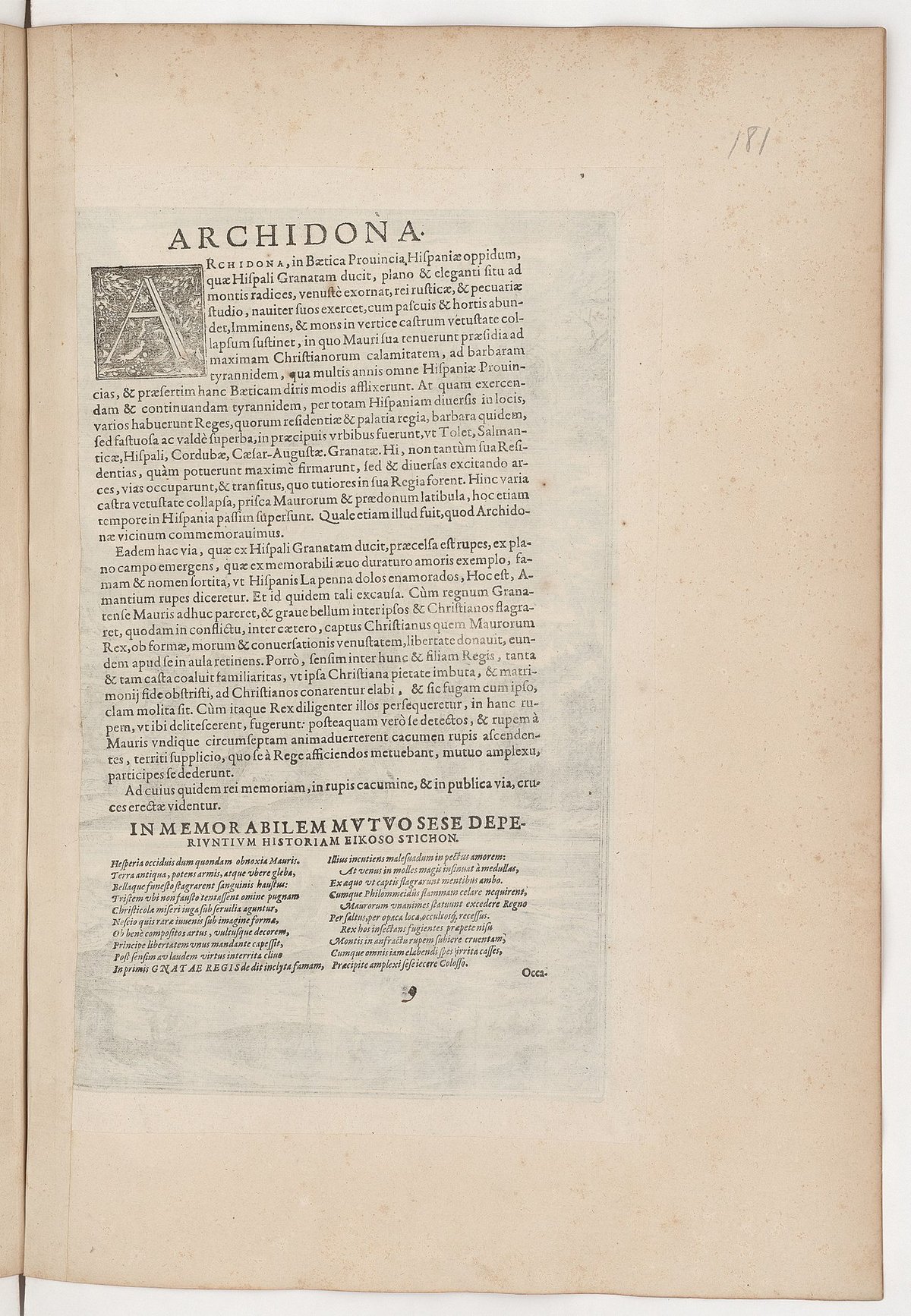
La penna de los Enamorados ; Archidona - Effigiabat Georgius Houfnaglius 1564 - btv1b53194492s (1 of 3).jpg
Vfersal · Flickr 4
Andalucía · Passion & Soul

Archidona

Six hundred and sixty-six metres above the olive groves, Archidona’s Plaza Ochavada appears so suddenly that drivers slam on the brakes. One moment...

8,105 inhabitants · INE 2025
666m Altitude

Why Visit

Plaza Ochavada Visit the Plaza Ochavada

Best Time to Visit

spring

Dog Fair (May) agosto

Things to See & Do
in Archidona

Heritage

  • Plaza Ochavada
  • Shrine of the Virgin of Grace
  • Convent of the Minims

Activities

  • Visit the Plaza Ochavada
  • climb to the Santuario
  • Washington Irving Route

Festivals
& & Traditions

Fecha agosto

Feria del Perro (mayo), Feria de Agosto (agosto)

Las fiestas locales son el momento perfecto para vivir la autenticidad de Archidona.

Full Article
about Archidona

Monumental town with Andalusia’s only octagonal plaza and a hilltop sanctuary overlooking the vega.

Ocultar artículo Leer artículo completo

Six hundred and sixty-six metres above the olive groves, Archidona’s Plaza Ochavada appears so suddenly that drivers slam on the brakes. One moment you’re winding through whitewashed lanes, the next you’re staring into an eight-sided courtyard that looks suspiciously like a bullring designed by a mathematician. Eighteenth-century planners drew it with compass and ruler: eight equal façades, eight identical balconies, eight arcs of terracotta roofline meeting in a perfect octagon. The effect is less “pretty Andalusian square”, more “Baroque geometry exam” – and it is the reason most visitors stay longer than the intended coffee stop.

The town spills down the northern flank of the Cerro de Gracia, a sandstone lump that once served as a Moorish redoubt. From the plaza, every street tilts. Cobbles glisten after rain; locals treat the gradient as a treadmill, marching uphill with shopping trolleys while visitors stop every ten metres to pretend they’re admiring the view. Park behind the IES secondary school – the only flat stretch of tarmac in town – and walk in. The lanes are barely a car’s width, and wing mirrors have a short life expectancy.

A balcony over Málaga province

The climb to the Santuario de la Virgen de Gracia is non-negotiable. You can drive, but the road corkscrews so tightly that even seasoned motorists emerge trembling. Better to walk: thirty minutes on a stony path that smells of wild thyme and diesel from the odd brave Seat Ibiza. At the top, the Renaissance church squats behind a broad terrace. On clear winter days you can pick out the snow-streaked Sierra Nevada 120 km away; in spring the foreground is a chessboard of green wheat and silver olive. Inside, the patrona, a small polychrome Virgin, receives a steady trickle of villagers who climb the steps precisely to say they’ve climbed the steps.

Back in the casco, the Iglesia de Santa Ana shows its age more honestly. Brick and stone are stitched together in the Mudéjar fashion; the tower leans slightly, as if eavesdropping on the bar next door. Fragments of the old Islamic wall survive further up the hill – a short stretch here, a tower there – enough to remind you that Archidona was once the capital of a Berber kingdom before Córdoba and Seville muscled in. Information panels are thin on the ground; half the fun is guessing which lump of masonry is Roman, which is Visigothic, which is simply last century’s repair.

Oil, wheat and a soup you eat with a fork

Agriculture built the town, not tourism. Eight thousand hectares of olive groves surround Archidona, worked by cooperatives whose chimneys smoke gently in December as the new oil flows. The local almazara, Nuestra Señora de Gracia, opens for tastings by appointment. You’ll compare picual and hojiblanca oils under fluorescent strip lights while the foreman swigs coffee from a plastic cup. It is about as un-glamorous as wine tasting gets – and far more useful. British visitors usually leave clutching five-litre drums that rupture in the hold on the way home.

In the bars, order porra archidonesa, the village’s thicker, gentler cousin of gazpacho. Bread, tomato, pepper and olive oil are pounded into a cold custard, served in a bowl and topped with diced ham and egg. It is the colour of Mediterranean terracotta and tastes like summer even in February. Molletes – soft white rolls baked in Antequera and trucked uphill – appear at breakfast, split and drizzled with raw oil. Main courses run to kid stew and migas – fried breadcrumbs strewn with chorizo and grapes. Vegetarians should practise the phrase “sin jamón, por favor”; otherwise everything arrives wearing a pork hat.

The smartest food in town is at Arxiduna on the plaza. The menu is Spanish-only, but the waiters will slow down if you attempt the accent. Expect charcoal-grilled octopus on chickpea puree, or pork cheek glazed with local honey, all priced at around €14 a plate. Book an outside table for sunset; the stone walls glow amber and swallows dive-bomb the eaves above your head.

When the quiet breaks

For fifty weekends a year Archidona dozes. Then Easter arrives and 30,000 extra bodies squeeze into streets built for mules. The Holy Week processions are considered among the most authentic in Málaga province – partly because there’s nowhere for the cofradías to go but up and down near-vertical lanes. Hooded penitents shuffle past your balcony at two in the morning, brass bands ricochet off stone walls, and the scent of beeswax drifts through open windows. It is spectacular, deafening and not for the claustrophobic. Hotel rooms triple in price; if you want atmosphere, book early. If you want silence, arrive the following Tuesday.

April’s Cruz de Mayo is gentler. Neighbours cover balconies with shawls and carnations, build three-storey-high floral crosses, and compete for the best display. The plaza fills with bootleg beer stalls and children chasing balloons. Again, the town doubles in volume, but the mood is more village fete than religious fervour.

Getting there, staying sensible

Málaga airport is 65 km south – 45 minutes on the A-45 and A-92 if you ignore the sat-nav’s attempt to send you via every olive grove. Car hire is essential; public transport means a bus to Antequera and a twice-daily local service that stops at 19:00. Accommodation is limited: a handful of small hotels and casa-rural apartments clustered round the plaza. Prices hover round €70 a night for a double, less off-season. Rooms facing the octagon get the morning sun and the evening chatter; those at the back are quieter but feel like a monk’s cell.

Bring sensible shoes – the word “flat” does not exist here – and a jacket whatever the season. At 666 m, nights can dip to 5 °C in January and 12 °C in May. Summer afternoons top 35 °C, yet the altitude keeps the air breathable, a blessed relief compared with the stifling coast.

Leave room in the suitcase for a bottle of early-harvest oil and a slab of torta de aceite, the crisp aniseed biscuit that survives the journey home. You won’t find fridge magnets or flamenco dolls; Archidona still sells bread and nails, not memories. That, more than the eight-sided plaza, is what makes the detour worthwhile.

Key Facts

Region
Andalucía
District
Nororma
INE Code
29017
Coast
No
Mountain
No
Season
spring

Livability & Services

Key data for living or remote work

2024
ConnectivityFiber + 5G
HealthcareHealth center
EducationHigh school
Housing~5€/m² rent · Affordable
CoastBeach 19 km away
Sources: INE, CNMC, Ministry of Health, AEMET

Official Data

Institutional records and open data (when available).

  • Castillo-Mezquita Ermita de la Virgen de Gracia
    bic Castillo/Fortaleza ~0.5 km
  • Convento de Santo Domingo
    bic Monumento ~0.3 km
  • Iglesia del Convento de Las Mínimas
    bic Edificio Religioso ~0.3 km
  • La Cilla
    bic Monumento ~0.2 km

Planning Your Visit?

Discover more villages in the Nororma.

View full region →

More villages in Nororma

Traveler Reviews