Full Article
about Cuevas de San Marcos
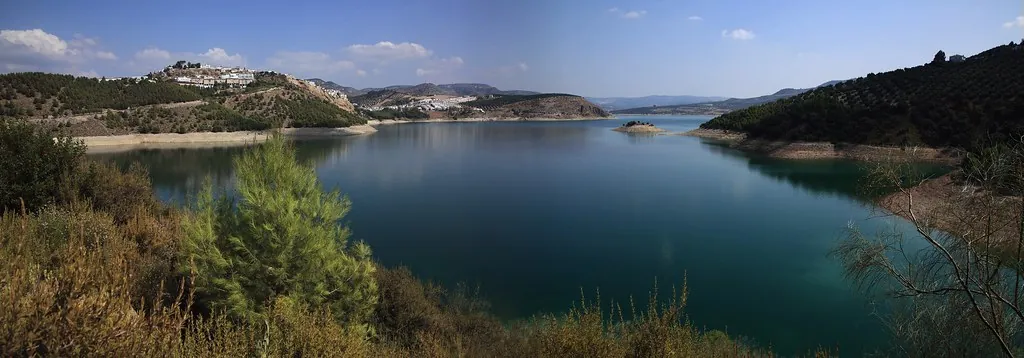
Border town with Córdoba, dominated by the Falla del Camorro and near the Iznájar reservoir.
Hide article Read full article
A place that does not perform for visitors
Cuevas de San Marcos sits in the interior of Andalucía with little interest in appearances. It is not the kind of place built for photos. There are no carefully arranged balconies or neat stone streets. What you find instead is a junction of roads, low houses, exposed brick and olive groves stretching far into the distance.
That first impression can feel plain, but it carries something that is harder to find elsewhere. Life here runs on its own terms. Conversations fill the square more than cameras do. In the bars, people walk in without checking a menu because they already know what is cooking. When you order wine, the likely question is simple: sweet or dry. Nothing more complicated is needed.
Even the name turns out to be literal. At the entrance to the village stands the Cueva de Belda. It appears almost before anything else. Inside, a small area displays objects tied to rural life, tools, old presses and pieces that reflect how olive farming was done decades ago. Move a little further towards the cave’s mouth and the atmosphere changes quickly. The smell and the sound of bats make it clear that this is still, first and foremost, a cave rather than a museum.
Up the Camorro, without much of a plan
A route called “Ruta de los Milenios” circles through the nearby hills. It covers around six kilometres and forms a loop. On paper, it looks straightforward. The path begins towards Medina de Belda, in the Sierra del Camorro.
The start feels manageable, but the mountain does not stay gentle for long. The slope sharpens without warning, as if the terrain suddenly shifts upward. The climb demands effort early on.
The payoff arrives quickly. When the ridge opens out, the Genil valley spreads below as a vast expanse of olive trees. The village sits among the roads, almost folded into the landscape. Higher up, the remains of Medina de Belda come into view. The site was already occupied during the Andalusí period. What stands today are low walls, traces of structures and an open area that explains the choice of location. From here, much of the valley lies in clear sight.
It is not a place of imposing ruins. There are no towering walls or grand reconstructions. The interest comes from the position itself and the sense of continuity. The setting has changed little across centuries, even as everything else has moved on.
Eating whatever is ready
Food in Cuevas de San Marcos does not follow a fixed script. It depends on what is prepared that day.
A typical stop takes the form of a roadside venta, simple and practical. A small terrace, a few tables, perhaps a dog asleep under a chair. The safest request is straightforward: whatever is available.
The response can be equally direct. There may be choto, young goat, or something quicker like porra. The porra arrives thick and substantial, the kind where the spoon almost stands upright. Then come migas with pieces of chorizo, carrying the smell of paprika from the kitchen to the table. These are dishes that do not aim to look impressive but do exactly what they need to do.
Conversations around the table often drift towards local traditions. The romería de San Marcos brings much of the village together out in the countryside. Families gather with folding tables and large pans, spending the day cooking and eating outdoors. It feels closer to a shared meal than an event arranged for visitors.
The green bridge over the Genil
Near the edge of the village, a metal bridge crosses the River Genil. Painted green, it forms a curved iron structure that looks assembled from oversized mechanical pieces.
It has the character of older infrastructure that continues to serve its purpose without drawing attention. When a car passes, the structure gives a slight vibration. The rivets and metalwork invite a closer look, hinting at how many winters and river floods it has endured.
It is not a landmark in the usual sense. There are no grand claims attached to it. Yet it fits perfectly with the rest of Cuevas de San Marcos. Functional, understated, still doing its job.
A stop that stays with you
Cuevas de San Marcos does not aim to impress at first glance. There are no souvenir shops lining the streets, no themed routes at every turn. What it offers is something quieter.
A visit here unfolds in simple steps. A walk through the village, a look inside the cave, a climb up towards the Camorro, a meal based on whatever is cooking that day. Nothing is staged, and nothing needs to be.
That is where its appeal lies. The village carries on with its routines, whether anyone is watching or not. For those passing through, that sense of everyday life can leave a stronger impression than more polished destinations.