Full Article
about Villanueva de Tapia
Known as El Entredicho due to old boundary disputes, it's famed for its long-running livestock fair.
Hide article Read full article
A village shaped by its setting
Understanding Villanueva de Tapia begins with its location. This small municipality in the north of Málaga sits within the comarca of Nororma, in a transitional zone between the Antequera depression and the first ranges that rise towards Granada. At around 660 metres above sea level and with just over 1,300 inhabitants, it remains closely tied to its agricultural surroundings.
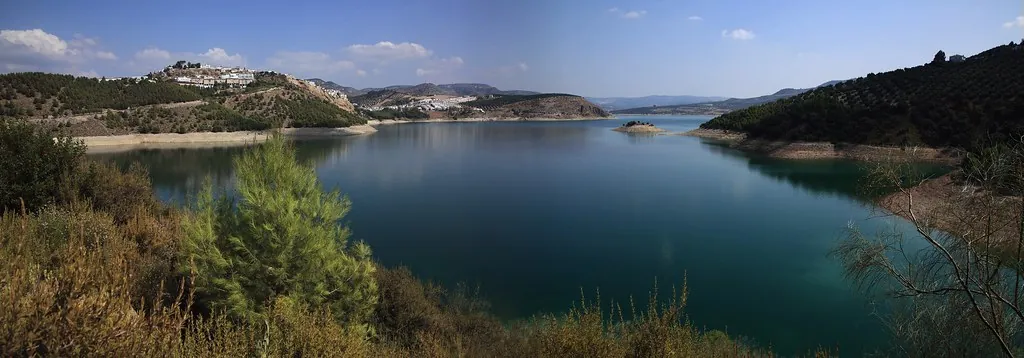
The landscape sets the tone. Olive groves dominate, alongside cereal plots and scattered cortijos spread across the low hills around the village. This is not a place defined by large monuments or grand landmarks. Instead, Villanueva de Tapia makes more sense as part of a wider agricultural territory whose basic structure has changed very little over time.
The urban centre is compact. It is organised around the parish church and a handful of small squares where daily life still gathers. The scale is modest, and the pace reflects that of a working rural community.
Streets, squares and the parish church
At the centre stands the church of Nuestra Señora de los Remedios. Its origins date back to the 16th century, although later alterations have shaped the building as it appears today. This kind of gradual adaptation is typical in small-town parish churches, where practical needs have guided changes over the centuries.
Architecturally, the church is restrained. Its importance comes less from ornament and more from its position. Set slightly above some of the surrounding streets, it acts as a clear point of reference within the village.
From there, a network of narrow streets extends outward. Some run uphill, others dip gently, and most are lined with one or two-storey houses. The architecture follows a familiar pattern seen across inland Málaga: whitewashed façades, iron window grilles and small balconies. There is no monumental historic quarter, but there is a coherent urban fabric. Many houses still retain traditional proportions and materials, giving the village a consistent visual identity.
The Plaza de la Constitución serves as one of the main meeting points. At certain times of day, it is still common to see residents chatting in the street or sitting just outside their homes. In a place of this size, these everyday scenes remain part of the rhythm of life.
The surrounding landscape
Olive cultivation defines almost the entire municipal area. From slightly elevated points within the village, the view reveals a continuous patchwork of groves stretching towards the Antequera countryside and up to the sierras that close the horizon to the north.
Between the olive trees, agricultural tracks connect cortijos and working farms. Over time, many of these paths have also become informal routes for walking or cycling. They are not marked trails in the usual sense, but working tracks that double as ways to move through the landscape without straying far from the village.
The character of the countryside shifts with the seasons. Winter brings a more subdued palette, while spring introduces a noticeable change as grasses and wild growth appear between the rows of olive trees.
Walking out into the countryside
One of the simplest ways to get to know Villanueva de Tapia is to leave the built-up area on foot and follow the nearby rural paths. There is no need for complex planning. It is enough to take one of the agricultural access routes leading out of the village and walk among the olive plots.
It helps to get your bearings beforehand or ask a local which paths are most commonly used, as not all of them connect clearly. The terrain is generally gentle, made up of low hills and shallow gullies rather than steep or demanding ground.
This is not a destination for mountain hiking. It is better suited to unhurried walks through a working agricultural landscape that continues to function as it always has.
Festivals and everyday life
Local celebrations follow the familiar pattern of many inland Andalusian villages. The summer fair brings a noticeable change in atmosphere, as people who live elsewhere return for a few days, increasing the sense of activity in the streets.
The patron saint festivities in honour of Nuestra Señora de los Remedios combine religious events with more popular activities. The procession of the image through the village streets is one of the central moments.
Semana Santa, or Holy Week, is observed in a more restrained way than in larger towns. Processions follow short routes through the streets, and participation is closely tied to families and local brotherhoods.
Getting there and practical notes
Villanueva de Tapia is reached by road from Antequera or from the boundary with the province of Granada. The usual approach is by car, using the main motorway that links Málaga with Córdoba before continuing along smaller regional roads.
Once there, the village can be explored on foot without difficulty and in a short amount of time. Some streets have noticeable slopes and sections of uneven paving, which is worth bearing in mind.
For walks in the surrounding countryside, comfortable footwear is advisable. Many of the paths cross working farmland, so they remain part of an active agricultural environment.
Services are those of a small municipality, so it is sensible to plan ahead to some extent, especially during the week. The overall pace is that of a village where agriculture still shapes daily life.