Full Article
about Orcera
Mountain village home to one of Europe’s largest natural swimming pools, at Amurjo.
Hide article Read full article
A village above the olive groves
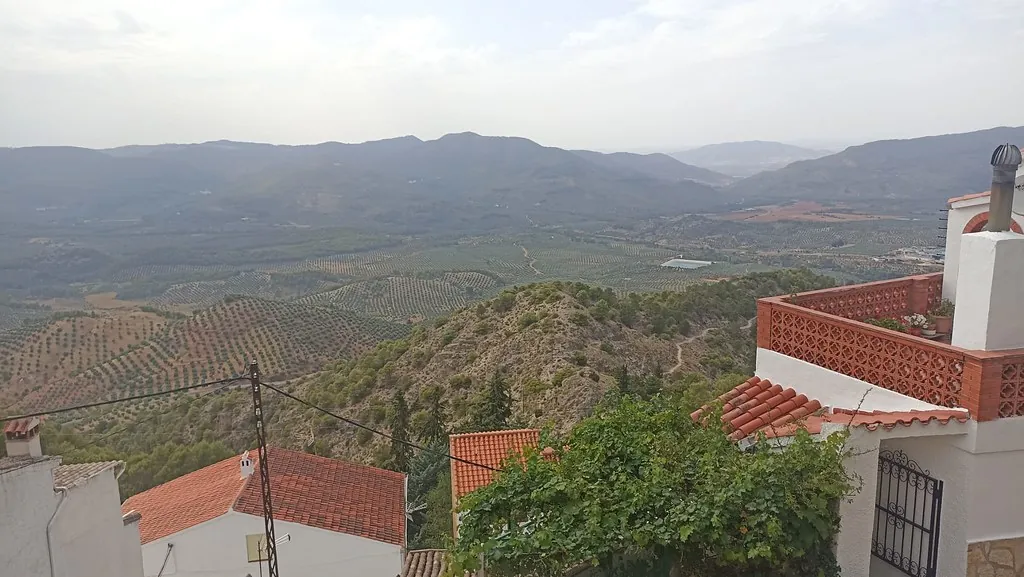
Orcera sits high in the Sierra de Segura, around 800 metres above sea level, in the province of Jaén. It is home to roughly 1,700 people. From a distance, the setting is defined by two clear elements: mountain pines and olive groves that cover almost everything that is not steep hillside.
Daily life here moves to a different rhythm. The pace is shaped more by the main square, the surrounding fields and the changing seasons than by a mobile phone clock. Doors are often left open. Conversations happen in the middle of the street. Cars pass slowly because many of the streets simply do not allow for speed.
The layout of Orcera feels organic rather than planned. Streets climb and dip without much logic. There are stretches of uneven paving, whitewashed façades, wrought-iron balconies and the occasional stone house that has faced the same slope for decades. This is not a restored backdrop designed for photographs. Shutters may be half repaired, a neighbour might be painting a wall, and children run between corners. Wherever you look up, the mountains are there, framing the village from all sides.
Landmarks in the heart of Orcera
The most recognisable reference point is the Iglesia Parroquial de Nuestra Señora de la Asunción. Its tower is visible from many parts of the town centre. The building combines older sections with later additions, something common in mountain villages where churches have been altered and expanded over the centuries. Towards evening, the tower often stands out clearly against the sky, especially when the light drops behind the surrounding hills.
Plaza de la Constitución acts as the social centre. It is not vast or monumental. Instead, it is where everyday life unfolds: people chatting, children playing, neighbours pausing before getting on with the day. Narrow streets lead away from the square, some with steps and simple balconies. Flowerpots decorate façades, and there are old fountains where the water runs cold in summer.
Another building that draws attention is the Casa de la Tercia. For a village of this size, it is strikingly large. It recalls the way the agricultural economy was once organised in the area. For centuries, buildings like this were used to store part of the harvest and to manage taxes paid in kind. Its function today is different, but the scale of the structure still hints at that past.
Just beyond the built-up area there are small rises and rural paths that offer views over the valley of olive groves. They are not always signposted and do not necessarily have railings. These are working tracks used by local people. A short walk, however, opens up wide views across the Sierra de Segura.
Into the Sierra from the village
Tracks and footpaths leave Orcera and connect with the Parque Natural de las Sierras de Cazorla, Segura y Las Villas. This protected natural area is one of the largest in Spain, covering mountains, forests and deep valleys. Some routes from the village are gentle walks through pine woods. Others venture further into mountain terrain, with steeper gradients and longer stretches.
It is worth checking the condition of the paths before setting out. After rain, certain forest tracks can turn into thick mud, and vehicles feel the strain. Weather in the sierra changes the landscape quickly.
In autumn, many local people head into the hills to collect wild mushrooms. It is a well-established activity in this part of Andalucía. There is regulation in place, and not everything that looks edible actually is. Anyone unfamiliar with the terrain or the species is better off going with someone who knows them well.
Food in Orcera remains closely linked to what the land provides. Hearty dishes are common, especially as the weather cools. Migas, made with fried breadcrumbs, gachas, a thick savoury preparation, and stews with meat appear regularly. Olive oil from the area features in almost everything. In a village surrounded by olive trees, it would be surprising if it did not.
For photography, the surroundings offer strong contrasts. Olive groves form long lines across the hillsides, and at sunset the shadows stretch out across the slopes. In spring, green tones dominate the view. In summer, the light becomes much harsher, and dust in the air can soften the horizon slightly.
Traditions that remain local
The main celebrations revolve around the Virgen de la Asunción in August. During these days, people who live elsewhere return to Orcera because they still have family or a house here. The procession is a central part of the atmosphere. Just as noticeable is the way the village fills with familiar faces who come back for a few days each year.
In May, Cruces are set up and decorated with flowers. Different groups prepare their own cross using plants, fabrics or elements from the countryside. They are simple displays, put together by neighbours working collectively.
There is also the romería of San Isidro Labrador, closely linked to agricultural life. A romería is a rural pilgrimage, usually combining religious devotion with time spent outdoors. In Orcera, it brings together faith, the countryside and shared food in the open air. It remains part of the annual calendar in many villages across the sierra.
The road up to Orcera
From the city of Jaén, the usual route heads towards Villacarrillo along the A-32. From there, the A-317 continues in the direction of the Sierra de Segura. The journey takes around an hour and a half. For much of the drive, the road cuts through extensive olive groves before gradually climbing towards higher ground.
When fog or heavy rain sets in, patience helps. Bends appear quickly as the road gains height, and conditions can change from one stretch to the next. The approach makes it clear that Orcera belongs as much to the mountains as to the sea of olive trees below.
In the end, Orcera is defined less by headline sights and more by its setting and everyday life. A church tower against the evening sky, a square where people stop to talk, paths that lead straight into pine forest, and fields of olives rolling away down the valley. It is a place where the landscape and the village remain closely tied, and where that connection is visible in almost every direction.