Full Article
about Puente de Génave
A communications hub in the sierra, known for its Roman bridge and river setting.
Hide article Read full article
Arrival Through the Olive Landscape
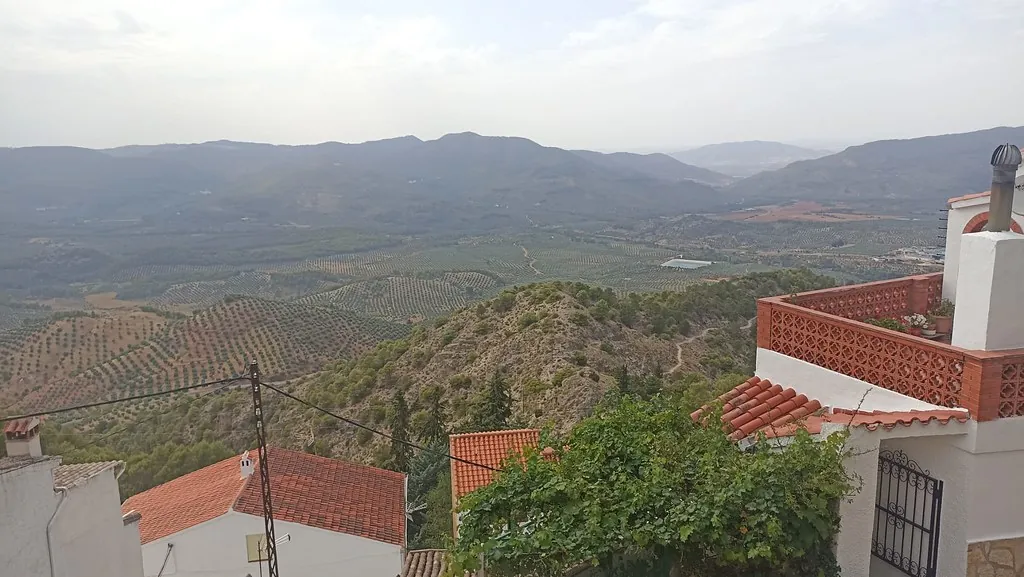
The olive groves begin before you even arrive. For kilometres, terraces of olive trees line the road until it crosses the Guadalimar and Puente de Génave comes into view, white against the mountains. From the current bridge, far more recent in construction, another can be seen downstream, older and traditionally linked to a Roman origin. That association is not surprising. This stretch of river has long acted as a natural gateway between the Spanish plateau and the Levante coast.
The setting explains much about the place. The river narrows here, the fertile plain offers space for cultivation, and the Sierra de Segura rises nearby, shaping movement through the landscape. What now appears as a settled village was, for centuries, primarily a point of passage.
From Crossing Point to Village
Puente de Génave did not emerge by chance. Its location made it a natural corridor for movement: transhumant livestock routes passed through, goods travelled down from the plateau, and paths linked inland territories with the eastern coast. The village’s role was defined less by permanence and more by flow.
Traces of that need to watch over the territory remain in the surrounding hills. In nearby Peñolite stands a watchtower of Andalusí origin, positioned to dominate the Guadalimar valley and monitor activity along the route below.
The settlement seen today is relatively recent. Its growth took shape in the 20th century, when improved communications and the expansion of olive cultivation transformed the area. Before that, the landscape was dotted mainly with cortijos, traditional rural farmhouses, and small scattered communities.
The church of San Isidro appears to date from the late 19th or early 20th century. It is a modest brick building, simple in design and proportion. Its importance lies less in architecture than in its role within local life, marking the rhythm of the community calendar.
Another building that reflects the village’s character is the olive oil cooperative. Its current form echoes mid-20th-century agricultural construction, practical concrete volumes with occasional decorative tile details. Much of the local harvest is processed there. In this part of the Sierra de Segura, the picual olive variety dominates, forming the basis of many oils produced under the region’s designation of origin.
Peñolite and the Guadalimar Valley
A few kilometres from the main village lies Peñolite, a small hamlet set on a hillside. The road leading there is narrow and winding, passing through pines, olive groves and old cortijos.
Above the cluster of houses stands the watchtower, a simple masonry structure without a roof. From this point, the logic of the landscape becomes clear: the river below, the natural corridor of the valley, and the rugged mountains surrounding it, which have long functioned as a boundary.
The Guadalimar itself creates pools along certain stretches. During the hotter months, local people head to these spots to bathe. There are no marked routes or developed facilities. These are places shared through word of mouth rather than signposts.
Along the road between Puente de Génave and La Puerta de Segura, the remains of the castle of Bujalamé can also be found. Very little survives, just fragments of wall and part of a tower. Even so, its position tells its story: a raised point overlooking the Guadalimar corridor, once a strategic route through the region.
Life Shaped by the Olive Harvest
In Puente de Génave, the calendar follows the land. Autumn brings the olive harvest, filling the area with the steady movement of tractors and trailers travelling between groves and the oil mill. The scent of crushed olive leaves lingers in the air for months.
The Plaza de la Constitución serves as the village’s meeting point. It is not large, with stone benches, a few trees and a kiosk that recalls an earlier era. Conversations there often revolve around the harvest, the long-awaited rain, or rain that arrived too late.
The festival of San Isidro, held around mid-May, remains one of the key moments of the year. People from nearby hamlets and rural homes come down into the village, often with decorated tractors. Families gather in the surrounding countryside, and the celebration takes the form of a romería, a traditional rural pilgrimage closely tied to agricultural life.
Summer brings its own rhythm. There are evening festivities and cultural activities, especially when those who work elsewhere return and many houses, closed during winter, open again.
Getting There and Moving Around
Puente de Génave sits in the north-eastern corner of the province of Jaén, within the Sierra de Segura region. It is reached by road via the N‑322, which connects several towns along the Guadalimar valley.
The village itself is easy to explore on foot. Reaching Peñolite or heading further into the mountains is best done by car, as public transport in this part of the region is limited. Suitable footwear is advisable when exploring rural areas.
In summer, anyone looking for access to the river would do well to ask local residents first. Some paths run close to private land and are not always clearly marked.
Olive oil is the most common souvenir taken away from here. In a place surrounded by olive groves, it is never far from hand, often freshly produced. Puente de Génave does not aim to impress at first glance. It reveals itself more gradually, in the way the river, the mountains and the olive landscape continue to shape everyday life.