Full Article
about Santiago-Pontones
Vast high-mountain municipality; pristine landscapes and scattered villages at the heart of the park
Hide article Read full article
Before You Set Off: Space, Distance and Planning Ahead
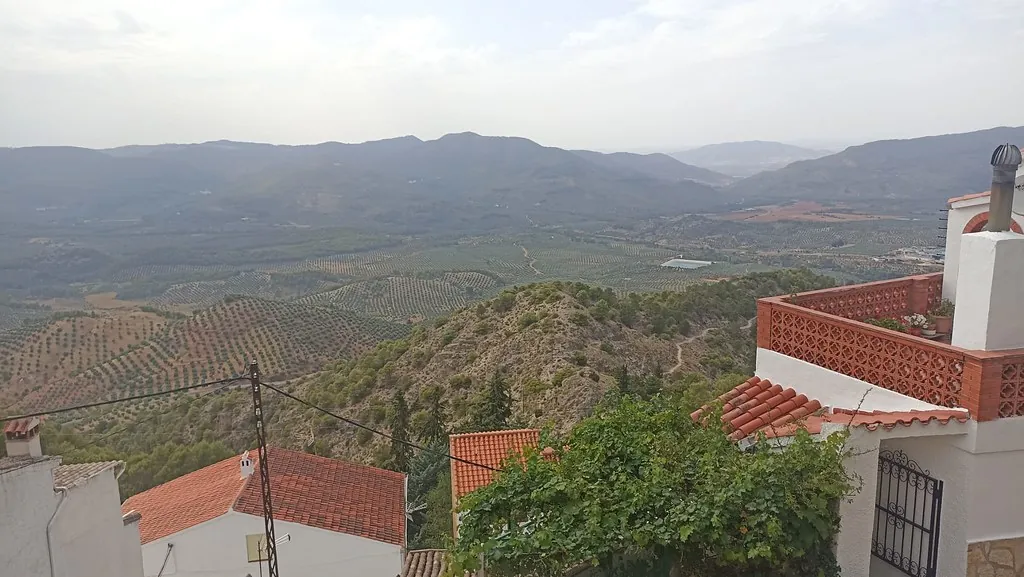
First things first: Santiago‑Pontones works best if you arrive with a full tank and at least half a plan. From Cazorla, the A‑319 climbs steadily through pine forest and bends for quite some time. After a certain point the traffic thins out, then almost disappears. This is a vast municipality, 683 square kilometres of mountain terrain, and its settlements are widely scattered.
Petrol stations, cash machines and large supermarkets are few and far between. Many visitors sort out practicalities before heading into the sierra. In winter, it is also wise to check the forecast. When it snows, some of the secondary roads become tricky.
Summer brings real heat at midday, although the temperature drops noticeably at night. Spring is often the most comfortable season for walking, when the countryside is greener and the air easier to manage on longer outings.
This is not a compact town with everything close at hand. It is a wide stretch of highland, where distances on the map can translate into slow, winding drives. Ten kilometres here can mean half an hour behind the wheel.
The Source of the River Segura
One of the best‑known spots in the area is the Nacimiento del Segura, the source of the River Segura. It lies near Santiago de la Espada, reached by a road that eventually becomes a track. You can drive as far as a spot where there is usually space to park.
From there, a short footpath descends through pine trees. It is straightforward and easy to follow. Before long you are standing in front of the spring itself, where water emerges between rock and vegetation. A few information panels explain the place, and that is about it.
There are no shops and no elaborate visitor facilities. People tend to look, take a couple of photographs and move on. It makes sense as a stop if you are already exploring the area, rather than as a destination that fills a whole day.
The walk to the Nacimiento del Segura is more of a stroll than a hike. For those after something undemanding, it is the simplest option around Santiago‑Pontones.
Eating and Moving Between Hamlets
Santiago‑Pontones is not a single, tightly knit settlement. It is made up of dozens of hamlets separated by kilometres of open countryside. Some consist of two streets and a bar. Others have a little more going on, but none feel urban.
Food follows the traditions of this part of the sierra. You might come across ajo arriero, a robust dish associated with muleteers, or andrajos, a hearty stew typical of the region. There is sometimes game meat when it is available. Nothing elaborate, nothing dressed up. If the kitchen is open, you will be served something hot. If not, a sandwich is often the fallback.
In winter, activity drops off noticeably. Summer brings more movement, particularly at weekends, when people return or visit for a few days.
At the beginning of January, the fiesta de las Ánimas is usually held. Neighbours light bonfires and children go from street to street asking for sweets. It is a local tradition, small in scale and very much rooted in village life. It depends a good deal on the year and on who takes charge of organising it, so the atmosphere can vary.
Moving between hamlets means driving along forest roads and mountain routes. The scale of the municipality shapes everything. Services are spread out, and the sense of space is constant.
Walks That Justify the Effort
There are many paths across the territory. Some are signposted, others are long‑standing forestry tracks that have been used for years.
The climb to Pino Galapán is among the more straightforward options. The path is clear, the gradient moderate. As the pine forest opens up, the views improve. It is a manageable outing for those who want a walk without committing to something too demanding.
The route to las Banderillas requires more effort. It is long and involves significant ascent. Several stretches are stony, and the higher sections offer little shade. Taking water and checking the weather before setting out are basic precautions here. This is mountain terrain, and conditions can change.
Then there is the walk to the Nacimiento del Segura, already mentioned, which serves as the short alternative. Compared with the others, it feels more like a gentle wander than a full route.
Across Santiago‑Pontones, walking is less about ticking off sights and more about covering ground in open country. The reward tends to be space and perspective rather than monuments or built landmarks.
A Sky Without Interference
One feature that stands out in Santiago‑Pontones is the darkness at night. Artificial light is scarce, and there are large areas without intensive farming or major roads.
Move a little away from the hamlets and stop at any mountain pass. On a clear night the sky appears clean and wide. The Milky Way is visible without effort.
No special equipment is required. Switch off the car, step outside and look up. In a place with so little light pollution, that is enough.
A Simple Plan Works Best
Santiago‑Pontones rewards a straightforward approach: a morning walk, a relaxed lunch, and little more on the agenda. This is not a destination for historic centres or urban life. It is a broad stretch of sierra where nature sets the pace.
Allow time for the roads. Distances are deceptive, and journeys take longer than they seem on paper. With realistic expectations and a simple plan, the experience becomes easier to enjoy.
The appeal here lies in the scale of the landscape, the quiet between hamlets, and the sense of being far from busy routes. It is 683 square kilometres of mountain without embellishment.