Full Article
about Alanís
Mountain municipality of great scenic value, dominated by its medieval castle and surrounded by holm-oak and cork-oak pastureland.
Hide article Read full article
A hillside village under open skies
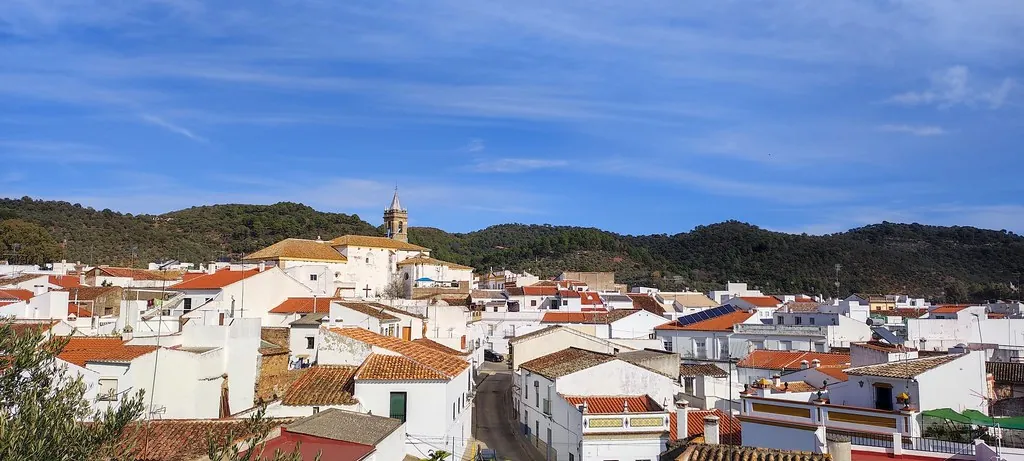
In the early afternoon, as the sun begins to drop towards the west, the slope below the castle in Alanís fills with a flat, golden light. From the top, the dehesas of the Sierra Norte stretch out in no particular hurry: widely spaced holm oaks, the occasional cow moving slowly, and white farmhouses that appear and disappear with the folds of the land. Alanís stands at just over six hundred metres above sea level, and that elevation is noticeable in the cooler air that often circulates here, even in summer.
The village has a restrained presence. Whitewashed façades line streets that climb and dip without much apparent order, and daily life follows its own rhythm, far from the noise of larger cities. There is no sense of display. Alanís sits quietly on its hillside, surrounded by pastureland and low mountain ranges.
Nuestra Señora de las Nieves and the old streets
Walking through the centre, the late afternoon light slips between houses at an angle and rebounds off the lime-washed walls. In places the ground alternates between asphalt and old stone, worn smooth by years of footsteps.
The parish church of Nuestra Señora de las Nieves rises above the rooftops, its tower serving as a constant reference point. From almost any street, it reappears between tiles and chimneys. The building combines different historical phases, from late Gothic elements to later additions, something common in churches that have grown gradually over centuries.
The surrounding streets retain an irregular layout that encourages a slower pace. The slopes are short but steady. Many houses keep their wooden doors half open, offering glimpses of interior courtyards with potted plants, shade and the faint sound of a radio playing inside. It is an everyday scene rather than a staged one.
Plaza de la Constitución functions as the village’s daily meeting point. Benches sit beneath the trees, people stop for a brief chat, and cars pass through unhurriedly. It is not a monumental square; it is simply where Alanís gathers as part of its routine.
The hill of the castle
The castle of Alanís occupies a hill that dominates the surrounding landscape. There are no large restored structures. What remain are stretches of wall and fragmented towers, partly absorbed by vegetation. Even so, the climb is worthwhile for the open views across the sierra.
The path includes loose stones in places and a noticeable incline, so comfortable footwear is advisable. It is not a long walk, yet the sun can be strong in summer. Early morning or late afternoon are the most sensible times to make the ascent.
From the top, the relationship between the village and its setting becomes clear. Alanís gathers along one side of the hill, while beyond it unfolds a patchwork of dehesas and low mountain ridges. The term dehesa refers to a traditional Iberian landscape of scattered oaks and open pasture, shaped over centuries by grazing and agriculture. Here, that pattern defines the horizon in every direction.
Dehesas and silence beyond the houses
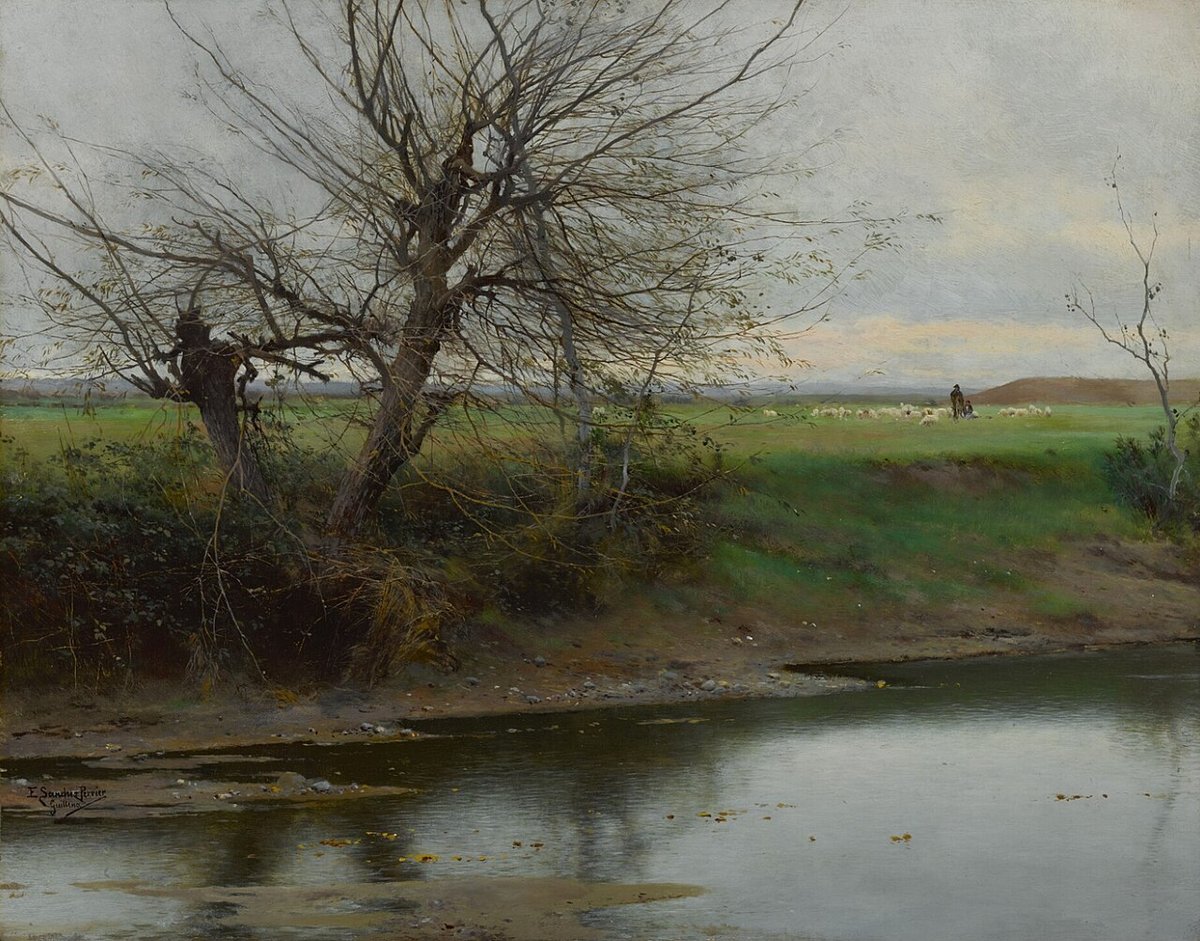
A short walk away from the last houses is enough for the sounds of the village to fade. The landscape around Alanís is typical of the Sierra Norte: holm oaks, cork oaks and open clearings where livestock graze.
On quiet days the most persistent sounds are distant cowbells and birds. Birds of prey often circle above these slopes, and it is common to see vultures gliding on the rising currents of air.
Autumn changes the atmosphere considerably. After the first rains, the ground fills with damp leaves and mushrooms begin to appear in different parts of the sierra. Foraging is a widespread activity in the area, though it is important to check the rules of the natural park and, above all, to know the species well before picking anything. The landscape becomes greener, the light softer, and the pace of life slows further.
Walking in the Sierra Norte
Several rural tracks and footpaths begin near the village, allowing for walks without extensive planning. Some circle the nearby hillsides; others venture deeper into the dehesa.
The routes do not involve major elevation changes, yet the terrain is uneven and summer heat can be intense from midday onwards. Starting early and carrying enough water is the sensible approach, as there are long stretches without shade. Conditions can shift quickly between seasons, so the experience of walking here depends as much on the time of year as on the path chosen.
The appeal lies less in dramatic landmarks and more in the steady presence of open land. The Sierra Norte around Alanís feels expansive rather than rugged, defined by its oak trees and broad views rather than sharp peaks.
Festivities and times of year
The best-known celebrations in Alanís are linked to the Virgen de las Nieves. In August, a romería is usually held in her honour. A romería is a traditional pilgrimage, often festive in character, in which an image of a saint or the Virgin is accompanied along country paths to a natural setting. On that day, the nearby tracks fill with people walking alongside the image as it is taken into its surrounding landscape. August also concentrates many of the village’s local festivities, bringing more movement to the streets.
During Semana Santa, or Holy Week, processions pass through the steep streets of the old quarter. The religious floats, known as pasos, move slowly around very tight corners, requiring careful manoeuvring at certain points. The combination of narrow streets and slopes shapes the rhythm of these processions, giving them a particular character.
Summer, especially August, brings more visitors and activity. Those who prefer a quieter atmosphere may find autumn or late winter more appealing. At those times the countryside is green, the air cooler, and the streets return to their usual tempo.
Getting there
The most direct way to reach Alanís from the city of Seville is typically via the A‑432 towards the Sierra Norte. The road passes through towns such as Constantina and Cazalla de la Sierra before continuing north. It crosses stretches of low mountain terrain with gentle curves, so an unhurried drive suits the setting.
Alanís does not try to draw attention to itself. It remains where it has long stood, resting against its hillside and surrounded by dehesa. The light changes, the seasons turn, and the village continues at its own pace.