Full Article
about Cazalla de la Sierra
Anise and brandy capital in the heart of the Sierra Norte, with a former Carthusian monastery turned into a landmark hotel.
Hide article Read full article
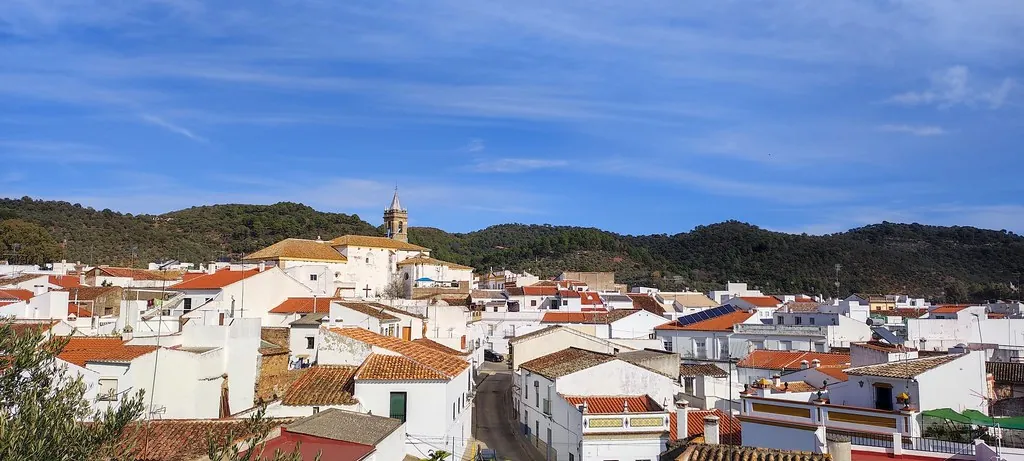
The smell of fresh grape must reaches you before the town comes into view. In September, along the winding road up from Constantina, trailers piled with tempranillo grapes head uphill, leaving a sweet trail in the air that mingles with the dry scent of holm oak. From the final rise, Cazalla de la Sierra appears like a stone ship anchored to the hillside: dark roofs, reddish brick towers and, beyond them, the rolling sierra stretching as far as the eye can see.
Tourism in Cazalla de la Sierra often begins in this quiet way, with the car descending slowly and the countryside and winery aromas drifting in through the window.
The taste of late afternoon
In the Plaza Mayor, beneath 16th-century arcades, tables start to fill as the sun drops behind the taller houses. It is the hour for anís, the local aniseed spirit. In Cazalla, aguardiente is part of everyday conversation. It is poured into small glasses that mist over as soon as they touch the table.
Sit in the shade along one side of the square and the scene unfolds at its own pace. Older women discuss local matters. Children run about with freshly cut fig branches in their hands. The air often carries the scent of crushed thyme and bread just out of the oven in a nearby house.
Now and then someone explains to a visitor how gazpacho serrano is prepared here. This version has nothing to do with the tomato-based soup many travellers know. It is made with stale bread, garlic, olive oil and cool water. The mixture is stirred until thick and pale, almost the same colour as the sun-bleached stone of the streets in summer.
Stones that speak of wine
The church of Nuestra Señora de la Consolación appears suddenly among narrow streets. If the doors are open, it is worth stepping inside for a moment and looking up. Light filters through the windows and falls across the floor in soft patches of colour. In the quiet, footsteps echo and little else disturbs the stillness.
Cazalla experienced periods of intense activity when wines and spirits from the sierra travelled downriver to Seville and from there out towards the Atlantic. That movement left its mark on the town. Walking along Calle Ancha, coats of arms can still be seen on some façades. Stone-carved grape clusters and weathered heraldic symbols hint at a prosperous past linked to vineyards and distillation.
Occasionally a large doorway stands half open, revealing deep courtyards that once housed bodegas. Inside, there is often a lingering smell of damp wood and old grapes, a sweetness that seems to cling to the walls for decades. The impression is not of a museum but of spaces that have simply shifted with time.
The mountain calls
In early August the sierra changes colour. The greens fade and the ground begins to crunch underfoot. These are the days when preparations start for the romería of the Virgen del Monte, a pilgrimage that draws people from Cazalla and many neighbouring towns.
The route up to the sanctuary fills with carts decorated with branches and groups setting off on foot before the heat becomes intense. Some walk barefoot as part of a promise. Close to the hermitage it is common to see small piles of stones left by pilgrims or stones thrown onto the hillside as they make a silent request. The dry sound of stone striking earth blends with the bells and the murmur of arrivals.
From up there, Cazalla looks small among the pinewoods. White houses cluster together, the bell tower rising above them, and beyond that the sierra dissolves into layers of blue. The perspective brings the town and its surroundings into a single view: settlement and landscape tightly connected.
Under the stars
When night falls, the rhythm slows dramatically. Streets empty and the orange glow of streetlights leaves façades half in shadow. From the Mirador de la Constitución, the sierra becomes a dark mass against the horizon. If the sky is clear, it is scattered with stars. This part of the Sierra Norte has little light pollution, something that becomes obvious as soon as you move a short distance away from the centre.
It is worth walking up towards the higher parts of town or along the tracks that lead out between the pines. The air carries the scent of rosemary and resin. In the ravines, dogs from nearby estates can sometimes be heard in the distance.
Early morning brings a gentle return to movement. A shutter lifts somewhere. A handful of cars pass along Calle Real. In the square, someone sits with a newspaper while the first sunlight brightens the white façades. The sierra often wakes beneath a faint pink mist that disappears once the day begins to warm.
When to go and how to arrive
Mid-September is a particularly evocative time to visit, when the grape harvest begins and the air smells of freshly cut fruit. August, especially at weekends, sees much more activity, largely because of the romería of the Virgen del Monte and the summer atmosphere it creates.
The simplest way to reach Cazalla de la Sierra is usually by car from Seville or from other towns in the Sierra Norte. Some stretches of road are narrow, though the dehesa landscape accompanies much of the journey and makes the approach part of the experience itself.