Full Article
about Gerena
Granite-quarry town with a mining tradition, set between the vega and the sierra.
Hide article Read full article
The Granite Underfoot
To understand Gerena, start with what lies beneath it. The town occupies a granite massif that supplied stone for Seville’s monuments and streets over centuries. This is not a distant historical fact. The material of the city, thirty kilometers to the southeast, came from here. The relationship is visible in the very fabric of the place.
The work defined generations. Older residents remember the sound of iron on stone and the fine dust that permeated everything. That legacy is in the ground you walk on and in the walls you pass. The town’s character is tied to this substance—solid, granular, and enduring.
Gerena rises on a hill west of Seville. Its location was strategic for quarrying, especially with the old Vía de la Plata route nearby. The Romans extracted stone here, and the practice continued with methods that changed little until the last century. Along sections of the Corredor Verde del Guadiamar, you can still see the geometric cuts of old quarry faces, the tool marks preserved in the rock.
The 19th century saw the most intense activity, driven by Seville’s growth and demand for paving and building blocks. By the later 20th century, deeper extraction became costly and concrete replaced granite for many uses. The trade faded, but its memory is kept in local collections that explain how stone was selected, split, and dressed for its journey to the city.
A Basilica in the Red Earth
Beyond the quarries, Gerena holds evidence of a different past. On its outskirts, mining operations in the latter half of the 20th century uncovered the remains of a Palaeochristian basilica. Excavations followed.
The structure dates from Late Antiquity, likely the 6th or 7th century. It had a basilical plan with spaces for worship and baptism. Sites like this help trace how Christian communities organised in the Guadalquivir valley after Roman administration ended.
What remains today includes sections of wall, patches of original flooring, and the baptistery area. The site is not reconstructed; you see the fragments as they were found. The setting is stark—red earth and scrubland, with the scars of modern mining nearby. The juxtaposition of ancient worship and industrial terrain is part of visiting.
Food for a Day of Labour
Local cooking was shaped by the quarry’s demands. Meals needed to be substantial for long days of physical work. Hearty stews like cocidos and potajes, simmered with chickpeas and ham bone, are still common.
In spring, foraging traditions surface. Collejas, a wild green gathered from oak woodlands, are sautéed with garlic and egg. They appear in homes and in some bars for a few weeks each year.
Another typical dish is menudo con garbanzos, a tripe and chickpea stew that requires slow cooking and patience. The recipes feel domestic, developed to feed families after a day defined by stone.
Gatherings Through the Year
Gerena’s calendar follows religious and seasonal rhythms. The romería de la Encarnación involves transporting the Virgin’s image from the parish church to a countryside hermitage. The procession is made with carts and on horseback, drawing families from across the municipality.
In summer, the town often holds a cultural velada, an evening of simple music and socializing in a square or courtyard. The event is less about spectacle and more about community.
A Practical View
Gerena is connected to Seville by a direct road. The historic centre is small enough to cover on foot.
Look at the architectural details: granite doorsteps, plinths supporting whitewashed walls, cobbles worn smooth. After rain, the stone can be slick.
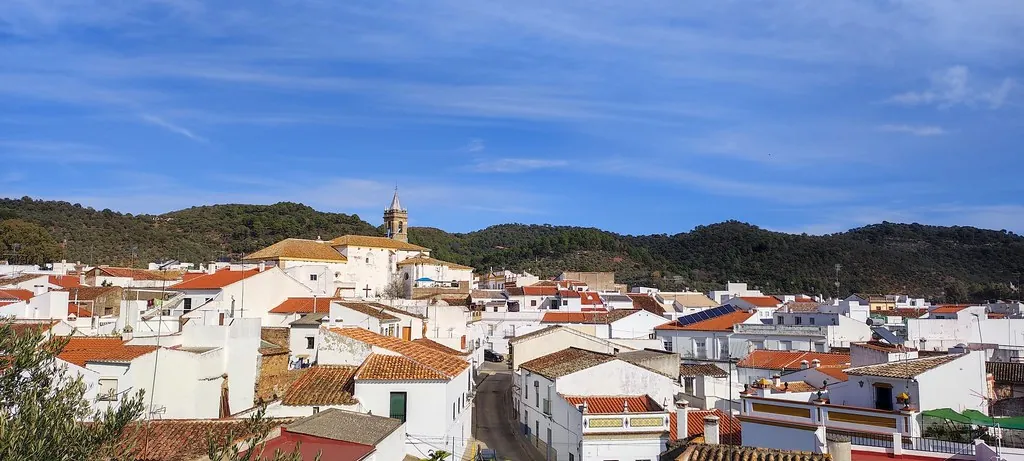
On the outskirts, old quarry fronts are still visible. From certain high points, you see Gerena spread across its hill, rooftops resting on the bedrock that built a distant city. There’s a local saying that Gerena is not so much a town as a quarry with houses around it. From that vantage point, the description holds.