Full Article
about Montellano
Set on the slopes of the Sierra de San Pablo, it offers sweeping views and ideal terrain for sports.
Hide article Read full article
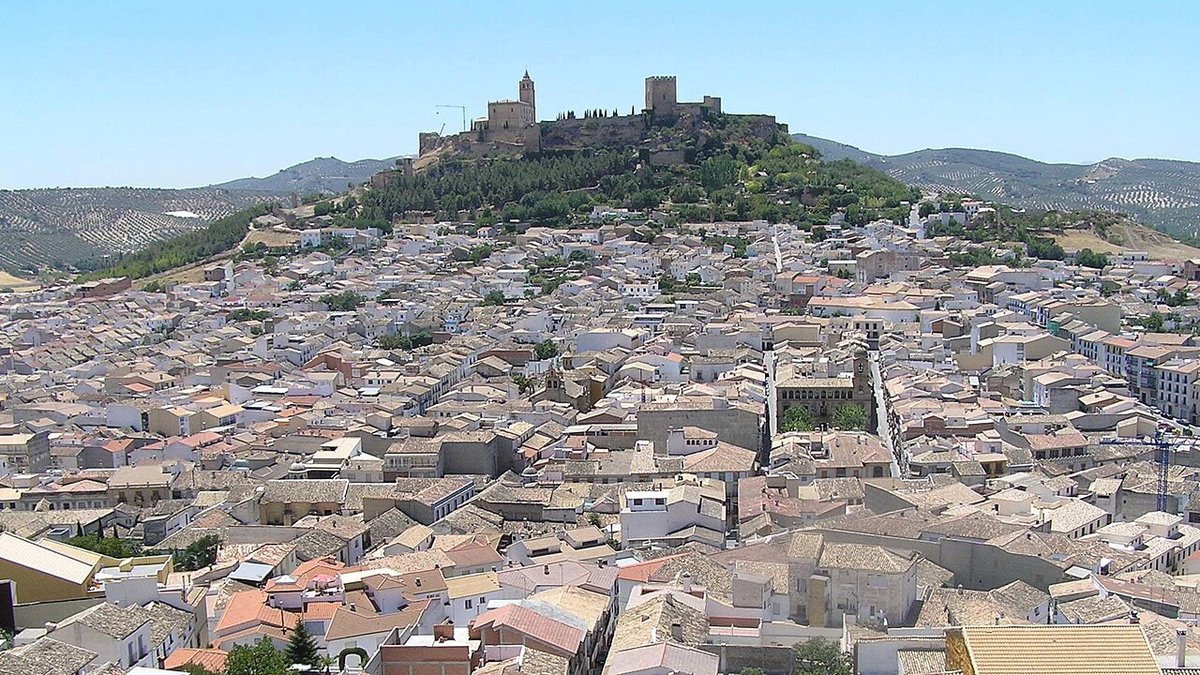
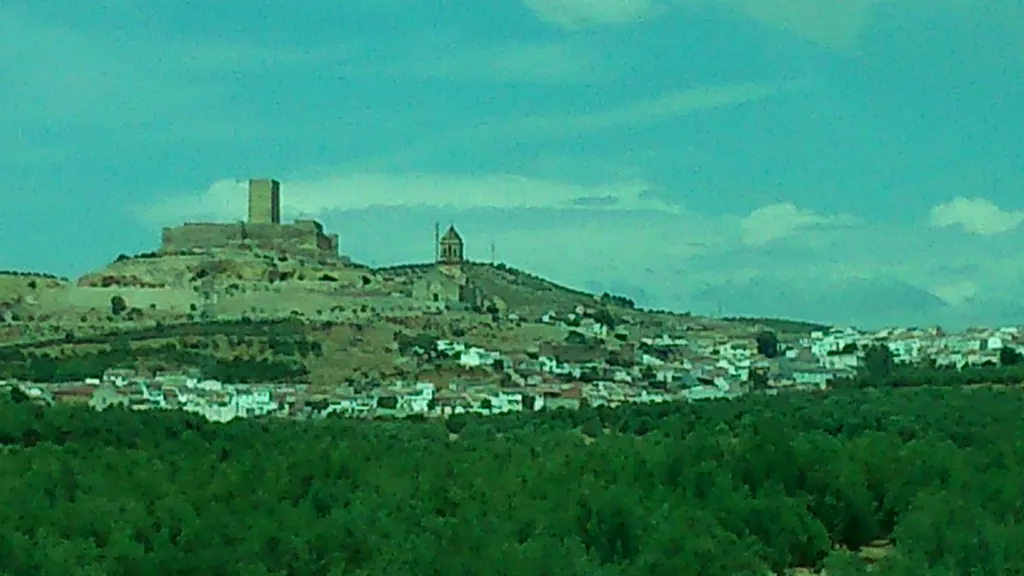
At nine in the morning, the sun is already warming the walls of the Castillo de Cote. From this height, the olive groves spread out in silvery green waves as far as the eye can see. The air carries the scent of hot earth and rosemary if brushed by hand when walking past. Down in the village, a bell marks the hour at an unhurried pace, as if the day were only just beginning.
The Tower That Was Not Round
The Castillo de Cote was built to watch over a frontier that now exists only in history books, the line that once separated Christian territories from the Nasrid kingdom of Granada. Alfonso X ordered its construction in the late 13th century, giving it an unusual design. Its four towers are not cylindrical but apse-shaped, as though a fortress had borrowed forms from a church. Many scholars cite it as one of the few examples of a four-apsed tower on the Iberian Peninsula.
The walk up from the car park near the sports centre is just over two kilometres. The path is straightforward at first, though the final stretch has loose stones and is best taken steadily. It is worth arriving early, when the light is still clear and the horizon opens out. Osuna appears in the distance as a white cluster, El Saucejo sits among pine trees, and on particularly clear days the outline of the Castillo de las Aguzaderas can be seen cut against the skyline.
The interior of the castle has been closed for some time for safety reasons. Even so, walking around its perimeter and looking out from the natural viewpoints along the hilltop makes it easy to understand why these ruins remain a reference point for the entire municipality.
Kilns and a Slow-Changing Town
For many years, Montellano also lived from lime production. In the surrounding countryside there are still caleras, stone kilns where limestone was burned until it became white powder. This lime was then used to whitewash houses and build walls. Some of these structures appear half hidden beside old farmsteads or along rural tracks.
Older residents say that when it rains, a faint scent of slaked lime and old smoke can still be noticed around certain kilns.
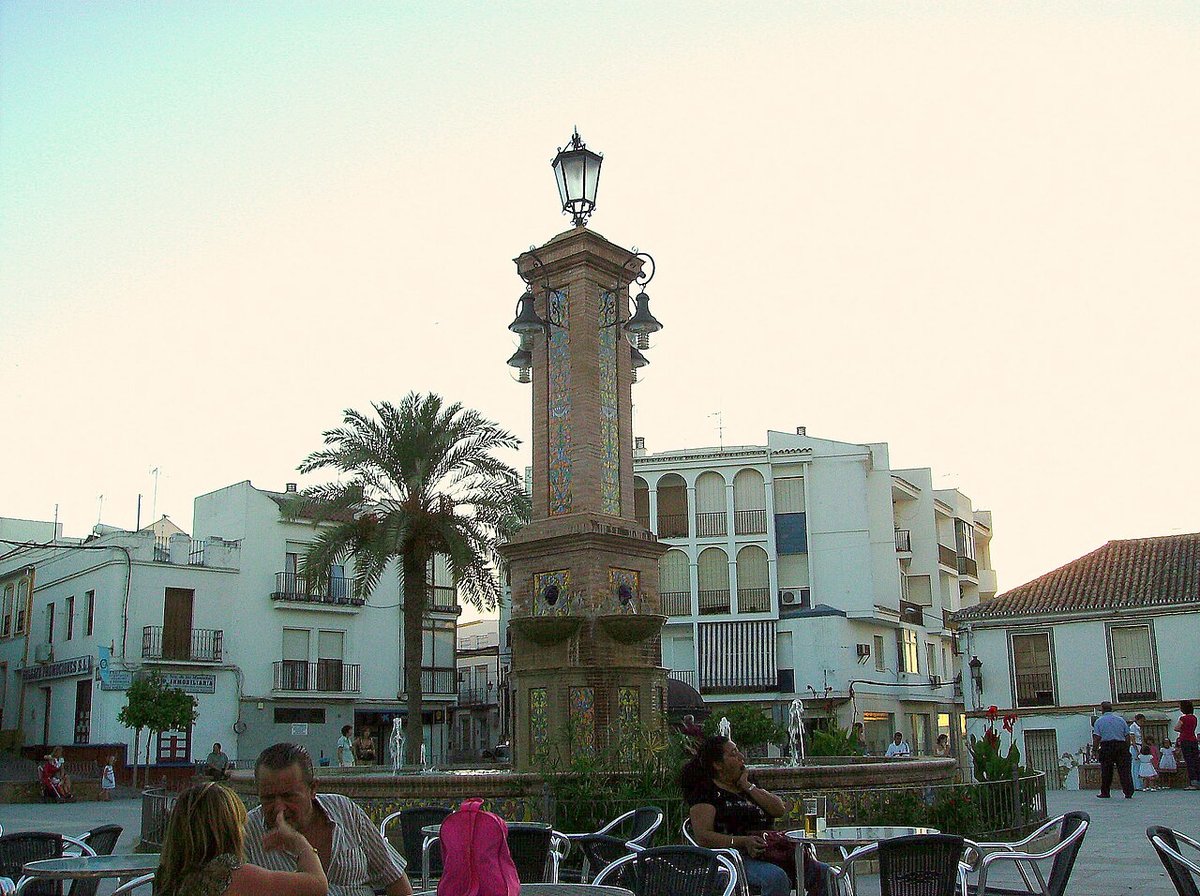
The town centre reflects a place that has changed slowly. Narrow streets, plain façades and shutters half lowered during the afternoon siesta give it a steady rhythm. In the main square, the bandstand still stands. It has been some time since music echoed there, yet the ironwork and octagonal roof continue to mark the heart of village life.
Rosemary on the Air in the Sierra de San Pablo
To the north rises the Sierra de San Pablo, a green wall that breaks the wind. It covers several hundred hectares of holm oaks, scrub oaks and Portuguese oaks. In spring, the air carries the scent of rosemary and thyme.
There is a circular route of around six kilometres that passes several natural viewpoints. It is not a demanding walk, but it invites a slower pace. Each bend opens onto another view of the valley. From the area known as the Cruz del Campanario, the whole municipality can be seen, divided into plots of olive trees that shift in tone depending on the light. Now and then a golden wheat field interrupts the grey-green pattern.
It is wise to bring water. Along the route there are few facilities beyond a recreational area at the start with stone tables. At weekends, families from nearby towns often spend the day here. During the week the silence feels more complete. At times the only sounds are the bells of grazing goats and the wind moving through the oaks.
Caldereta, Tomato Soup and Pestiños
In Montellano, cooking remains closely tied to the countryside. Caldereta de cordero, a lamb stew prepared with tomato, pepper and a touch of cumin, often appears at family gatherings or on special days. It is eaten with dense-crumbed bread that ends up soaked in the sauce.
In winter, sopa de tomate con huevo is still made, with the egg set directly in the hot broth. It is the kind of simple dish that smells of a kitchen in use from early morning.
Pestiños are most common during Semana Santa, the Holy Week before Easter. These small pastries are fried in olive oil and coated in honey. In many homes they are still prepared in large trays that pass from one family to another. One day it is your turn to cook, the next it is your neighbour’s.
May in the Countryside
In mid-May, Montellano shifts its focus to the countryside for the romería of San Isidro. A romería is a traditional rural pilgrimage and celebration, usually linked to a saint. Here it means carts, horses, outfits kept all year for the occasion, and plenty of shared food beneath awnings and canvas shades. The gathering point is usually the area known as Los Cepos, where the stream still carries some water in spring.
On that day, access is regulated. It is common to leave the car in designated areas at the entrance to the village or in nearby zones. From there, many people continue on foot or use the transport organised to reach the countryside.
Approach with respect and it rarely takes long to find a place at a long table. In Montellano, romerías still work like this. Someone asks if you are staying for lunch, and a plate appears without much ceremony.
Getting There and Choosing Your Moment
Montellano is approximately an hour…