Full Article
about Villanueva de San Juan
Small mountain town surrounded by nature, known for its campsite and the Corbones river.
Hide article Read full article
At ten in the morning, when the sun is already warming the whitewashed walls, the smell of fresh bread drifts out of the bakery and mingles with the dry scent of almond blossom. In Villanueva de San Juan, there is no rush. A man brings out his woven chair and sets it on the pavement, watching the street as if waiting for something to happen. The silence is broken only by the hum of a bee slipping between geraniums on a window ledge.
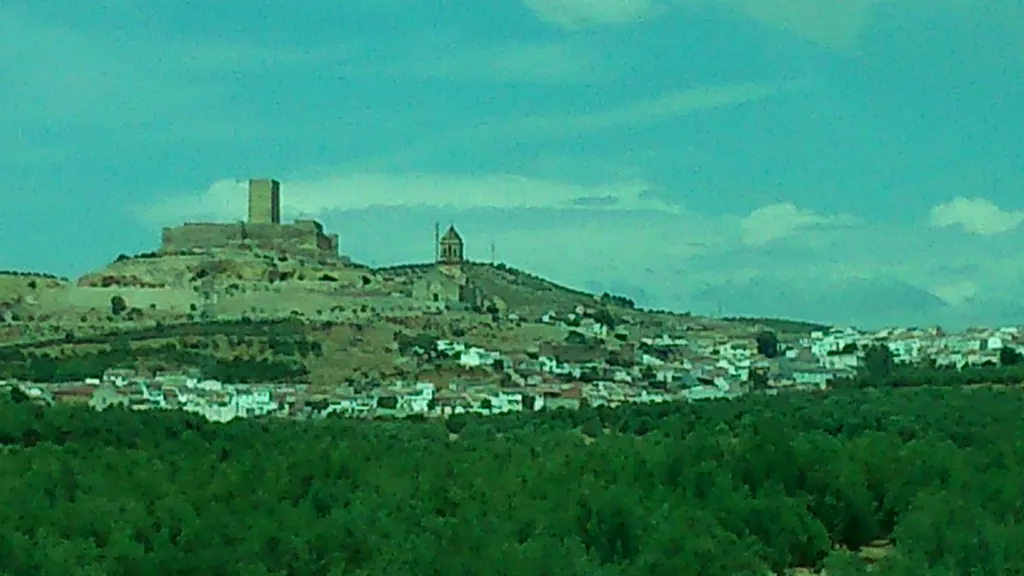
Villanueva de San Juan, in the Sierra Sur of Seville province, is small even by local standards. Fewer than a thousand residents live here, in a cluster of houses gathered around the main square and a handful of streets that quickly give way to open countryside. Life still follows the rhythm of the olive groves and the summer heat, which in July and August arrives hard and early, building from mid-morning.
The church left unfinished
The parish church of San Juan Bautista stands on the square with the air of a building shaped over time. Inside are three naves, a wooden roof and a clear light that enters through high windows, falling in bands across the floor.
On one side wall there is a relief of San Pablo Miki. It is not part of a large altarpiece or a grand composition. It looks more like a fragment saved from something larger. Locally it is known as “El Arriero”, because the spears of the martyrdom resemble the poles used by muleteers. According to local accounts, it may be the only remaining piece of an eighteenth-century Jesuit altarpiece. The rest has disappeared over time.
On the opposite wall, something much more recent appears: a mural portrait of an older resident, wearing a peaked cap and a calm expression. Similar paintings can be found on several façades around the village. They are not designed as part of a formal visitor route. They depict people from here: a woman in an apron, a boy with a bicycle, olive groves in the background. In places, the paint has begun to crack, but the colours still hold against the sun.
The stream once used by women
Following Calle de la Fuente eastwards, the asphalt ends without much ceremony and becomes a dirt track. From there, the path leads to the Arroyo de las Mujeres, a small ravine with reddish walls shaped by water over centuries.
There is little signposting. A narrow path runs between poplars, some juniper and clusters of rosemary that scent the air strongly in spring. After a wet winter, water still flows here, audible as it moves over the stones.
The name of the stream reflects what took place here decades ago. Women from the village came to wash clothes when the public washhouse was too crowded, or when they wanted some time away from the bustle of the square. No structures remain to mark those activities, but the stones in the streambed, worn smooth through use, still suggest that steady movement.
Footwear with a firm sole is advisable, as some sections can be slippery, especially after rain.
Cliffs above the village
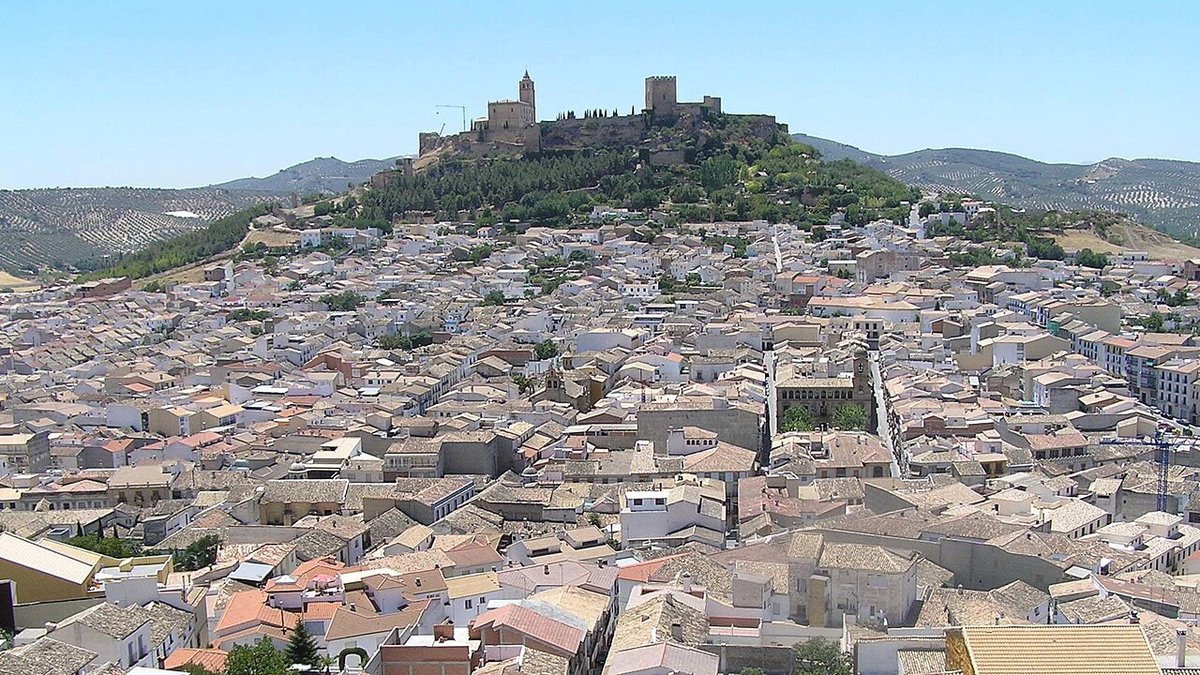
From Cerro Alto, the village comes into view all at once: roofs of curved terracotta tiles, the bell tower rising above them, and beyond, an expanse of olive groves stretching towards the hills of the Sierra Sur.
The climb is short. At an easy pace it takes around twenty minutes. The path crosses small terraces with almond trees and low scrub. When the almonds flower towards the end of winter, the contrast between white blossom and red earth is striking.
At the top are Los Tajos, vertical cuts in limestone rock. Tajo del Cirineo is the deepest in the area. When the wind blows, it slips through the cracks and produces a thin whistling sound that can be heard even before reaching the edge.
There are no railings or built viewpoints. Only the rock and an edge that requires care. Many locals walk up at sunset, when the sun drops behind the olive groves and the light softens.
When San Juan lights the night
The fiestas of San Juan are usually held around 24 June and last several days. The liveliest night is that of the bonfires.
People gather near the Puente de los Seis Ojos, an old bridge over the river Corbones that is no longer used for traffic. Firewood is piled up, often olive wood, and as night falls the bonfires begin to burn. The smoke carries the smell of dry wood and rosemary, while nearby there are pots and trays of homemade food.
There is no central stage or fixed programme. Each group organises itself: folding chairs, guitars, long conversations. As the flames die down and only embers remain, some people jump over them, following a custom common in Andalucía at this time of year.
In spring, weekdays tend to be quieter. At weekends the atmosphere becomes livelier, and visitors arrive from other parts of the region.
Accommodation is limited. There are few places to stay in the village itself, and during festival periods they tend to fill quickly. It is worth looking in nearby towns or asking ahead.