Full Article
about Fines
Marble industrial municipality; noted for its urban sculpture and greenway
Hide article Read full article
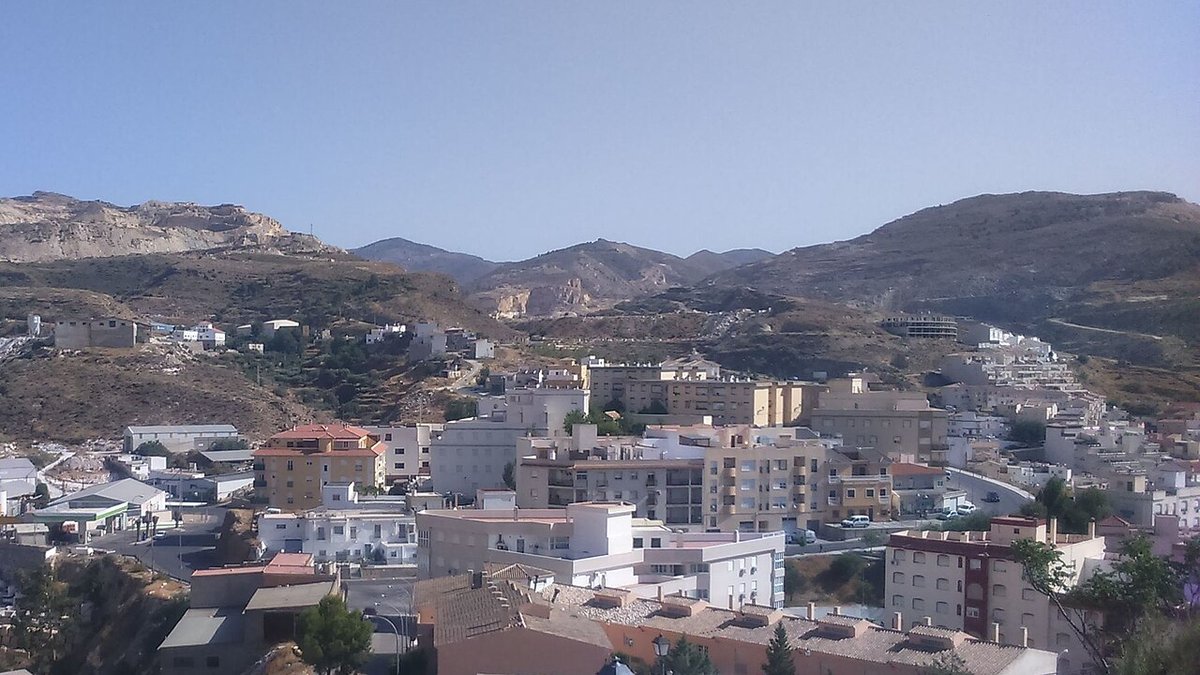
At seven in the morning, the dust from the quarry road hasn’t yet been stirred by traffic. It lies in a fine, pale layer on the leaves of the olive trees. In Fines, the first thing you notice is the light—it’s sharp, reflected off every white marble surface, from the boulevard to the window sills. This is a town built from its own mountain, and that fact isn’t just history; it’s the pavement under your shoes and the bright glare in your eyes.
The material changes the air. It holds the day’s heat long into the evening and bounces sound off narrow streets. There’s a dryness here that seems to settle in your throat, a mix of calcite dust and burnt olive wood.
The colour of the season
Come in February. That’s when the valley shifts. Almond trees bloom among the stark white quarry cuts, their pink and white flowers softening the industrial lines of the slopes. The light is milder then, and the sky holds that deep, clean blue particular to inland Almería, before the Levante wind begins to haze the horizon.
From the Cerro del Calvario, you see how it all fits together. The dark spread of olive groves is punctuated by those bright gashes of marble. Fines itself clusters tightly below, its streets narrow enough that passing someone often means stepping aside onto a slim marble curb.
A walk through worked stone
The town’s relationship with marble is most direct along the Museo de Esculturas al Aire Libre. It’s less a museum than a public boulevard lined with pieces carved from Macael stone. You’ll find a figure of Lorca, a woman with a basket, doves in flight. Many of the sculptors learned their trade in local workshops or quarries first. The work has a straightforward quality to it, an absence of fuss.
Late afternoon is when to walk it. The low sun throws long shadows that deepen the contours of the stone, highlighting a fold in a robe or the curve of a wing.
Up a slight incline sits the Iglesia del Rosario. Its exterior is plain, whitewashed and simple. Inside, the wooden Mudéjar ceiling resembles an upturned ship’s hull—a quiet, cool space that smells of old timber and wax. The door isn’t always open. Mornings or late afternoon are your best chance, and if it’s locked, asking at the nearest bar often yields someone with a key.
The greenway and what you hear on it
The Vía Verde de Fines follows an old mining railway track for about three kilometres. It starts near the rambla park and runs straight and flat between groves. Locals walk or cycle here in the evening when the heat breaks.
There are no grand viaducts. Its character comes from the rows of almond trees, the crunch of pale gravel underfoot, and the small seams of marble in the embankment that catch the sun. The path ends abruptly where a station once stood, now just an empty space and an informational panel.
Halfway along, once you’ve left the town’s noise behind, another sound carries across the fields: the distant, metallic clang and hum from the quarries. It comes in waves with the wind, a constant reminder of the work that still defines this place.
Practicalities: light and dust
You’ll need a car. Fines is reached from the A-7 motorway, turning off towards the Valle del Almanzora and following local roads that climb gently into town. Park on the outer streets; the centre is too tight for comfortable driving.
If you come in July or August, plan around the heat. The stone radiates well past sunset. Winter and early spring are easier. January through March brings those almond blossoms and clearer air.
Before rejoining the motorway, roll down your window. That fine, white dust hangs in the air at the valley’s mouth, carrying a dry, mineral scent that clings to your clothes. It’s the last trace of the place—the taste of its mountain.