Full Article
about La Granjuela
Quiet Guadiato village with a square dominated by a modern church and natural surroundings ideal for hunting and enjoying the countryside.
Hide article Read full article
A village shaped by its surroundings
Tourism in La Granjuela begins with a simple question: where exactly are you? This small municipality in the Valle del Guadiato, in the north of the province of Córdoba, sits among open dehesas and the gentle hills of Sierra Morena. Just over four hundred people live here. The landscape and the rhythm of rural life still set the tone for each day. It is not a place that has reshaped itself for visitors. If anything, the opposite is true.
The setting explains much of what follows. The dehesa, a traditional system of pasture dotted with trees, defines the horizon. Farming and livestock have shaped both the land and the habits of those who live on it. Time feels tied to daylight, to seasons, and to practical routines rather than schedules.
Streets, houses and the marks of history
The layout of the village is straightforward, reflecting its agricultural roots. Short streets, whitewashed houses and interior courtyards designed to cope with the summer heat form its basic structure. At the centre stands the parish church of Nuestra Señora del Valle. The current building is usually dated to the 18th century, although there may have been an earlier church on the same site.
It is not a monumental structure, yet it organises the space around it. The square, the nearby streets and much of daily life revolve around this point. For generations, the bell tower has served as an audible reference for work in the fields, marking time in a way that still lingers.
Some houses feature wrought-iron grilles and more elaborate entrances. These details hint at periods of greater economic activity. During the 19th century and the early 20th century, mining in the Valle del Guadiato brought movement and change to many nearby towns. La Granjuela felt that influence, although it never became a major mining centre.
Traditional homes are adapted to a demanding climate, with hot summers and cold winters. Thick walls, small openings and central courtyards helped regulate temperature and provided space for much of domestic life.
The dehesa and its quiet complexity
The surrounding landscape is an open dehesa of holm oaks, with some scattered cork oaks and patches of low scrub. Olive groves appear on the gentler slopes. It is a carefully worked environment, shaped over centuries by extensive livestock farming and cultivation.
There are no dramatic peaks or built viewpoints. Even so, the nearby hills offer a clear sense of the valley’s structure. From there, the view opens onto a mosaic of oak trees, fenced grazing land and plots of olive trees.
Autumn brings a different kind of activity. Many families head out to gather mushrooms. Níscalos, a type of saffron milk cap, grow in some nearby pinewoods, while gurumelos are well known across Sierra Morena. Mushroom picking here remains a domestic practice rather than a commercial one. It helps to know what to look for or to go with someone familiar with the land.
Paths that follow work, not tourism
The tracks around La Granjuela were not created as walking routes. They are working paths: livestock trails, access routes to farms and old connections between villages. Some can be explored on foot or by bicycle, though it is wise to get your bearings first. Asking locals or checking a map is the usual way to understand where they lead.
Wildlife tends to appear at the edges of the day. Roe deer and wild boar move through quieter areas, especially at dawn and dusk. Birds of prey are also a common sight, circling above the dehesa.
Scattered across the landscape are remains of the area’s mining past. Shafts, embankments and metal structures still stand as reminders of the Guadiato’s industrial history. They are not set up for visits, and many lie within private land, so keeping a respectful distance is important.
Food here remains closely tied to the agricultural calendar. In winter, hearty stews and migas, a dish based on fried breadcrumbs, are common. The traditional pig slaughter has long played a central role in family diets. In summer, lighter dishes such as salmorejo, a cold tomato-based soup, take over. Olive oil produced in the area is mostly consumed locally or in nearby towns.
Festivities and the rhythm of the year
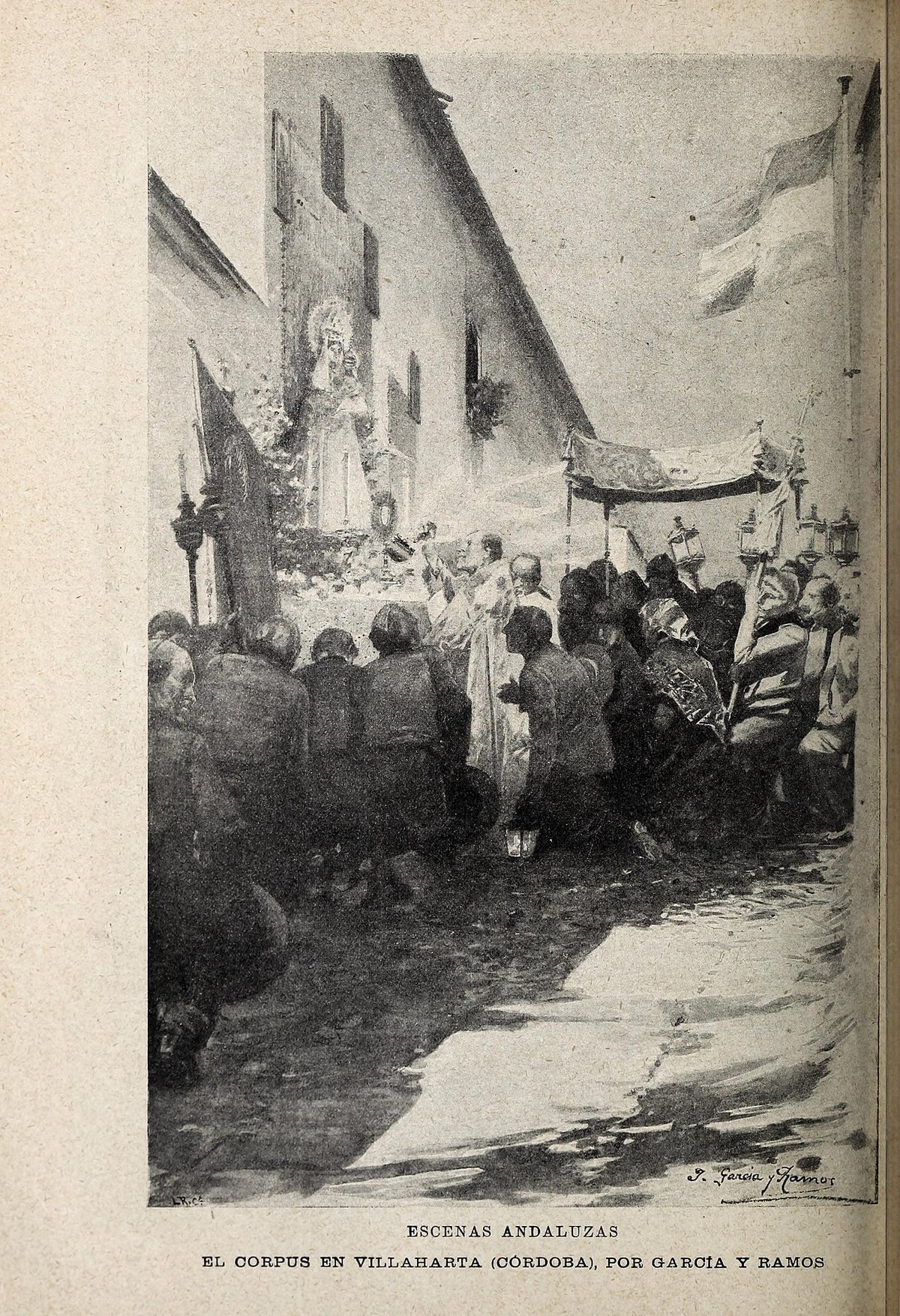
The most visible celebrations follow the religious calendar. The patron saint festival takes place in summer and often brings back residents who live elsewhere for a few days. It is a moment when the population briefly expands and the village feels more active.
Easter week, or Semana Santa, is marked with simple processions and short routes through the streets. The scale is modest, in keeping with the size of the village.
In autumn, attention shifts to the olive harvest. During the campaign, the pace of life changes. There is more movement of tractors, early starts for work crews and a steady flow between the countryside and the village centre. It is not an activity organised for visitors, yet it offers a clear view of how the local economy continues to function.
Reaching La Granjuela and choosing your moment
La Granjuela lies in the northern part of the province of Córdoba, within the Valle del Guadiato. The usual approach from the provincial capital follows roads that first cross open farmland before entering the hills of Sierra Morena.
Each season brings a slightly different perspective. Spring shows the dehesa at its greenest. Autumn comes with milder temperatures and the olive harvest. Summer can be intensely hot at midday, so walking is more comfortable early in the morning or later in the day. Here, the passage of time is still guided more by the sun than by the clock.