Full Article
about Sabiñánigo
Hide article Read full article
A town between factories and mountains
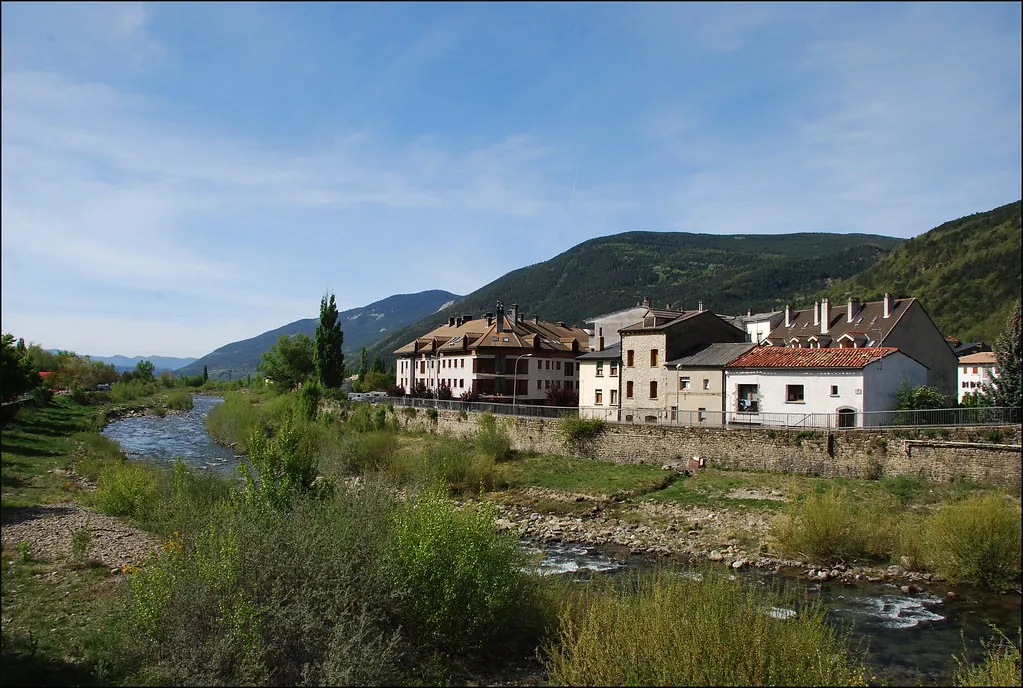
At seven in the morning, when the Gállego still carries a layer of mist along its surface, the first lorries cross Avenida de los Pirineos on their way to the industrial estates. Tourism in Sabiñánigo exists alongside that daily rhythm. This is a small town shaped by industry that also works as a gateway to the central Pyrenees.
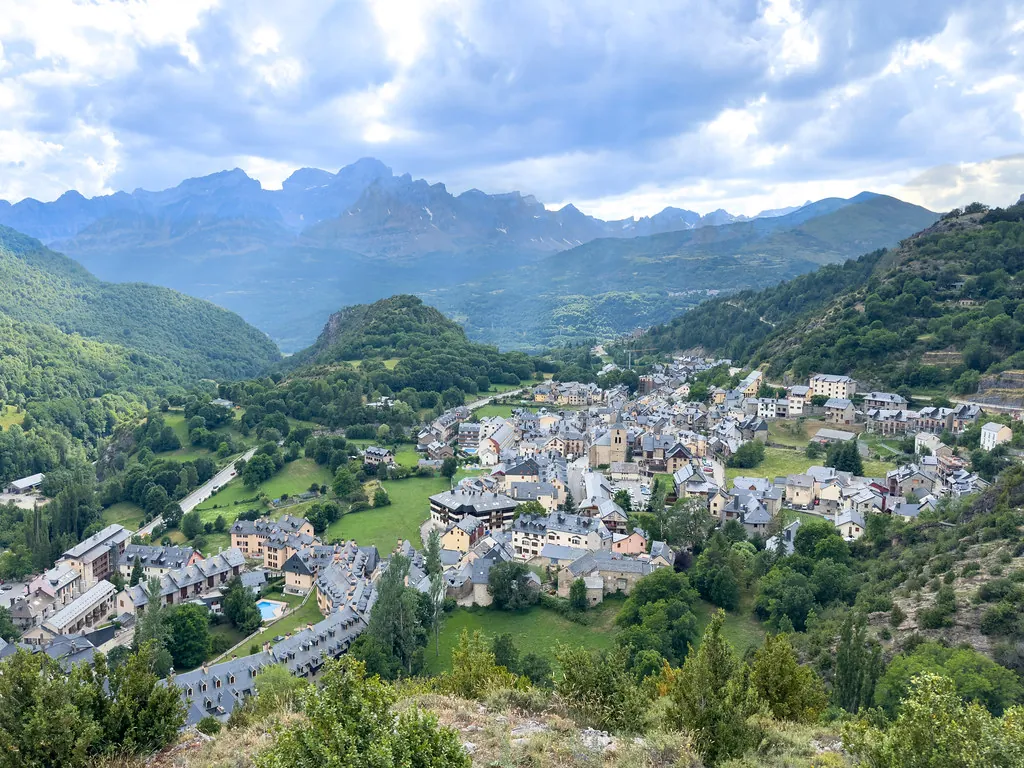
The municipality is large, covering more than five hundred square kilometres, and includes several villages that were administratively brought together in the mid-20th century. There is no single compact old quarter or carefully preserved mountain centre. Instead, Sabiñánigo is a place where people live and work while the valley moves at its own pace.
That sense of everyday life defines the visit. It is not a destination built around spectacle. It is a base, a lived-in town, and part of a wider landscape that gradually becomes more mountainous as you move further north.
From smoke to expansion
Modern Sabiñánigo grew alongside the chemical industry established next to the Gállego at the beginning of the 20th century. Those factories made use of the river’s energy and the nearby railway, and for decades they set the economic tempo of the area. Some chimneys still form part of the town’s skyline.
Before this industrial phase, there was only a small settlement documented in the Middle Ages as “Sabiniano”, linked to the sphere of the old monastery of San Victorián. Very little remains visible from that period today. One of the clearer traces is a historic building on Calle Mayor, known locally but now absorbed into everyday urban life as just another house.
The real transformation came in the middle decades of the 20th century. Sabiñánigo attracted families from across Aragón and neighbouring regions. That movement of people is still visible in the town’s layout: residential blocks from different eras stand alongside rows of brick workers’ houses, often with interior courtyards and small vegetable plots. In winter, stacks of firewood can still be seen.
This mix of architectural styles tells a straightforward story. Sabiñánigo expanded quickly, with practicality taking priority over uniformity, and the result is a town that reflects successive waves of growth rather than a single historical moment.
Serrablo churches across the valley
The municipality lies within the area associated with the so-called Serrablo Romanesque, a group of small rural churches scattered across Alto Gállego and nearby valleys. These buildings are modest in scale and, according to the most widely accepted interpretation, date from the 10th and 11th centuries.
They are easy to recognise once seen: simple apses, restrained decoration, and slender towers rising above meadows. Rather than forming a single site, they appear across villages and open countryside, often with little around them beyond fields and low hills.
A short distance from the main urban area, the village of Larrés houses the Museo de Dibujo inside its castle. This museum is dedicated to contemporary drawing, an unusual presence in a medieval setting. From there, several of the Serrablo churches can be reached in nearby villages.
It makes more sense to think of these churches as part of the landscape rather than as a conventional sightseeing route. Some remain closed much of the year, while others open occasionally in summer or during organised visits. In smaller villages, a familiar Pyrenean custom still exists: the key may be held by a local resident.
The experience is therefore uneven by design. There is no guarantee of access, and that uncertainty forms part of the character of the area.
Between science and industry
Santiago Ramón y Cajal, the Nobel Prize-winning scientist, spent part of his childhood in this region while his father worked as a rural doctor in the valley. There are no major landmarks tied to his presence, yet his biography recalls the Pyrenean landscape, which appears in some of his writings.
More than a century later, another name linked to Sabiñánigo emerged in a very different field. Javier Oliván became involved in the international development of Facebook and its expansion into multiple languages. The comparison between the two figures often surfaces in local conversation: two very different paths beginning in the same place, one long associated more with factories than with technology.
That contrast helps explain Sabiñánigo. Industry, valley life, and small historic villages all exist side by side, without any single element fully defining the town.
Winter fair in El Puente
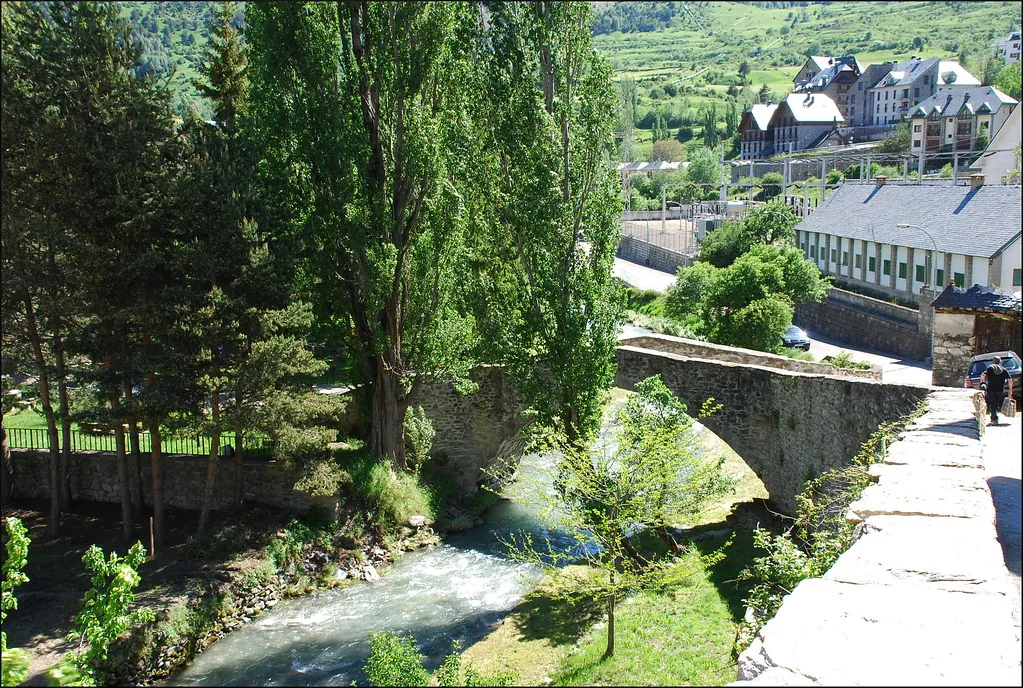
Across the river, El Puente de Sabiñánigo has a slightly different atmosphere from the main urban centre. This is where the traditional Santo Tomás fair takes place towards the end of December, when winter has firmly settled over the valley.
Stalls line the street with local products such as cured meats, bread from traditional ovens, sweets, and river fish. Large iron griddles are set up to prepare migas pastoriles, a hearty dish eaten standing up around improvised fires.
If snowfall coincides with the fair, which is common at that time of year, the mix of cold air and rising steam from the cooking creates a distinctly Pyrenean scene. It is a seasonal moment rather than a permanent attraction, shaped as much by weather as by tradition.
Getting there and around
Sabiñánigo sits on the route connecting Huesca with the central Pyrenees and is well linked by road to places such as Jaca and the Tena Valley. Its position makes it a practical base for moving further into the mountains.
Within the town, distances are manageable on foot. Reaching nearby villages or exploring the Serrablo churches is usually easiest by car.
Walks and local information
Around Sabiñánigo there are simple paths along the river and trails that climb towards the surrounding hills. These routes are used daily by residents for walking and running, forming part of everyday life rather than a designated attraction.
For up-to-date guidance, the local tourist office in Plaza del Ayuntamiento provides information on which Serrablo churches are open at any given time, along with routes across Alto Gállego.
Sabiñánigo does not present itself as a finished picture. It is a working town, shaped by its past and still in motion, where industry and landscape remain closely connected.