Full Article
about Puertomingalvo
Ocultar artículo Leer artículo completo
The thermometer on the hire-car dashboard reads 8 °C at midday in late April, even though Valencia’s beaches baked at 24 °C this morning. Puertomingalvo sits at 1,456 m, higher than Ben Nevis’s summit, and the air is thin enough to make the ears pop on the final switchback from the A-23. Stone houses huddle round a knife-edge ridge; beyond the battlemented tower the land falls away into pine-dark gorges that stay snow-dusted into May. This is Aragón’s roof, and it feels like it.
A village that grew downwards
Most Spanish hill-towns spread outwards as they prospered. Puertomingalvo had nowhere to go but down. The medieval core clings to the spine of rock; every lane tilts steeply and every doorway is one step lower than the last. Houses are built from the same grey-brown slate they stand on, giving the impression that the mountain has merely cracked open to let people slip inside. Wooden balconies jut over lanes barely shoulder-wide; if you stretch out both arms you can touch opposing walls and feel the stored cold of centuries.
Start at the only flat space in town, the Plaza Mayor, where bench-bound locals track strangers with unhurried curiosity. The 16th-century church of San Antón squats on the north side, its sandstone portal carved by masons who also cut the castle arrow-slits above. Inside, the air smells of wax and mountain thyme left by earlier worshippers; the altarpiece is gilded but the nave is bare stone, as if to remind visitors that faith here has always been a practical, weather-proof affair.
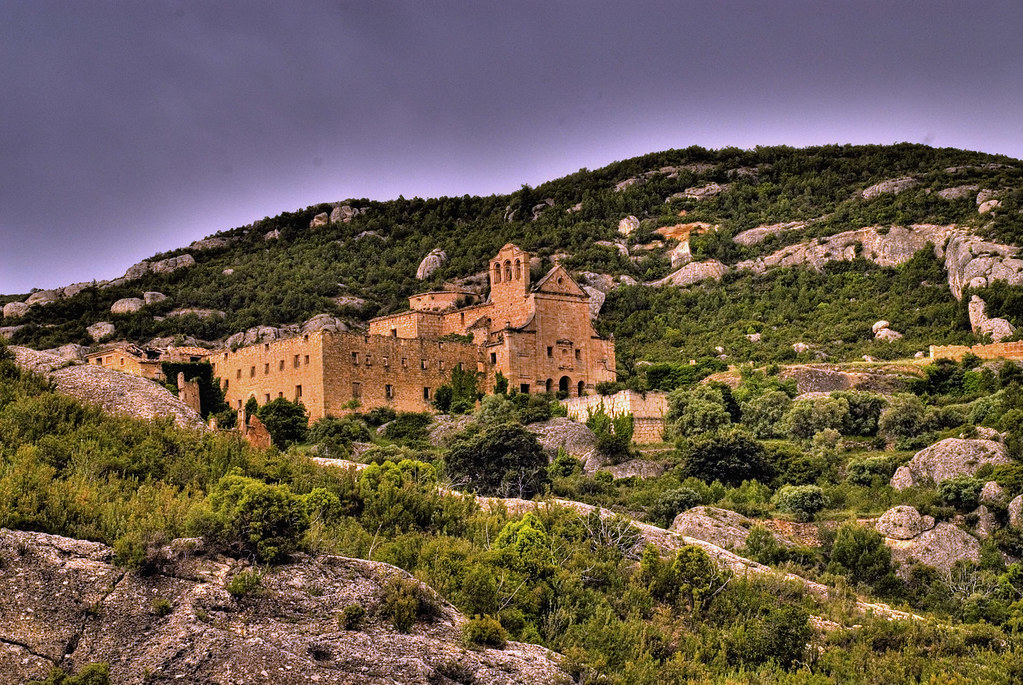
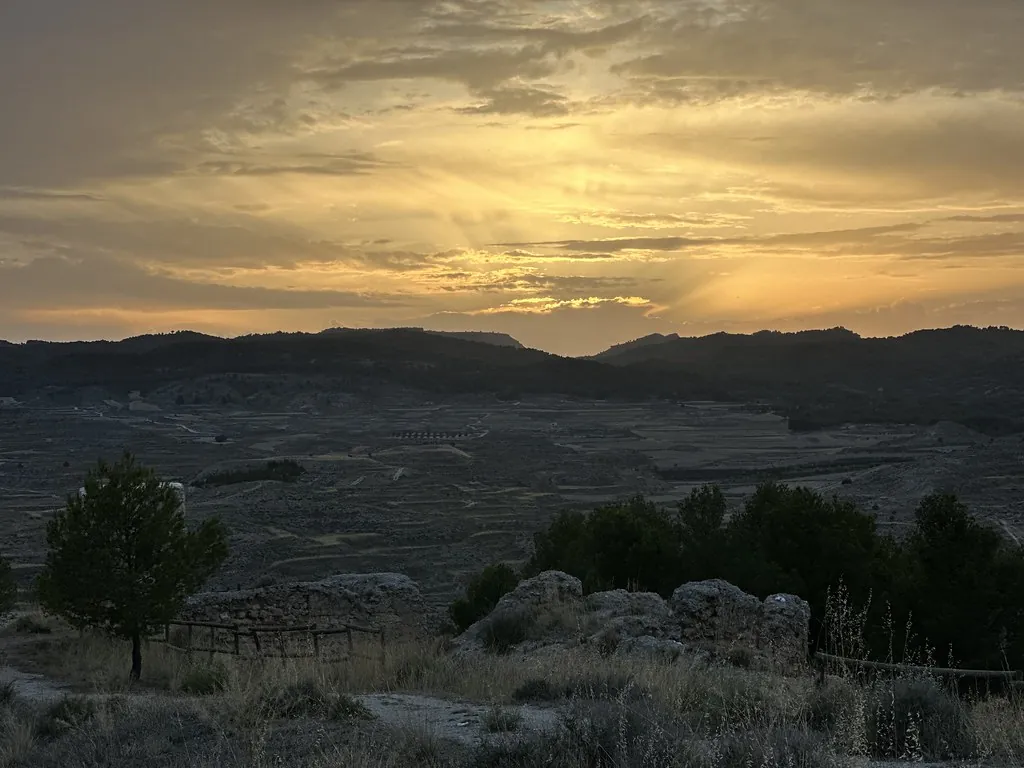
From the plaza a five-minute climb brings you to the castle gate. What looks like a single fortress is actually two: an 11th-century Moorish alcázar patched by Crusader-era Christians, then again by Napoleonic troops who needed a gun platform. The interior is open, unfenced and guardrail-free – Health-and-Safety Britain would have a conniption – but the payoff is a 270-degree panorama. On clear days you can pick out the aquamarine splash of Escurís reservoir 30 km south; more often the view dissolves into successive blue ridges until the sky takes over. Sunset is spectacular, yet even in August you may share the battlements only with a pair of red kites.
Walking tracks that bite back
The Sierra de Gúdar looks gentle from the café terrace; on foot it is all calf-burning ascents and sudden shale slips. Three waymarked trails leave the upper gate. The shortest (3 km, 45 min) loops to the Fuente de la Higuera, a stone trough where shepherds once watered mules; the water still runs drinkable-cold. The medium circuit (7 km, 2 h 30 min) climbs to the Ermita vieja ruins at 1,650 m, a natural balcony over the Javalambre ski slopes – white ribbons in winter, brown scars by July. Maps mark it “moderate”; the reality is a 350 m climb on loose scree, so carry more water than you think necessary.
Serious walkers can tackle the GR-8 variant that traverses to Mosqueruela (17 km one way), but the route crosses 1,900 m passes where snow can linger until late May. Phone signal dies within 500 m of the village; download the IGN 1:25,000 sheet beforehand or pick up a €6 paper map at the Bar Plaza. Stout boots are non-negotiable – the stone is sharp and the wind scours like sand-paper.
Food that sticks to the ribs
Back in the lanes the smell of wood-smoke and slow-cooked lamb drifts from doorways. Puertomingalvo keeps no frills restaurants, just two family bars that open when the owners feel like it. Order the ternasco – milk-fed Aragonese lamb roasted until the skin crackles like parchment yet the meat stays rose. A half-kilo portion (€18) feeds two; it arrives with only a dish of roasted peppers and a hunk of bread to mop the juices. Vegetarians can try migas aragonesas, breadcrumbs fried with garlic and pancetta, though asking for it “sin cerdo” provokes polite bafflement.
Local wine comes from the Bobal grape, a variety rarely bottled outside Valencia province. Expect bright cherry flavours and none of the throat-coating tanin that puts newcomers off Rioja. A glass costs €2.20; they’ll bring a free tapa of goat cheese from Mosqueruela, nutty and faintly citrus. Pudding choices are sponge cake or sponge cake – Aragón never got the memo about chocolate fondant.
When to come – and when to stay away
May and late September gift long, mild days and meadows speckled with wild crocus. Night temperatures still dip to 5 °C, so pack a fleece even if the car thermometer hit 30 °C on the coast. July and August are dry but rarely oppressive; 25 °C at noon can plunge to 12 °C the instant the sun slips behind the ridge. Winter brings proper snow: the access road is gritted, but chains may be asked for after 1,200 m and the village can feel cut off. The upside is silence so complete you hear your own heartbeat echo off the stone.
Avoid the second weekend of January unless you fancy joining San Antón’s romería: locals parade geese, dogs and the odd tractor to the church for blessing, then light a bonfire fuelled by old grapevines. It’s colourful, friendly and impossibly crowded – all 141 inhabitants plus emigrants back from Zaragoza – but every bed within 40 km is booked months ahead.
Getting there, staying over, getting out
The closest airports are Valencia (1 h 45 m) and Zaragoza (2 h). From the A-23 take the exit at Sarrión, then snake 38 km on the TE-11 and A-226. The final 12 km climb through pine forest is single-lane with passing bays; reverse into them when you see oncoming locals – they know every pothole by heart. Petrol and cash machines are 25 km behind you in Sarrión; fill both.
Cars must park in the signed outer lot – barrier opens at 8 a.m., closes 10 p.m. Overnight guests haul suitcases five minutes uphill; the cobbles laugh at wheeled luggage. Hotel EntrePortales occupies a 17th-century mansion inside the walls (doubles €70–€90, breakfast €8). Rooms have beams, wool blankets thick enough for a Yukon winter and, mercifully, modern bathrooms. The rooftop terrace faces west: bring a bottle of Bobal and watch the sun drop into Teruel’s endless forest.
Check-out time is noon, but most visitors are gone earlier, pointed towards the coast or the high-speed train in Zaragoza. Puertomingalvo has no souvenir to sell you, no music festival, no boutique hotels. What it offers instead is altitude – literal and metaphorical – a place where Spain’s familiar soundtrack of cicadas and cafe spoons is replaced by wind in the pines and the occasional clop of a neighbour’s donkey. Drive back down the mountain and within twenty minutes the thermometer climbs, the olive groves reappear and the 21st century rushes in. The village stays where it was, half in the clouds, half in the past, waiting for the next traveller who doesn’t mind a bit of vertigo with their history.