Full Article
about Balconchan
Hide article Read full article
Morning light over the fields
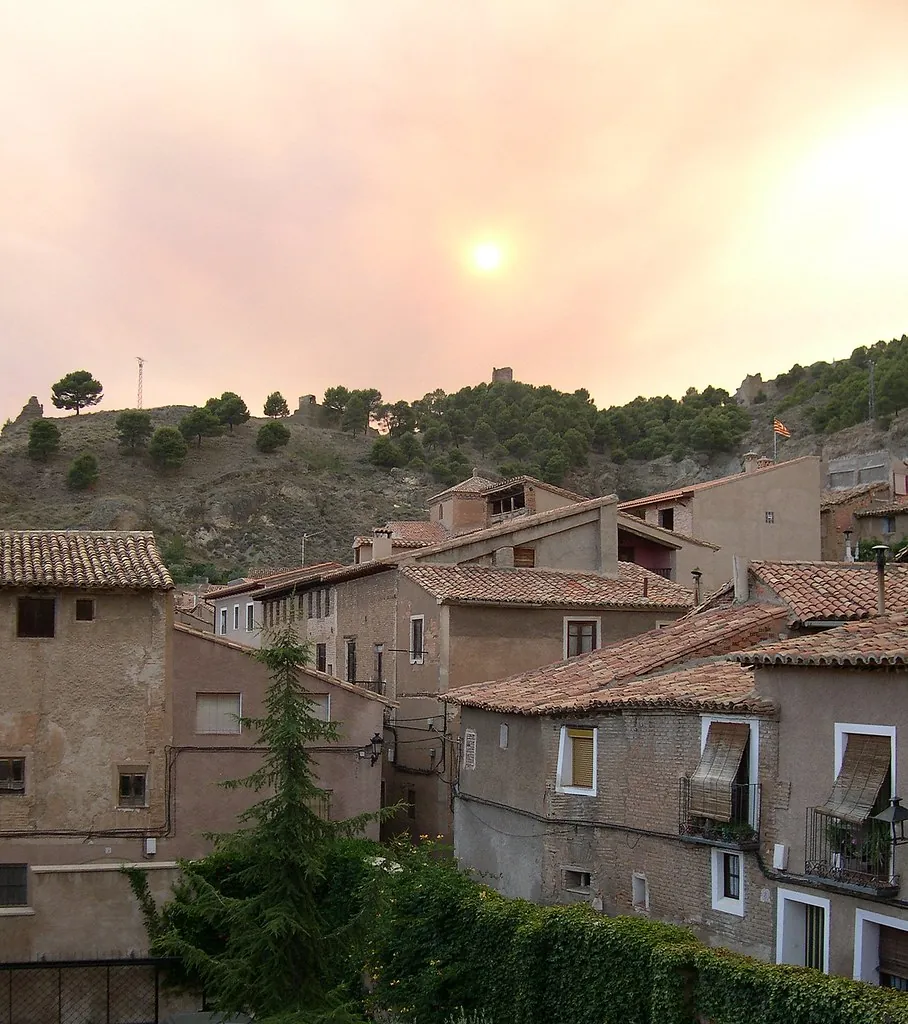
Early in the morning, the fields around Balconchán still hold the night’s moisture. Skylarks can be heard above the soft rustle of cereal crops shifting in a light breeze. The sun arrives low and almost horizontal, picking out the faded red roof tiles and pale stone walls that form the village’s small cluster of houses. At that hour, there is little else to hear apart from the occasional distant engine out in the fields.
Balconchán lies in the Campo de Daroca, surrounded by gently rolling hills where cereal dominates for most of the year. The village sits at around 780 metres above sea level and appears suddenly as the road approaches. A handful of streets, stone and rammed-earth walls, and animal pens attached to homes define the layout, along with a quiet that belongs to very small places.
Only a few residents live here throughout the year. Time moves slowly, which is noticeable in the closed doors, half-lowered shutters, and the sound of wind slipping through the streets as evening approaches.
Traces of a rural past
The most noticeable building is the parish church, rising slightly above the houses. It has a simple form, with pale walls and a square bell tower that can be seen from the surrounding paths. It is not large, yet it acts as a reference point when approaching across the fields.
A slow walk through Balconchán reveals details that show how the village has been built over time. Some stone doorways are more carefully finished than the surrounding walls. Thick wooden doors still carry old nails, and iron grilles have bent slightly over the years. In places, wooden eaves extend out over the street, casting shade during the summer months.
The landscape changes noticeably with the seasons. In spring, the hills turn green and the wind moves through the cereal like water. Summer shifts everything towards gold, and the smell of dry earth lingers in the air, especially in the evening. From any small rise nearby, the patchwork of fields, farm tracks and the occasional isolated pen becomes clearly visible.
Walking the open tracks
Several dirt tracks leave directly from the village, used by farmers to reach their land. These same paths are also used by anyone wanting a walk through the surrounding countryside. There is no formal signposting, but it is difficult to get lost. The terrain is open, and landmarks can be seen from a distance.
The ground is mostly flat or gently sloping, which makes walking easy. Shade is scarce, so carrying water is advisable. In summer, the sun becomes intense from midday onwards, so it is better to walk early in the day or later in the afternoon.
Wildlife is part of the experience here. Partridges often take flight from the edges of fields, and birds of prey can be seen gliding overhead when the air begins to move. As the day draws to a close, the light turns low and warm, colouring everything in ochre tones. Silence is never absolute, but it comes close.
When Balconchán fills again
For much of the year, Balconchán remains very quiet. Summer brings a noticeable change. Families who have homes here return for a few days, and the village fills again with voices in the streets, cars parked by the façades, and lights appearing at dusk.
Local patron saint celebrations usually take place during this period. These are small-scale events, organised by residents and those who return for the occasion. A procession forms part of the festivities, along with shared meals and music in the square or another open space within the village. The atmosphere shifts compared to the rest of the year, though it remains firmly local in character.
Reaching the village and choosing the moment
From Zaragoza, the journey is roughly one hundred kilometres. The usual route heads along the motorway towards Teruel, then continues through the Daroca area on smaller roads that cross open countryside for several kilometres.
Spring and autumn are often the most comfortable times to visit, with milder temperatures and a landscape that shows more contrast in colour. Summer brings strong heat in the middle of the day, so it makes sense to plan around the cooler hours. Winter can be harsher than it appears from a distance, with wind and cold making themselves felt.
Balconchán does not offer major monuments or developed tourist activity. It is one of the villages in the Campo de Daroca where what stands out is a different pace of time: open land, few houses, and the sense that the day unfolds slowly.