Full Article
about Valdehorna
Hide article Read full article
A village that wakes slowly
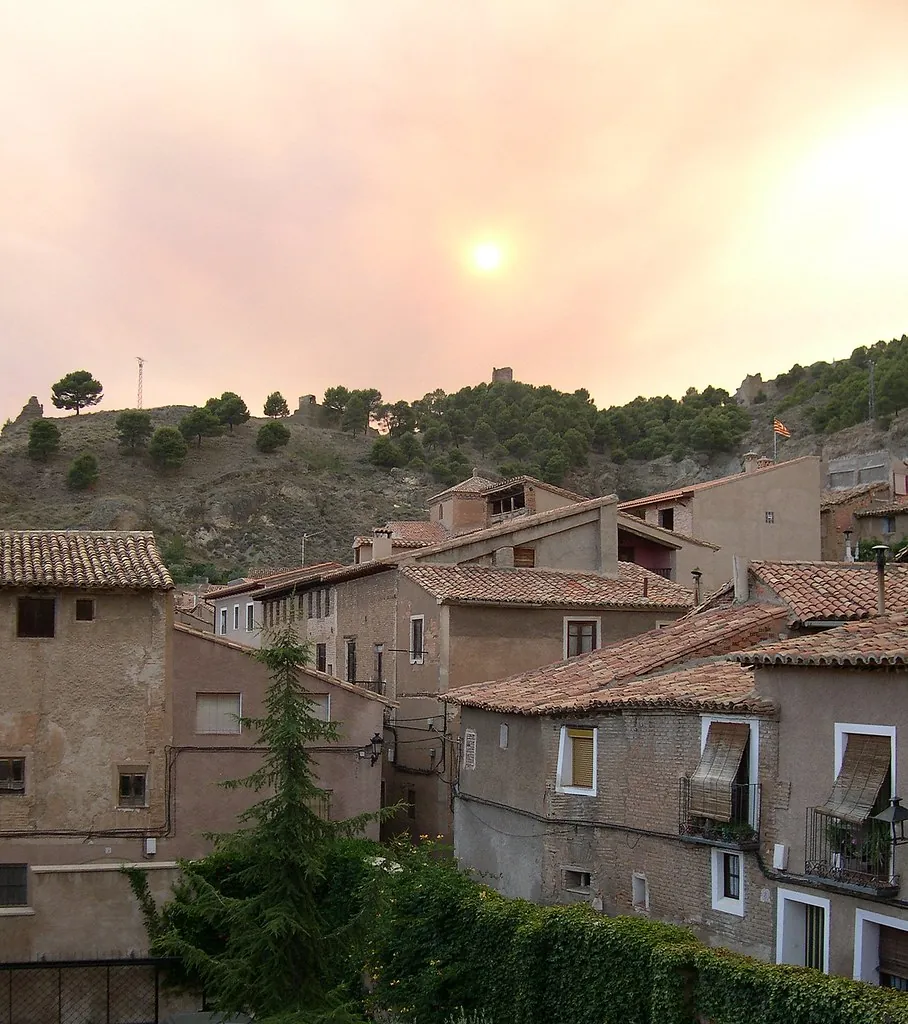
Early in the morning, when the cold still clings to the stone, Valdehorna feels almost empty. A door opens somewhere, a shutter drops with a sharp sound, footsteps echo along a narrow street. This small village in the Campo de Daroca, with only a few dozen residents throughout the year, keeps a way of life that has never quite disappeared. Thick-walled houses and reddish roofs hold on to routines shaped more by season than by schedule.
The approach already sets the tone. A minor road leaves the main route and runs through open farmland. In summer, cereal crops spread a dry yellow across the landscape. In winter, the ground lies bare and the wind becomes more noticeable. As the village comes into view, façades of stone and adobe appear in muted tones, ochres and greys that shift with the changing light of the afternoon.
Stone, wood and traces of the past
At the centre stands the parish church, its masonry tower worn down by time. It is not large, yet it is visible from almost anywhere in Valdehorna. Inside, there is usually a baroque altarpiece with faded gilding and aged paint, workshop pieces that recall periods when even small communities devoted considerable effort to their church.
The village can be crossed in a matter of minutes. Streets are short and sometimes gently sloped. Houses follow a traditional structure, with stone walls, small windows and heavy wooden doors. On some façades, carved coats of arms can still be made out, signs of former family homes with a certain standing in the area. Between the houses are barns and stables, some still in use, others adapted for storage.
Beyond the built-up area, the landscape shifts with the seasons. Holm oaks and Portuguese oaks remain scattered across the nearby slopes. As evening falls, the sound of a tawny owl is not unusual, and rabbits can be seen darting across the edges of fields.
Paths that link past and present
There are no marked routes or interpretive panels here. Instead, there is a network of agricultural tracks and footpaths that have connected Valdehorna with neighbouring villages for decades, probably centuries. Some follow the course of old livestock routes or access ways to orchards and fields.
With a map or a mobile GPS, it is straightforward to walk these tracks without much difficulty. Along the way, wells, small springs and watering troughs appear from time to time, reminders of how water was managed before modern systems were put in place.
Climbing any of the low rises nearby opens up the view towards the Jiloca valley. There is no formal viewpoint, just a higher point in the terrain from which kilometres of fields and gentle hills can be seen. On clear days, the horizon stretches further than expected on arrival.
Time measured by walking and light
Valdehorna has no infrastructure designed specifically for tourism. That absence shapes the experience. Walking here is simple because nothing is prescribed. There are no fixed routes, no suggested itineraries. The idea is to follow a path and see where it leads.
At night, the sky is often very clear. Street lighting is minimal, and moving just a short distance away from the houses is enough to see the stars with clarity. In winter, preparation matters. The cold in this part of the Campo de Daroca drops quickly once the sun sets.
For those interested in photography, details are everywhere. Weathered wood on doors, walls marked by fine cracks, old chimneys rising above the roofs. The low light at sunset brings out these textures with particular intensity, shifting the tones of stone and earth.
Traditions that still bring people together
Local celebrations remain closely tied to those who keep a connection with the village. August tends to bring more activity, when families return who still own houses here or maintain links to Valdehorna.
In January, the feast of San Antón is observed, traditionally associated with the protection of animals. During Semana Santa, or Holy Week, simple processions and acts take place through the streets, adapted to the actual scale of the village.
Autumn often brings quieter forms of collective work. Some residents take the opportunity to repair paths, clean springs or check stone walls. These are modest tasks, yet they play a role in maintaining the place year after year.
Reaching Valdehorna and choosing the moment
From Zaragoza, the usual route is to follow the A-23 towards Daroca. From there, a stretch of regional road crosses the open landscape of the Campo de Daroca before reaching Valdehorna.
In winter, checking the forecast is advisable. The area can experience dense fog or patches of ice on particularly cold days. Spring and early autumn are generally pleasant times for walking in the surroundings, when the colours of the fields shift and the wind is less sharp than in midwinter.