Full Article
about Alba
Hide article Read full article
Early in the morning, when the sun still arrives at an angle, the stone of Alba’s church takes on a pale, almost dusty tone. There is barely any sound in the street: a door opening, a car engine starting slowly, wind moving down from the surrounding fields. Alba, in the province of Teruel, is one of those villages where the day begins unhurriedly and silence feels like part of the landscape.
It sits not far from the city of Teruel, about half an hour by car, reached along secondary roads that cut through wide cereal fields. In winter the land looks rough and ochre. In spring the colour shifts and everything softens, turning greener across the open ground.
The church above the village
The parish church of San Pedro is visible from almost anywhere in Alba because it stands at the highest point. It is not monumental, yet it shapes the layout around it: streets climbing upwards, façades facing the tower, a small open space where the light falls directly in mid-afternoon.
The entrance is simple, with a semicircular arch, and the tower carries a clock that still marks the village hours. When the bells ring, something that continues as part of daily life here, the sound travels quickly across the flat terrain beyond.
Short streets, stone and timber
The centre can be covered in a short walk. Houses combine rough stonework with sections of adobe, and many still keep old doorways, some worn smooth by decades of use. Wrought iron grilles appear on windows, and wooden galleries shelter entrances from the strong summer sun.
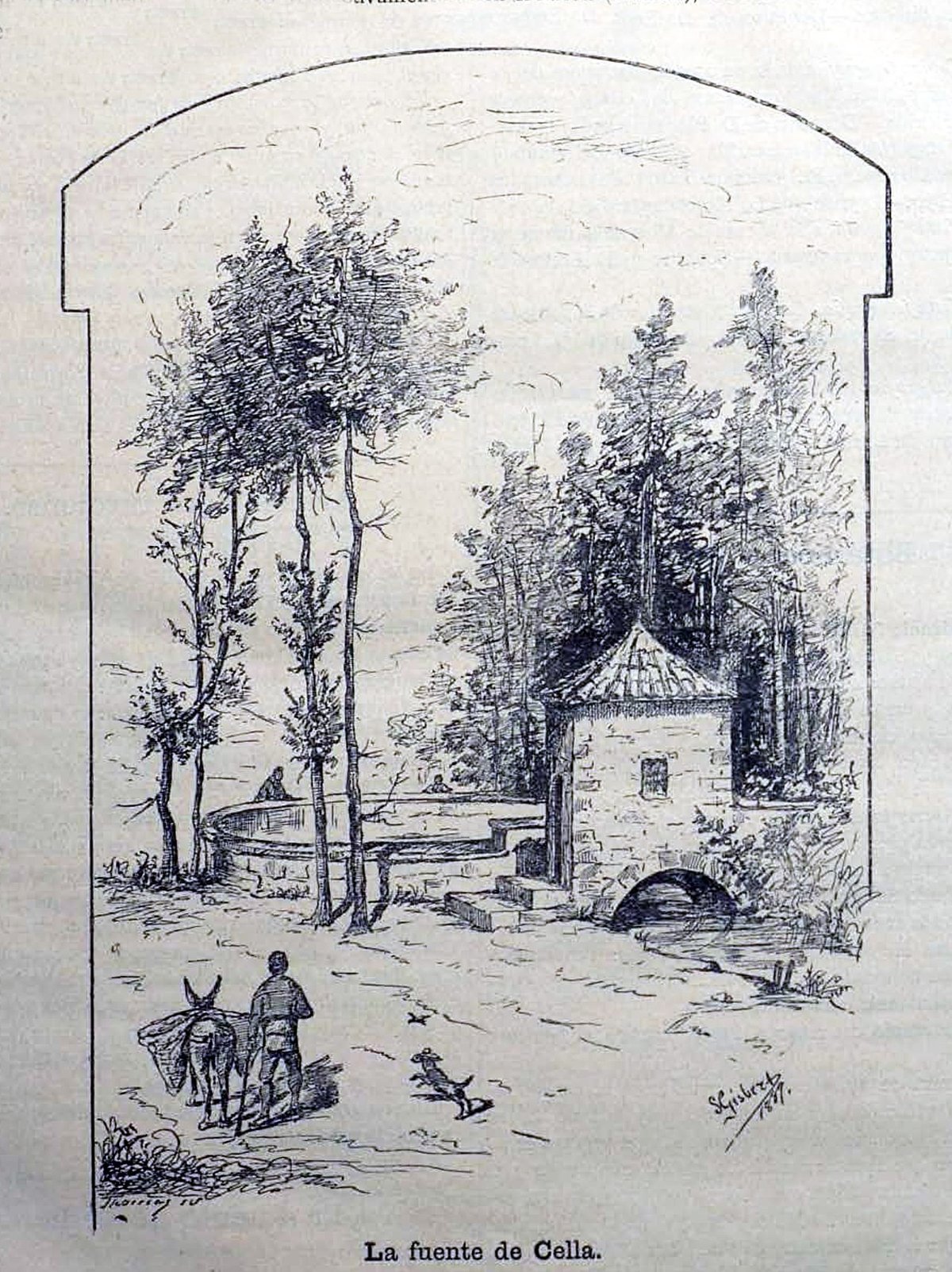
In the small square there is a stone fountain that is still used, especially during the hotter months. Nearby are corrals and former agricultural workspaces. They are easy to miss if walking quickly, yet they say a great deal about how life here was organised.
The landscape around Alba
Beyond the village the land opens into gentle hills and large cultivated plots. There are no dense forests or nearby mountains. What dominates is a long horizon of cereal fields, broken by scattered trees and dirt tracks crossing the farmland.
At sunset the place changes noticeably. The ploughed earth turns reddish, and the stone walls of the village appear rougher, with shadows picking out every uneven surface.
For those who enjoy walking, several agricultural tracks leave from the village and link to nearby places such as Alfambra or Villarquemado. They are not always marked as formal routes, so it is worth carrying a map or using an app with offline maps, as mobile coverage drops in some stretches.
Food from inland Teruel
The cooking found here follows long-standing traditions: substantial dishes suited to field work and cold winters. Migas with garlic and chorizo are common, a dish of fried breadcrumbs mixed with pork and seasoning. Lamb stews from the area also feature regularly.
During mushroom season some locals head into nearby hills to look for níscalos, a type of saffron milk cap, though exact spots are rarely shared. Traditional cured meats remain part of daily food, including longaniza and chorizo, made with recipes very similar to those used decades ago.
Local life and celebrations
The village festivals keep a distinctly local feel. Around the feast of San Pedro there are religious events and gatherings in the square, and across the year other moments tied to the agricultural calendar appear, such as the olive harvest.
These are not celebrations designed to draw visitors from afar. They are days when people who have moved away return for a few hours or a few days, reconnecting with the place.
When to come
Spring and autumn are usually the most rewarding times to visit Alba, with milder temperatures and fields showing more contrast in colour. In summer the midday sun is intense, and the village becomes very still for several hours.
A visit works best without rushing: park, walk through the streets, then head out along one of the tracks that circle the village and pause to look across the horizon. In a place like this, much of what there is to see does not sit in a single building but in the relationship between the village and the land that surrounds it.