Full Article
about Anadon
Hide article Read full article
A village shaped by distance
Tourism in Anadón is closely tied to its isolation. This small settlement in the Cuencas Mineras region of Teruel sits on the lower slopes of the Sierra de Cucalón, in a landscape of hills and ravines where the population has been shrinking for decades. Today, the official register lists only a little over thirty residents. The village still reflects the character of many agricultural communities in inland Aragón: compact, restrained and closely connected to the land around it.
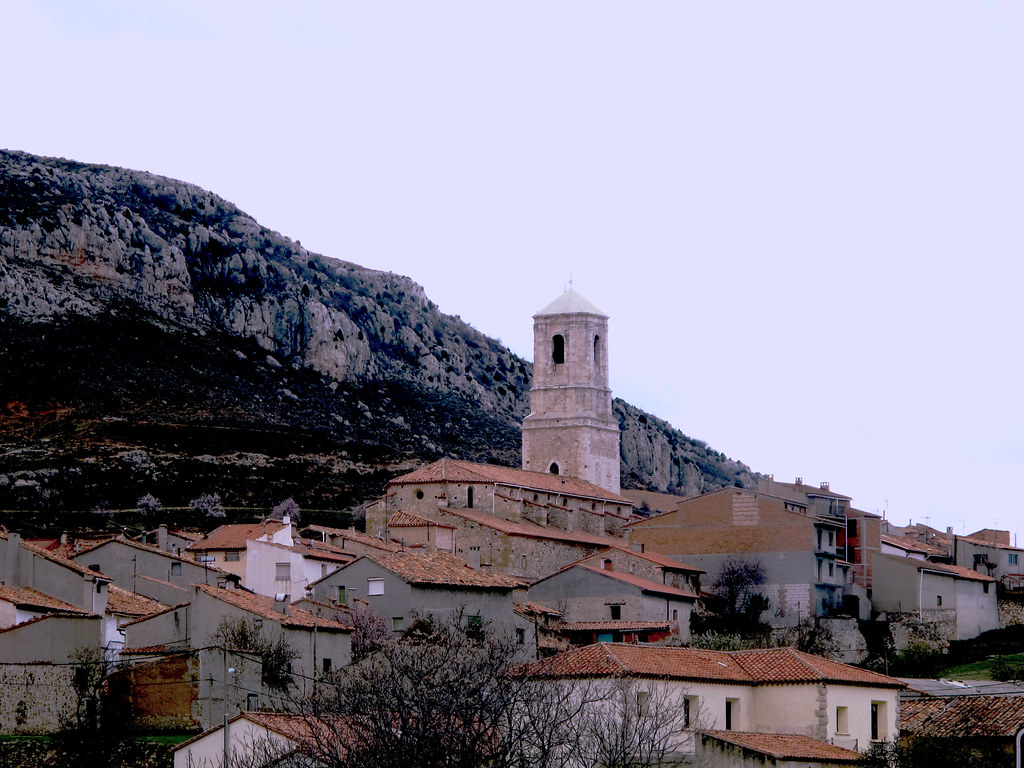
The layout follows the incline of the hillside. A single main street runs through the centre, with houses arranged along either side. These are built in masonry, some with carefully worked doorways and iron balconies. Many date from the eighteenth and nineteenth centuries, a time when farming and livestock were still central to daily life. Later alterations can be seen on several façades, showing how homes have been adapted over time while keeping their original structure largely intact.
From the edge of the village, the view opens onto a terrain marked by scrubland, old fields and deep-cut ravines. Holm oaks, scattered oaks and low vegetation cover much of the surrounding area. This is a landscape shaped over centuries by traditional land use. Small plots were cleared and cultivated, while the surrounding hills provided firewood and grazing.
San Miguel Arcángel at the centre
The parish church, dedicated to San Miguel Arcángel, stands in one of the central spots in Anadón. The current building largely reflects alterations carried out in the modern period, probably during the eighteenth century. This type of rebuilding or expansion was common in rural parishes across the region, often replacing earlier structures or enlarging them.
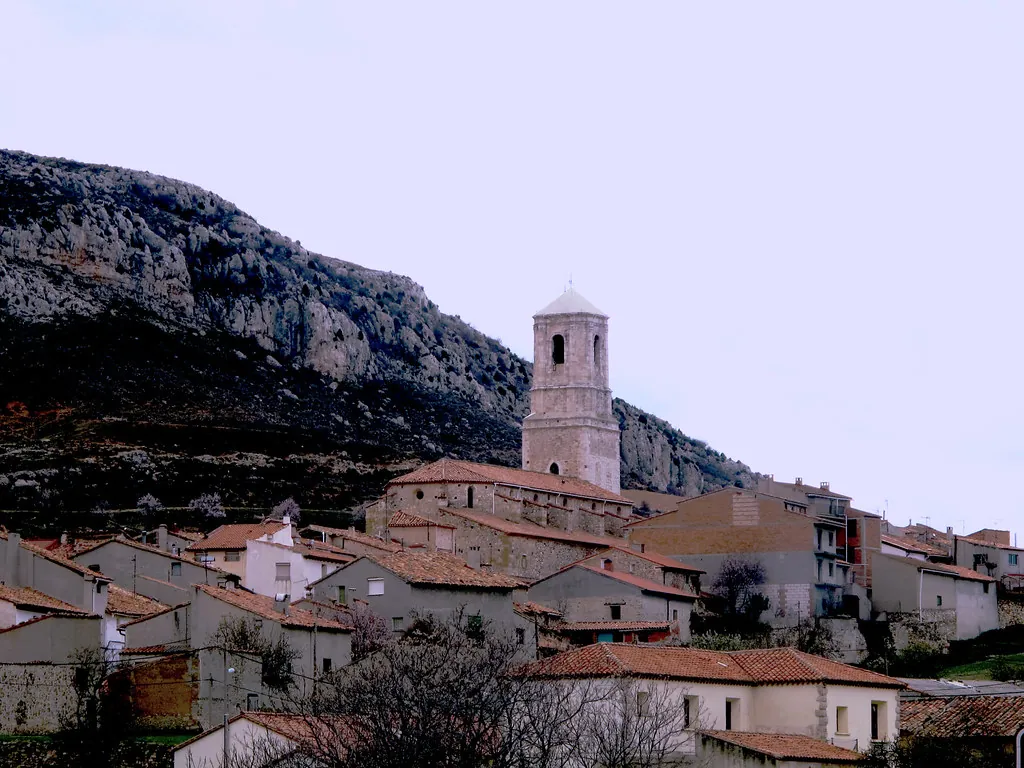
It is a simple stone church, with a bell tower rising above the rooftops. Inside, the layout follows the typical pattern of rural Aragonese churches: a single nave with modest decoration. The building’s importance goes beyond its architectural features. For generations, it served as a meeting point and reference for a small population scattered across the surrounding area.
Nearby there is usually a small open space that acts as a forecourt to the church. Traditionally, this was where social life gathered on important days, linking religious practice with everyday community life.
Land, vegetation and traces of use
The surroundings of Anadón help explain how people once lived here. Nearby hills combine areas of holm oak woodland with old fields that are now abandoned. In some clearings, it is still possible to see embankments and stone walls that once marked the boundaries of cultivated plots.
Rural tracks around the village make it possible to explore this landscape at a measured pace. In wetter years, mushrooms appear in the wooded areas, and collecting them becomes a common activity in the comarca during autumn. At the same time, it is worth bearing in mind that many of these plots remain privately owned.
The ravines that cut through the municipality also play a role in understanding the terrain. These are seasonal watercourses, yet they were important for livestock and for small family gardens over many years. Their presence explains both the shape of the land and the way it was used.
Walking the old routes
Several agricultural tracks begin in the village and climb towards the higher parts of the surrounding land. As the elevation increases, the structure of the territory becomes clearer. Patches of woodland alternate with old fields, and small shelters linked to livestock activity appear along the way.
There is no formal network of marked footpaths, and some sections have gradually fallen out of use. Even so, walking these tracks gives a clear idea of how the landscape functioned in the past. Stone walls enclosed plots, routes crossed the ravines at practical points, and grazing areas occupied the gentler slopes.
Anyone planning to walk beyond the immediate surroundings should carry a map or another means of orientation. The terrain and the condition of the paths can make navigation less straightforward than it first appears.
Festive dates and seasonal life
The main annual celebration in Anadón is dedicated to San Miguel, at the end of September. As in many very small villages, this is when former residents return and the population briefly grows. The celebration is simple, centred on the church and shared spaces within the village.
During the summer months, there is also a noticeable increase in activity. Houses that remain closed for much of the year reopen, and more people gather for short periods. At times, local meetings or activities linked to the memory of the village and traditional trades are organised, although there is no fixed programme.
These moments highlight the rhythm of a place where daily life has long been shaped by departures and returns, and where connections to the village extend beyond those who live there permanently.
Reaching Anadón
Anadón lies within the Cuencas Mineras comarca, in the province of Teruel. Access is usually from Calamocha or from the areas around Utrillas and Montalbán, followed by smaller regional roads.
The final stretch runs along a narrow, winding road, typical of villages located in mountainous areas. There is no regular public transport service to the village, so most visits are made by car. Once there, the size of Anadón makes it easy to explore on foot in a short time.