Full Article
about Cortes de Aragón
Hide article Read full article
A small village shaped by its surroundings
Tourism in Cortes de Aragón makes sense only when seen in the context of its wider setting. This small municipality lies in the Cuencas Mineras region, in the province of Teruel, at around 900 metres above sea level. The landscape opens out in gentle hills and broad fields, with long views that define this part of inland Aragón.
For much of recent history, life here was tied to coal mining. That activity shaped both the economy and the rhythm of the surrounding area for decades. Even so, livestock farming and agriculture never disappeared, and they still form part of everyday life. Today, with only a few dozen residents, Cortes de Aragón has remained on a modest scale, the kind of place that never expanded beyond its original footprint.
The approach reflects that same sense of distance and calm. A quiet local road leads in, crossing small valleys and stretches of cultivated land. Along the way, traces of the mining past appear here and there: old platforms, cut slopes, or access points to workings that are no longer active. They sit unobtrusively in the landscape, reminders of an industry that once defined the region without dominating its present.
The village centre and its church
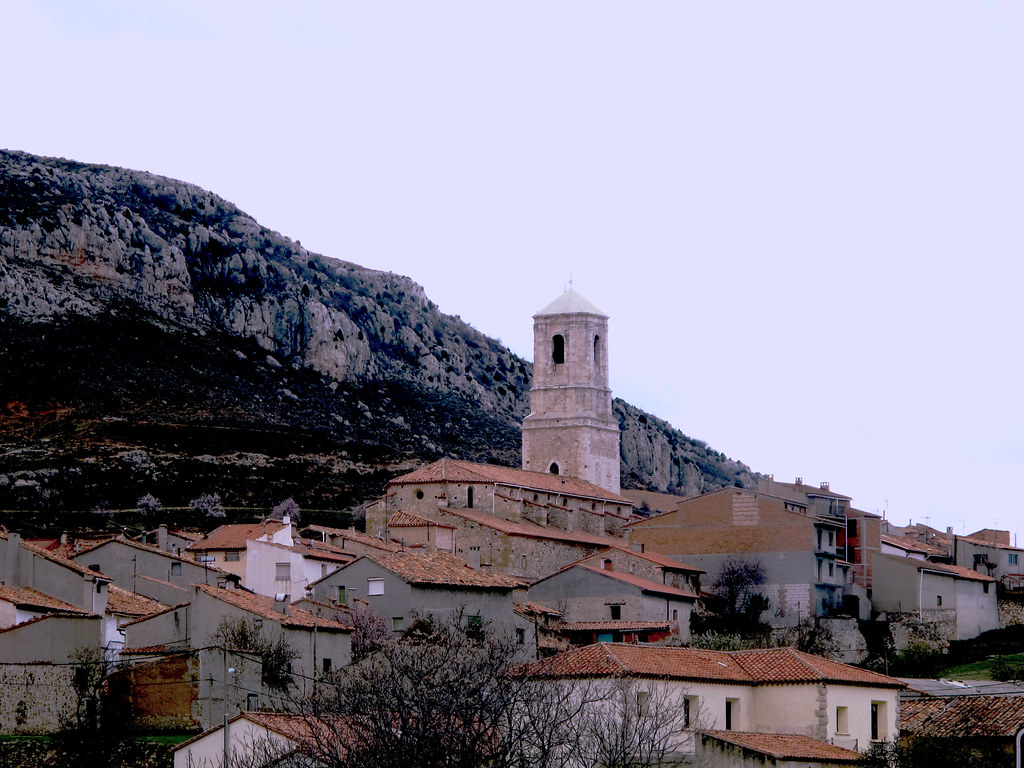
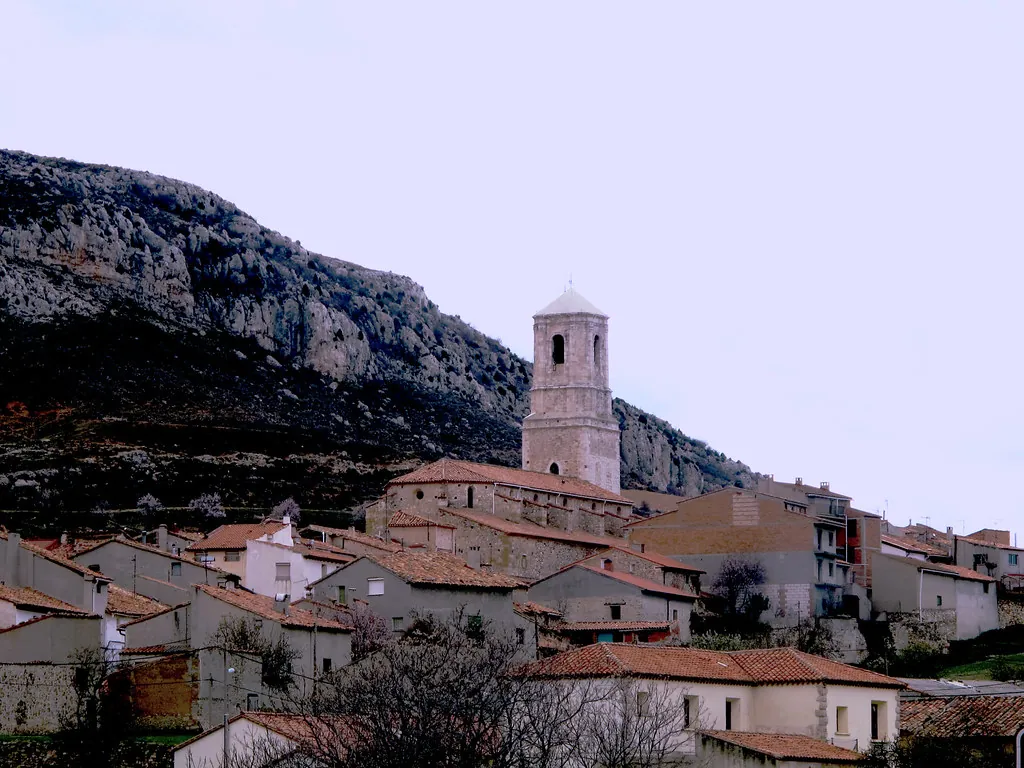
Cortes de Aragón has a compact urban core, with just a handful of streets. Houses line the slope, following the natural shape of the terrain rather than imposing a strict layout. Traditional construction combines stone, adobe and curved roof tiles, materials typical of this part of the Sistema Ibérico.
Some homes have been restored with clear respect for their original form, while others show the wear that comes with a shrinking population and limited year-round activity. The overall impression is of a place that has adapted slowly, without losing its basic structure.
The parish church of San Pedro stands at the most visible point in the village. Its current form is largely built in stone and appears to rest on a 16th-century base, though later alterations have changed its appearance over time. Inside, there is a main altarpiece in polychrome wood, following the style of popular Aragonese Baroque. It is not especially elaborate, yet it fits naturally within the building as a whole.
Nearby, a small square acts as the village’s shared space. This is where celebrations and gatherings take place, which is typical in settlements of this size where public life centres on just a few locations. When something happens, it tends to happen here.
Paths through fields and low hills
From the edge of the village, several agricultural tracks extend outwards into the surrounding fields and low hills. These are not marked hiking routes. They are working paths, used to reach plots of land, animal enclosures or grazing areas.
Even so, they can be followed on foot without much difficulty. The terrain is not steep, making for straightforward walks across a landscape that alternates between cereal crops, Mediterranean scrub and small patches of pine woodland. The changes are subtle rather than dramatic, but they give the area a varied texture.
At quieter times of day, there is movement overhead and nearby. Birds of prey can often be seen circling above the fields, while the presence of livestock is noticeable in the distance, whether through sound or occasional glimpses of activity around enclosures.
From some of the nearby high points, the geography of this part of Teruel becomes clear. The horizons are wide, villages are spaced far apart, and a network of tracks links scattered agricultural sites. It is a setting where distances feel longer than they appear on a map, shaped as much by emptiness as by what is there.
Local traditions and the yearly rhythm
The festive calendar in Cortes de Aragón remains closely tied to both agriculture and religious observance. The main celebrations usually take place in summer, when many people who live elsewhere return to the village for a few days. During that time, the square fills again with simple events, shared meals and music, bringing a temporary change in pace.
In winter, the tradition of San Antón is still observed. This celebration, common across rural Aragón, includes bonfires and the blessing of animals. It reflects the continuing link between community life and livestock, even in places where farming is no longer the sole occupation.
In some years, small pilgrimages are organised in spring to nearby hermitages. These gatherings combine a walk through the countryside with time spent together, mixing outdoor movement with social contact in a way that feels consistent with the wider character of the area.
A place to move slowly
Cortes de Aragón can be explored in a short amount of time. What tends to matter more is not the number of sights, but the way the surroundings are experienced. Walking without hurry, noticing how the land is used, and recognising the traces of mining alongside long-standing agricultural practices offers a clearer sense of the place.
Spring and early autumn are generally the most comfortable seasons for being outdoors. During these periods, the fields shift in colour and temperatures allow for walking at almost any time of day. Winter, by contrast, can bring intense cold, which is typical at this altitude.
Cortes de Aragón does not revolve around tourism, and that is precisely what defines it. The atmosphere remains quiet and closely aligned with the everyday life of many villages in the Cuencas Mineras. What endures here is a slow rural rhythm, along with the recent memory of a territory that, for decades, worked below ground in its mines while continuing to live above them.