Full Article
about Jarque de la Val
Hide article Read full article
Setting the Scene in the Cuencas Mineras
Tourism in Jarque de la Val begins with its setting. This small municipality lies in the Cuencas Mineras district, in the province of Teruel, part of the autonomous community of Aragon. It stands in an elevated, open stretch of sierra at more than 1,200 metres above sea level. The altitude and exposure shape the place from the outset.
The population today barely exceeds sixty residents. That scale influences everything: the pace of daily life, the compact size of the built area, and the way the village has been preserved over time. Nothing feels hurried, and there is little in the way of expansion or modern reshaping.
Jarque appears in medieval records linked to the organisation of territory after the Christian conquest. For centuries, the local economy depended on agriculture and livestock, as in much of this part of Teruel. In more recent times, coal mining in the wider region left its mark on nearby settlements. The most important mines were not within Jarque’s boundaries, yet mining still formed part of everyday life for several generations.
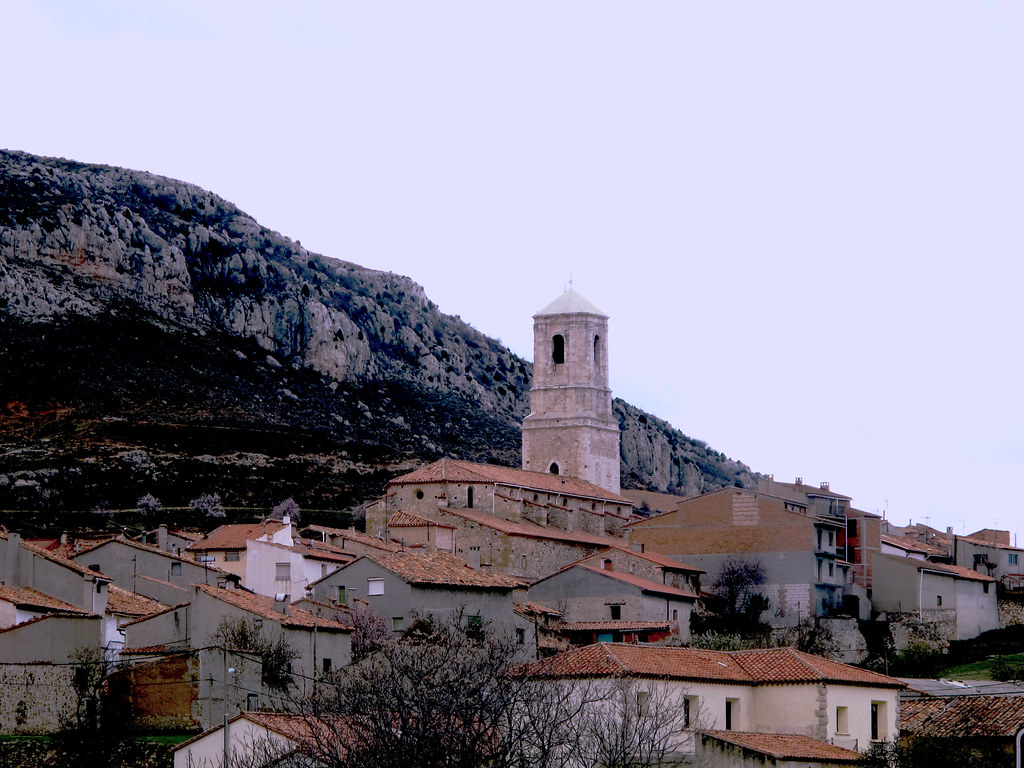
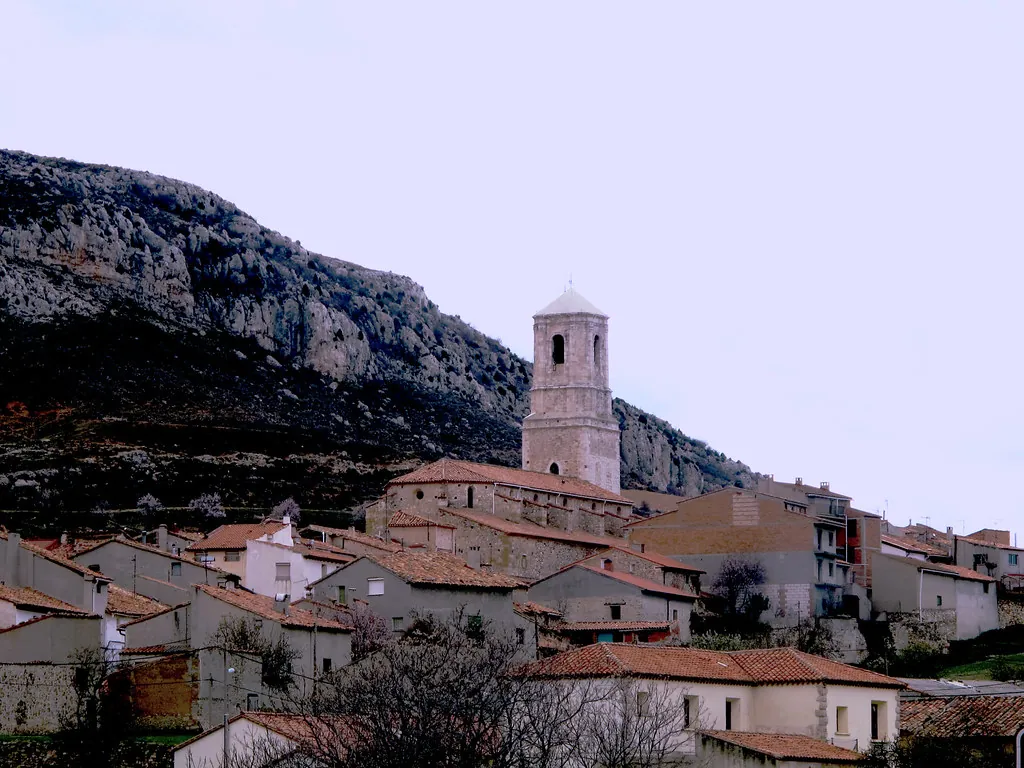
The parish church, dedicated to San Pedro, occupies a dominant position within the village. The current structure dates back to the 16th century, although later alterations have been made. Its appearance is restrained, in keeping with rural Aragonese architecture of that period. The tower rises above the surrounding houses and acts as a clear visual reference when approaching by road. Access to the interior is not always possible, which is common in villages with such a small year-round population.
A Compact Village Layout
The urban centre of Jarque de la Val is small and easy to explore on foot. Streets are arranged around the main square and the routes that lead out of the village. There is no sense of sprawl, and distances remain short throughout.
Stone masonry dominates the construction, with some houses featuring more carefully worked doorways. Wooden eaves appear on older buildings, adding to the overall consistency of materials and style. Rather than large monuments, the interest lies in smaller details that reveal how the village once functioned.
Look for carved lintels above entrances, broad doorways designed for carts, and small coats of arms on certain façades. These elements point to a time when the population was larger and agricultural activity more intense. They are not presented as attractions, but they are easy to notice while walking through the streets.
The Landscape Around Jarque
Beyond the village, the landscape of the Cuencas Mineras stretches out in a way that feels open and somewhat austere. This is typical of the area. There are gentle hills, cultivated land in the lower areas, and patches of pine forest at higher elevations. The overall impression is one of space and quiet.
In several places nearby, old terraces and fields can still be identified, even if they are no longer in use. These are clear traces of a landscape that was worked for centuries, although human activity has eased in recent decades.
Agricultural tracks lead out from the village and can be followed without difficulty. Many of them connect to forest paths that cross the surrounding hills. These are not marked hiking routes in a formal sense, but they are regularly used by local residents and by those who still have land in the area. Walking here tends to be straightforward, with no need for specialised planning, though the absence of signage means navigation is simple rather than structured.
Dark Skies and a Steady Rhythm
One of the most noticeable features of Jarque de la Val appears after sunset. The darkness is striking. Limited artificial lighting and the distance from larger towns allow the night sky to be seen with unusual clarity on clear evenings. This is a common characteristic across the wider district.
Daily life follows a calm rhythm, closely tied to the presence of residents who live here throughout the year or return during certain seasons. Activity levels shift depending on the time of year, but the underlying pace remains steady and unhurried.
There is no sense of a busy tourist destination. Instead, the atmosphere reflects continuity, with routines shaped by a small community and its surroundings.
Local Festivities and the Calendar
The main celebrations in Jarque de la Val are dedicated to San Pedro. They usually take place in summer, when people who live elsewhere return and the village briefly becomes more active. These gatherings bring a change in atmosphere, even if the scale remains modest.
Events are typically simple. They include religious observances, meetings in the square, and activities organised by residents themselves. The emphasis is on participation rather than spectacle.
Other celebrations linked to the traditional calendar continue throughout the year, though in a reduced format. They form part of the continuity of village life rather than serving as major attractions.
Getting There and Choosing When to Visit
Jarque de la Val is reached via regional roads that cross the Cuencas Mineras area. The journey passes through low mountain ranges, ravines and small villages that are widely spaced. The setting remains consistent throughout the approach, with few signs of dense settlement.
In winter, the climate can be cold, and ice or snow may appear on certain stretches of road. From late spring to early autumn, access is generally easier, and the surrounding paths can be walked without difficulty.
The village itself can be seen in a relatively short time. What defines a visit is less about the number of sights and more about the landscape and the calm that characterise this part of Teruel.