Full Article
about Montalbán
Hide article Read full article
A town shaped by coal
Montalbán sits in the centre of the Cuencas Mineras of Teruel, just over 900 metres above sea level. This is a part of Aragón where recent history is closely tied to lignite mining, and that legacy still frames how the place is understood today. Any visit tends to begin with that context, because for much of the 20th century the local economy and daily life revolved around extraction.
The marks of that activity remain visible in the surrounding landscape. Old mine entrances, spoil heaps and industrial structures can still be found on the outskirts. Some are abandoned, others lack clear signage, but together they form a scattered record of a period that reshaped both the terrain and the community.
Streets that reflect a regional role
The historic centre of Montalbán has a compact layout, shaped by the terrain it sits on. Streets adjust to the contours rather than imposing a rigid grid, and the buildings follow suit. Stone and masonry houses dominate, with occasional carved coats of arms that point to the presence of local lineages in earlier centuries.
These are not grand palaces, yet they hint at a social structure in which certain families held prominence. For a long time, Montalbán functioned as an administrative centre for the surrounding area, and that role is still legible in its built fabric.
The Plaza Mayor remains the main point of reference. Arcades line parts of the square, recalling its historic commercial function. For generations, agricultural and livestock trade set the rhythm of local life, and this open space acted as the meeting ground where those exchanges took place.
San Pedro and the town skyline
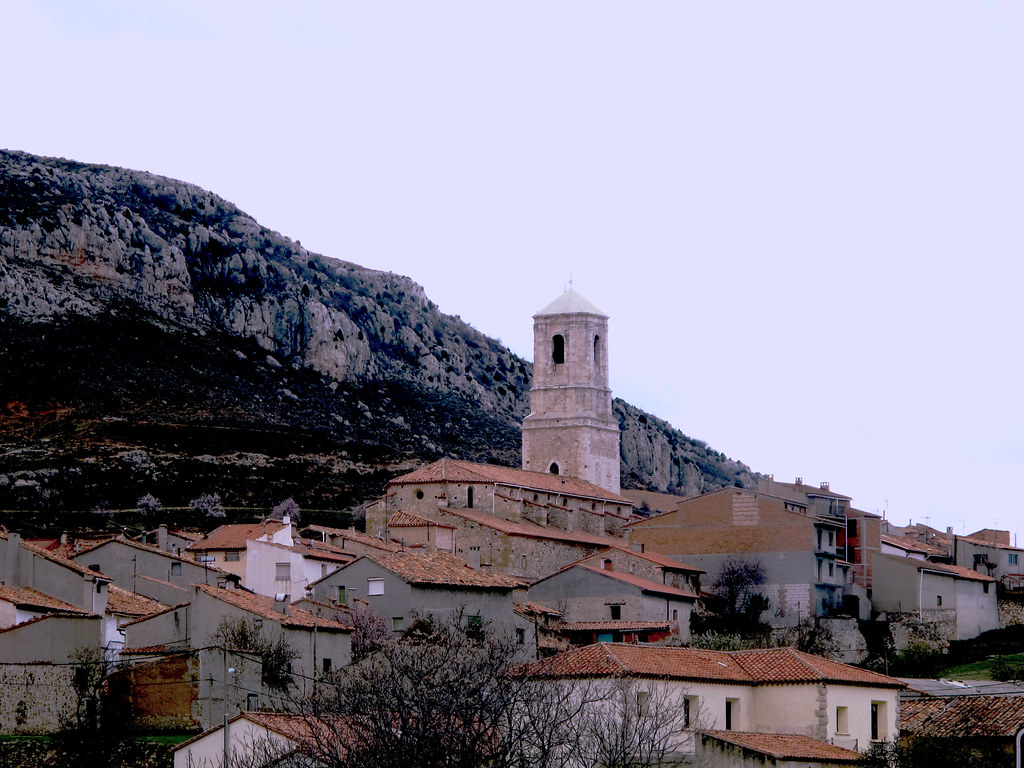
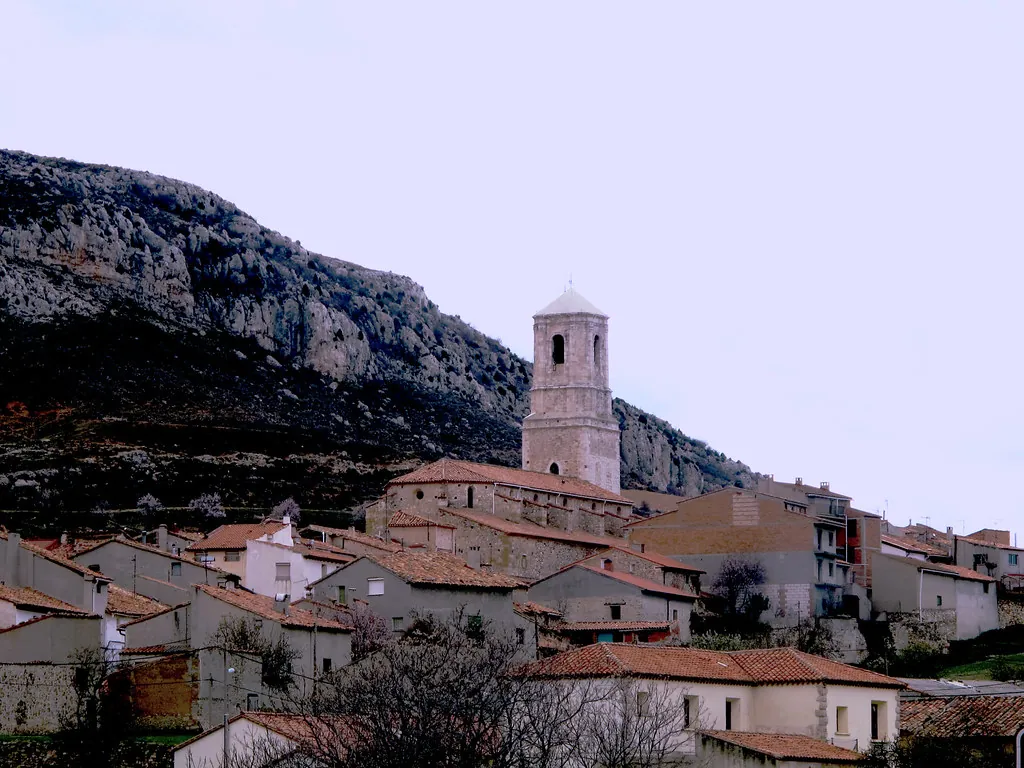
The parish church of San Pedro rises on the site of earlier structures. The current building is generally dated to the 16th century, with later alterations, particularly in the 18th. Its construction uses masonry and dressed stone, following architectural models common across inland Aragón during that period.
The bell tower stands out clearly against the skyline and can be seen from different points across the town. It acts as a visual anchor within the urban landscape.
Inside, the church is restrained in style. The altarpieces that survive come from different periods and reflect a more local, popular form of religious expression rather than major artistic commissions. Their interest lies in what they reveal about the community’s history and beliefs over time.
Traces of the mining past
For much of the 20th century, lignite mining underpinned Montalbán’s economy. The industry brought employment and left a lasting imprint on the surroundings. Even now, elements of that past remain scattered across the area.
Some shafts and structures are considered part of the comarca’s industrial heritage. Not all have been adapted for visitors, and access can vary. Anyone exploring these sites should take care and, where possible, seek information locally before setting out.
This industrial layer adds another dimension to the town. It connects the quieter present-day atmosphere with a period when activity in and around Montalbán was far more intense.
A dry, broken landscape
The countryside around Montalbán is dry and uneven. Ravines cut through the terrain, while rocky hills rise between patches of vegetation. Holm oak and juniper are common here, typical of this part of Teruel, and they form small wooded areas amid more open ground.
In autumn, mushrooms appear in some nearby hills. Foraging is regulated, and it is important to know which species are safe before collecting anything.
There are paths and tracks that allow visitors to explore the surroundings on foot. Conditions vary. Some routes are reasonably clear, while others are less well marked or maintained, which is fairly typical for the comarca. Checking locally about the state of these paths is advisable before heading out.
Birdlife is another feature of the area. At certain times of year, birds of prey are relatively easy to spot overhead. The red kite and the booted eagle are among the species that can often be seen crossing these open skies.
Festivities and the rhythm of the year
The main fiestas in Montalbán take place in August. This is when many people who have moved away return to the town, and the atmosphere shifts noticeably. Streets fill with events, music and religious celebrations, bringing a temporary intensity to places that are otherwise quiet for much of the year.
Holy Week is also marked here. Processions pass through the historic centre in a more restrained tone, in keeping with traditions found across inland Aragón. These events reflect a continuity of customs that remain part of local life.
Getting there and around
Montalbán is connected by road to other towns in the Cuencas Mineras and to the main routes of the province. Access usually involves regional roads that cross fairly mountainous terrain.
Journeys from Teruel or Zaragoza are typically made by car, linking up with roads that serve the comarca. Road conditions can change in winter or after periods of rain, when some stretches may become slower or more winding than usual.
Public transport does exist, but services are limited, as is common in much of the rural interior of the province. For most visitors, getting around independently offers greater flexibility when exploring both the town and its surroundings.