Full Article
about Vivel del Río Martín
Hide article Read full article
A village that moves at its own pace
By mid-morning in April, light slips sideways through the windows of the church and hangs in the fine dust drifting inside. Along Calle Mayor, there is barely any movement. The ground is uneven stone, and when a breeze picks up, it carries the faint scrape of branches from a bent tree against a nearby façade. A visit to Vivel del Río Martín often begins like this, with the sense that time follows a different rhythm here, slower and shaped by the landscape of the Cuencas Mineras that surrounds it.
At around 970 metres above sea level, the village sits among gentle hills covered in scrub and scattered pine woods. The area’s mining past does not appear in the form of museums or explanatory panels. It is suggested instead through the terrain itself, in old tracks or in structures that seem to have outlived their purpose. Winter brings dry air flowing down from the hills, and the silence feels heavier in the streets. In summer, new voices arrive as families return for a few days and houses reopen after months of being shut.
The church and the streets around it
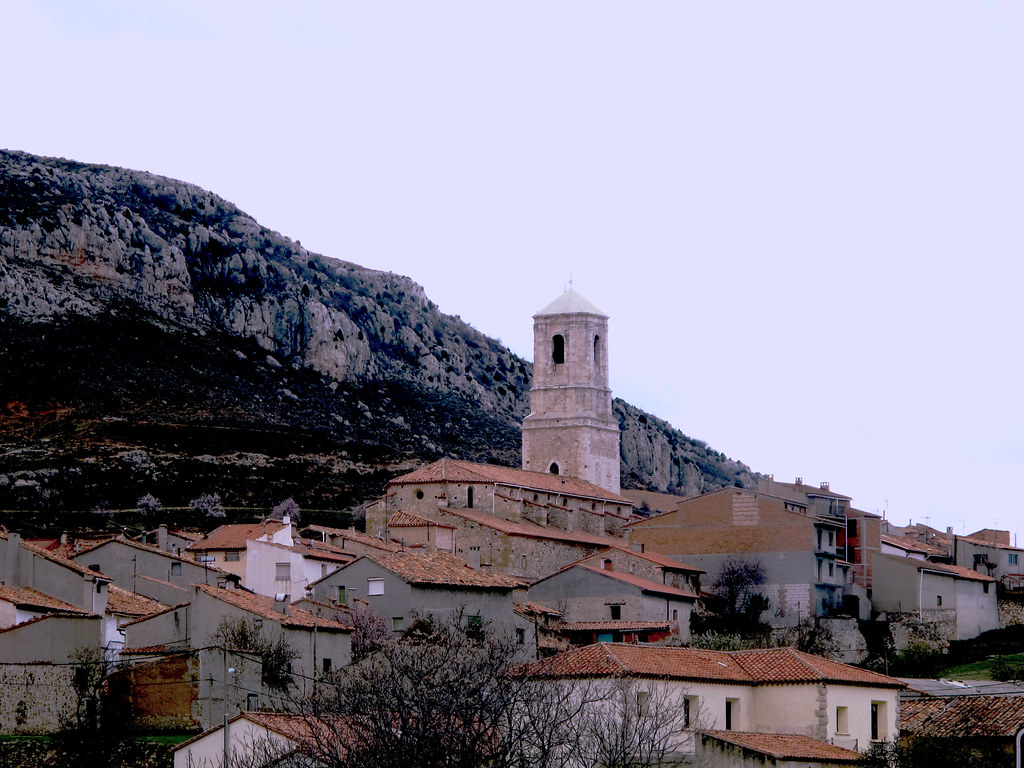
The village square centres on the church of Nuestra Señora de la Asunción. The building is usually dated to the 16th century, although later alterations have shaped its current appearance. Its façade combines masonry and brick. The entrance is simple, framed by an arch with little decoration, and the bell tower ends in a tiled top that stands out clearly against an open sky.
Houses line narrow streets where wooden balconies and wrought iron grilles still remain. Many of these homes stay closed for much of the year. Others show small signs of life, an open window, a freshly watered plant, a brief conversation held at a doorway. The village core is compact and easy to walk through in a short time.
Traces of mining in the landscape
Beyond the village, dirt tracks stretch out between holm oaks, young pines and slopes of reddish soil. The wider region of the Cuencas Mineras has left its mark across the surroundings. It is not always immediately visible, yet scattered remains appear here and there: unusual embankments, flattened areas that do not seem natural, or structures partly hidden by vegetation.
One route commonly taken by local residents follows the track leading towards the Fuente del Puerto. It is not signposted as a formal trail, though it allows for a walk through the hills and offers a clearer sense of the area’s terrain. From some of the higher points, the land can be seen forming a series of shallow basins, with colours that shift depending on the time of day.
Anyone heading out on foot is advised to carry water and protect against the sun. Shade is limited, and in summer the heat makes itself felt quickly.
What can be heard when everything is still
On the nearby paths, the most constant sound is the dry crunch of low scrub underfoot. Occasionally, the flight of a bird of prey can be heard above the ravines. Tracks of wild boar or roe deer are not unusual on less frequented stretches, particularly early in the day or towards evening.
The quiet brings out smaller details. The tap of a loose shutter, a dog barking somewhere in the distance, the brief echo of a car passing along the regional road. These sounds stand out precisely because there is so little else competing with them.
Summer and the return of activity
For much of the year, movement in Vivel del Río Martín is limited. Summer changes the atmosphere. Families who live elsewhere return for a few weeks, and the village regains a degree of activity. The patron saint festivities in honour of Nuestra Señora de la Asunción are usually held at this time, with processions through the streets and shared meals in the square.
During those days, the air carries the smell of roast lamb, homemade sweets and wood fires lit towards evening. Once August comes to an end, the pace slows again.
Everyday cooking and local flavours
The cooking here remains closely tied to what has traditionally been available in the area. Cured meats, stews made with small game when it is available, and simple dishes suited to long working days all form part of the local diet. Morcilla with onion and rice is widely prepared in the region and is still made in some households during the season of matanza, the traditional pig slaughter.
There is no dining scene designed for visitors. What is eaten in Vivel belongs to the daily life of the families who maintain homes in the village.
When to go and what to expect
Vivel del Río Martín lies roughly 90 kilometres southeast of the city of Teruel. The final approach follows secondary roads that cross the region. Tourist signage is limited, and there are few services aimed at regular visitors, so it helps to arrive with a clear idea of the route, especially when planning to explore the surrounding area.
Spring and early autumn tend to offer the most comfortable conditions for walking in the nearby hills. In high summer, the sun becomes intense from midday onwards. Winter brings wind that can make the cold feel sharper than the temperature suggests.
Rather than a place defined by a long list of attractions, Vivel works best when taken slowly: a short walk, a brief conversation, and time to notice how the landscape and the village shape each other.