Full Article
about Quicena
Hide article Read full article
A quick arrival from Huesca
Most visits to Quicena begin the same way. Leaving Huesca on the A‑132 towards Barbastro, the village appears within minutes. It is small and easy to get around on foot, with no real need to plan your route. Parking is usually straightforward, with space at the entrances to the built-up area.
In summer, timing matters. Early morning or late afternoon is more comfortable, as the midday sun can be intense and there is very little shade. The setting is open and exposed, so the heat tends to linger.
A simple village centre
Quicena has a single main street with a handful of short side lanes branching off it. The buildings are mostly stone, some whitewashed, others updated in a practical, unfussy way. There is nothing particularly monumental here, and that is part of the place’s character.
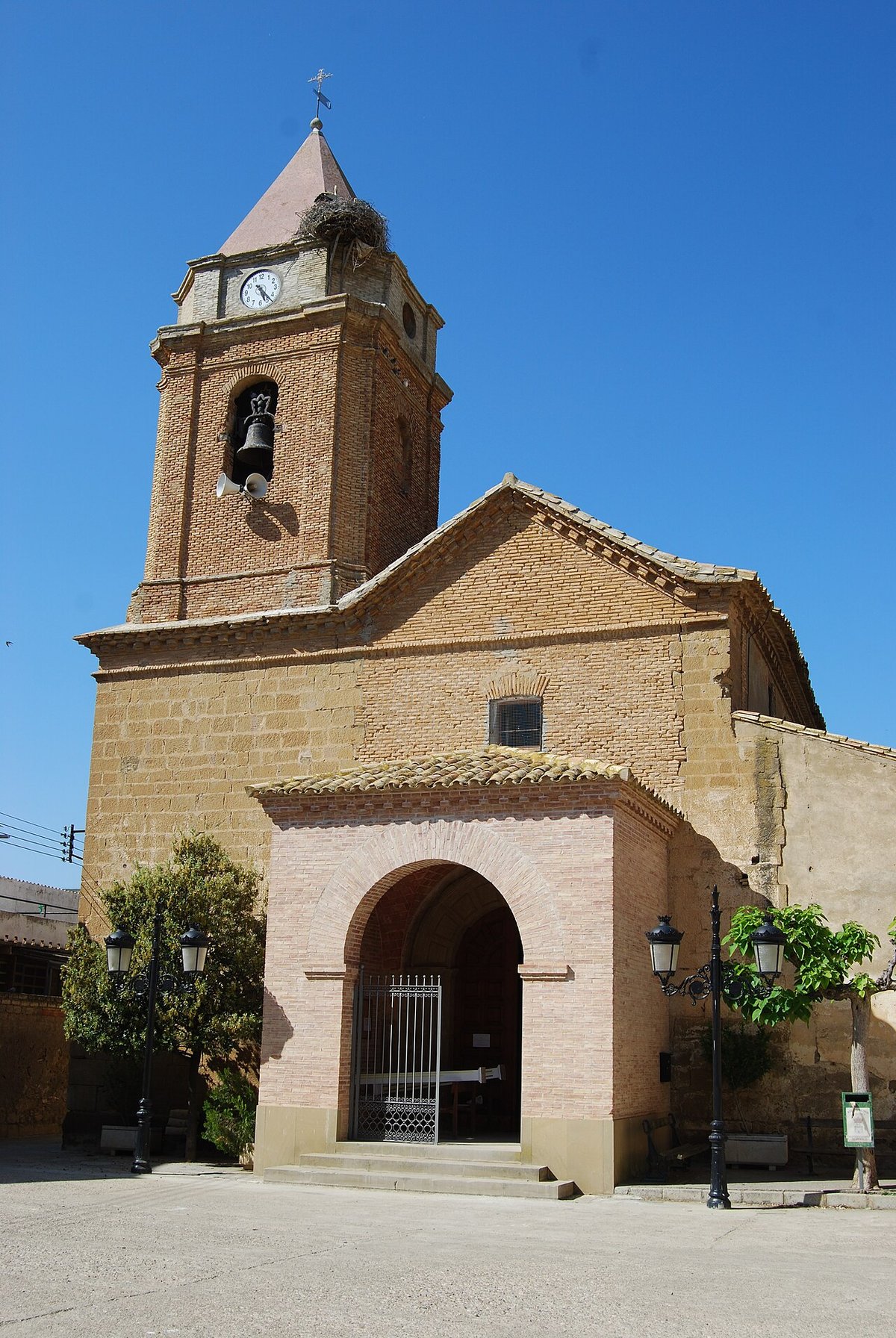
At the centre stands the parish church of San Pedro, dating back to the 16th century, though it has been altered over time. Its brick tower is visible from the surrounding fields and works as a useful point of reference when walking nearby.
There is also a small square where residents tend to gather outdoors in the evenings during summer. Beyond that, there is little to detain you for long. There are no museums or major landmarks that demand extended attention, and the village reveals itself quickly.
The open landscape
The landscape around Quicena is defined by flat terrain. Cereal fields dominate, especially wheat, along with some almond trees scattered across the area. Between February and March, the almond blossom changes the look of the surroundings quite noticeably, though it remains an open, largely treeless landscape with minimal shade.
On clear days, the outline of the Pyrenees can be seen to the north. The view is not always sharp and depends on the conditions, but when it appears, it adds a distant backdrop to the otherwise level horizon.
Several agricultural tracks lead out from the village into the fields. These are used by farmers but are also suitable for walking without difficulty. For anyone looking to stretch their legs, it is easy to spend an hour or two wandering without worrying about getting lost. The terrain is uncomplicated, and the paths are straightforward.
Up to Montearagón
Quicena lies very close to the castle of Montearagón, and many people pass through the village for that reason. The castle sits on a hill just a few kilometres away and can be reached either by track or by footpaths that climb from the surrounding area.
At the top are the ruins of this medieval fortress, along with wide views across the Hoya de Huesca, the broad plain in which the village sits. The visit itself does not take long, but it adds context to the area and complements a short stop in Quicena.
Food and nearby options
For anything beyond a brief wander, most visitors head into Huesca. It is very close and offers a more varied experience, with its cathedral, older streets and a noticeably livelier atmosphere compared to the smaller villages nearby.
Across the wider comarca, local produce remains important. Vegetables from market gardens, olive oil and ternasco, a type of lamb typical of Aragón, appear frequently in regional cooking.
When to go
Spring and autumn are generally the most pleasant times to visit. The colours of the fields shift with the seasons, and temperatures are more manageable for walking and exploring.
Summer brings strong heat as soon as you step outside the village streets, while winter can bring fog on some days, which is quite typical in this part of the Hoya de Huesca.
A short and simple stop
Quicena does not take long to see. An hour in the village, a short walk along the tracks and a visit up to Montearagón make for a complete stop. If you come only for the village centre, the visit will be brief. The interest here lies more in the surroundings than in the village itself.