Full Article
about Bello
Hide article Read full article
A village shaped by height and horizon
Bello sits in the comarca of Jiloca, in the north-east of the province of Teruel, on a high plateau where the horizon stretches out in every direction. With around two hundred residents, it is a small place where the connection to the land remains clear and direct. Cereal crops, small vegetable plots and livestock still form part of everyday life, not as a backdrop but as a working landscape.
The surrounding territory defines the rhythm of the village. A short walk beyond the built-up area leads straight into wide खेत-like parcels and agricultural tracks. There is little transition between village and countryside, and that closeness gives Bello a strong sense of continuity between home and field.
Altitude plays a noticeable role in daily life. Winters are typically long and cold, with frequent frosts, and the valley wind moves through the village with little to slow it down. Summer brings a shift in mood. Days grow longer, agricultural activity increases with the harvest, and life spills out into the street and onto doorsteps, where people gather in the warmer evenings.
San Andrés and the fabric of the village
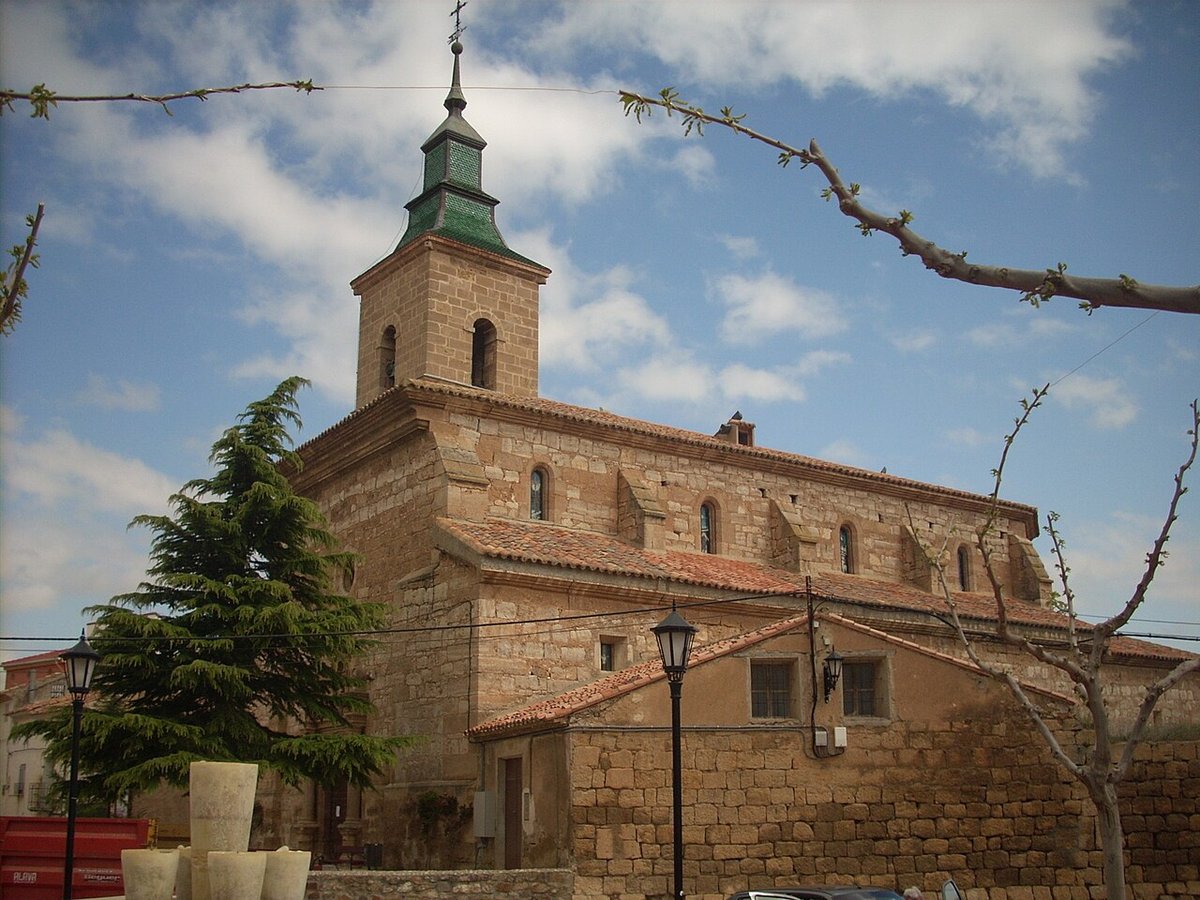
The most prominent building in Bello is the parish church of San Andrés. The current structure stands on the site of a 16th-century building that has been altered over time. It is not a grand or imposing church, yet inside it preserves some Baroque elements, most notably in the carved wooden main altarpiece.
In a village of this scale, the church has long played more than a religious role. It helped organise the layout of the settlement and set the rhythm of the calendar, marking key moments of the year for the community.
Around it, the central streets retain features typical of rural architecture in the Jiloca area. Houses are built with masonry walls and large gateways, often leading into interior courtyards. These spaces reflect a way of life in which homes were also workplaces. Many properties were designed to accommodate both family life and agricultural activity.
In some of these courtyards, traces of earlier uses remain visible. Haylofts and small agricultural storage areas can still be found, offering a glimpse into how the village functioned before farming became mechanised. These details are easy to overlook, yet they reveal how closely daily life was tied to seasonal labour and the management of resources.
The open landscape of the Jiloca
Beyond the village, the landscape opens out into broad expanses dominated by cereal fields. The terrain is largely flat, allowing long, uninterrupted views across the plain. This is characteristic of the Jiloca valley, where the sense of space is one of the defining features.
In winter, the scenery can feel austere. With the fields at rest, the colours fade to muted tones of ochre and grey. There is a quietness to the land at this time, shaped as much by the climate as by the agricultural cycle.
Spring transforms the same setting. Green spreads across much of the terrain as crops begin to grow, and the network of agricultural tracks becomes more active again. Many of these paths start directly from the village and can be followed on foot or by bicycle. The lack of steep gradients makes moving through the area straightforward, and distances feel manageable in the open terrain.
At certain times of year, birdlife becomes noticeable, especially species linked to open farmland and nearby wet areas in the valley. There are no large gatherings, but those who walk slowly and pay attention often spot movement overhead or along the field edges. It is a landscape that rewards patience rather than spectacle.
Everyday life and rural memory
Life in Bello has long been tied to the agricultural calendar, and that connection remains part of local memory. Older residents recall tasks that have now largely disappeared or been greatly reduced. Among them are the long days of threshing and the winter pig slaughter, a practice that for generations helped supply much of a household’s food for the year.
Even today, small kitchen gardens are still kept for personal use, and recipes continue to be passed down within families. These are not always visible to someone passing through for a short visit, yet they form an essential part of the village’s cultural fabric.
The annual cycle also includes the patron saint festivities, usually held in summer. At that time, people who live elsewhere for most of the year return to Bello. Processions, shared meals and activities in the main square mark these days, when the village briefly recovers something of the population it had decades ago. The atmosphere shifts, bringing together past and present in a way that reflects the enduring ties many people maintain with the place.
Walking through Bello today
Bello can be explored at an unhurried pace in a short amount of time. The interest lies less in individual landmarks and more in the small details: the features of older houses, the courtyards that still survive within the village, and the immediate presence of farmland just beyond the last row of buildings.
Spending a little longer makes it worthwhile to follow one of the agricultural tracks leading out from the village. A few minutes away from the centre is enough to grasp the scale of the Jiloca landscape. Large fields stretch outwards, the horizon remains wide and open, and neighbouring villages appear in the distance as small clusters of rooftops set within the plain.
It is in this relationship between settlement and surroundings that Bello is best understood: a place where the land is not simply scenery, but the framework that has shaped how people live, work and remember.