Full Article
about Lanzuela
Hide article Read full article
Arriving slowly
The road from Monreal del Campo narrows past Báguena, the asphalt giving way to packed earth and gravel. Your own dust hangs in the air behind the car. The fields here are wide and flat, a sea of stubble in late summer, broken only by the dark, stubborn shapes of holm oaks. Then, without a sign or a bend, Lanzuela is just there. Twenty-four people. Red tile roofs over walls of stone and sun-baked adobe. The silence, when you stop the engine, has weight.
You notice the wind first. It comes down from the Sierra de Cucalón, a constant, low sound in the telephone wires. In winter it smells of woodsmoke; in July, it’s hot and carries the scent of dry thyme and warm earth from the tracks.
A church, a square, and the rhythm of a day
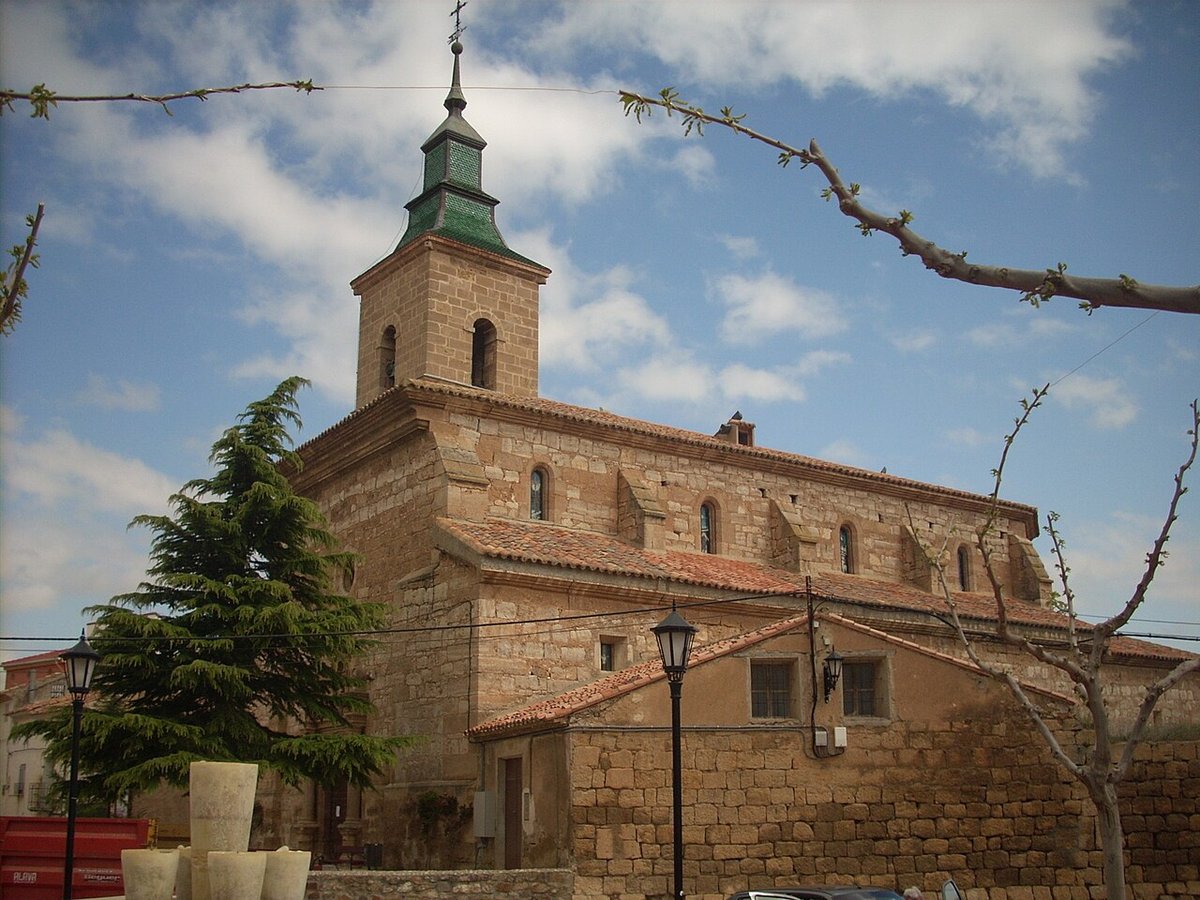
The streets are just passages between houses, some paved with worn river stone, others bare dirt. They all lead, quickly, to the church of San Miguel. It’s a solid, no-fuss building of rubble masonry, its corners reinforced with larger blocks. The bell gable is the village’s highest point.
The square in front is just a widening in the lane. A few benches face nothing in particular. This is where life happens after five o’clock: long conversations in the shade, the scrape of a chair on stone. If the wind is right, you hear the soft, metallic knock of the bell against its yoke. Look at the buildings around it—they’re built for work, not for show. Wide doors for tractors, low annexes that were once pens, walls thick enough to keep the heat out.
The tracks are your map
To walk here is to follow the farmers’ logic. Marked trails don’t exist; you take the caminos de sirga, the service tracks that run along field boundaries. One easy loop starts behind the last house and traces the village perimeter on packed earth, passing small huertos where tomatoes grow and patches of land left fallow. At a slow amble, it takes about an hour.
The landscape changes with your elevation, which is never much. From one of these gentle rises, you see it all: the village clustered below, the geometric fields of Jiloca stretching west, and the rolling scrubland of the sierra to the east. On a crystal-clear morning after rain, you might make out the hazy blue line of the mountains near Albarracín.
Life at ground level
With so few people, other residents claim the space. Look up mid-morning as the thermals build: common buzzards circle over the fallow fields. A hare might bolt from a furrow if you walk quietly enough. The holm oaks are miniature ecosystems—listen for the chatter of warblers and the persistent tap-tap-tap of a woodpecker on a dead branch.
The village has no shop, no bar, no accommodation. What it has is a working fountain by the church, where you can fill a bottle with cold water before heading north on foot, where the land tilts up into mixed pine and oak woodland.
What sustains the place
Life is tied to the garden and the season. Summer meals are built around green beans, tomatoes, and zucchini from family plots. If autumn is damp, people head into the pinewoods for níscalos, which end up scrambled with eggs. The cooking is hearty—lamb stews, pots of beans—because it fuels physical work.
The year pivots on the fiesta of San Miguel in late September. The bell rings more persistently then, calling everyone home: the two dozen full-time residents and those who return from Zaragoza or Teruel for a few days. In August, there’s a different kind of gathering, more diffuse, as families open their shuttered houses for the summer weeks.
Getting there and a word on timing
Lanzuela is in eastern Jiloca. You navigate to it via Monreal del Campo or Báguena, following local roads that get progressively quieter. Don’t rush that last stretch. Come with time to walk, water, and your own provisions. And if you visit in August, aim for a weekday morning; weekends bring cars and voices that reshape the silence entirely.