Full Article
about Bonansa
Hide article Read full article
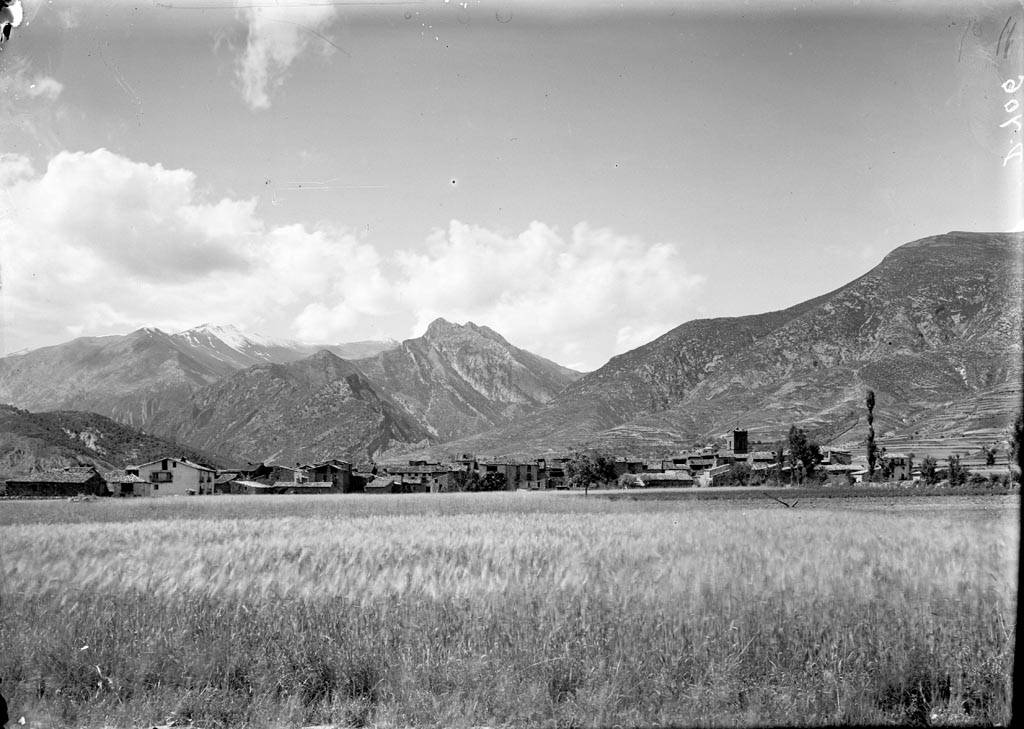
Early in the morning, before the sun clears the rounded hills, Bonansa carries the smell of spent firewood and damp grass. A door opens somewhere, a car starts and rolls downhill, and the bells of the Romanesque church cut through the stillness with a clean sound that lingers briefly across the valley. At 1,256 metres above sea level, the day takes its time to arrive here.
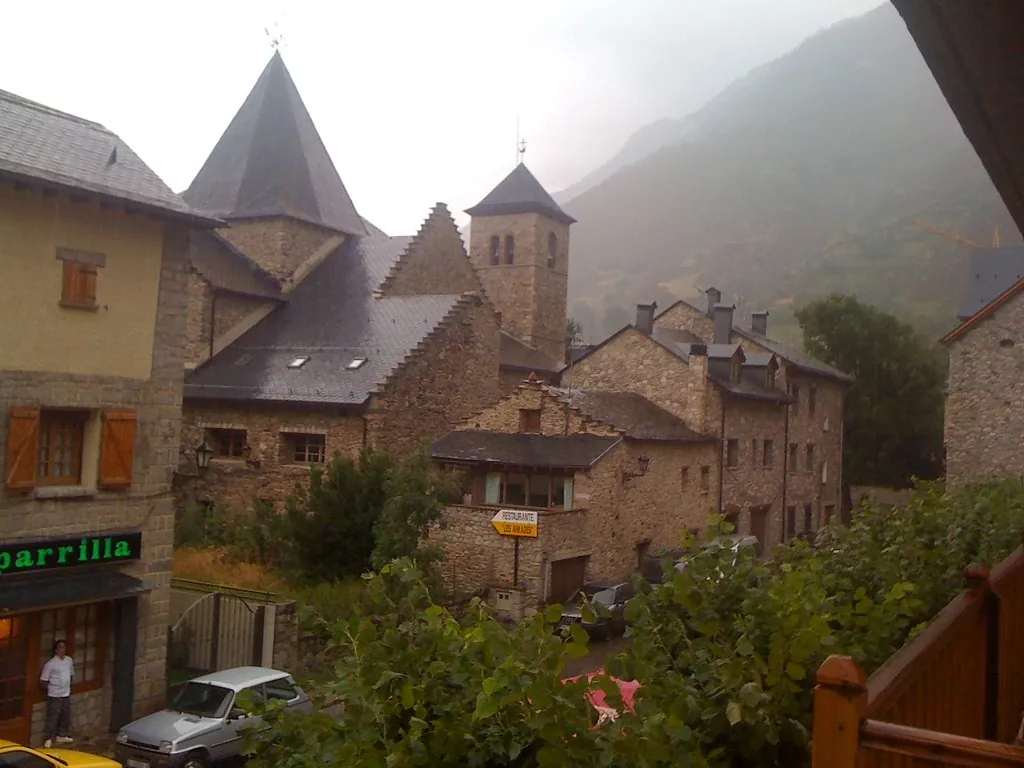
With just over eighty registered residents, Bonansa sits among firs, beeches and black pines, holding onto a way of settling in the mountains that feels deliberate rather than improvised. Stone and slate houses line the streets, many with carved doorways and wooden balconies darkened by long winters, angled to catch what sun they can. Walking through the village means noticing small signs of daily life: a bench pressed against the warmest wall, neatly stacked firewood, pots that reappear as soon as spring returns.
The Romanesque church at the centre
The church of San Pedro stands at the heart of the village. It is generally dated to the 12th century, though like many churches across the Pyrenees it has been altered and repaired over time. From the outside, its structure is easy to read: a simple nave and a semicircular apse built in pale stone that shifts in tone depending on the light.
A slow walk around the building reveals more. Worn corbels sit beneath the roofline, small carved figures appear on some capitals, and the stone blocks still show marks left by the tools that shaped them. The bell gable rises above the rooftops and, on clear days, stands out sharply against a bright blue sky. It does not take much to see how this has been the place where the village gathered for centuries.
Forests and meadows of the Ribagorza slopes
The landscape around Bonansa alternates between open meadows and dense woodland. In summer the green is deep and constant, with cattle grazing calmly across the fields. By autumn the beech forests begin to turn, shifting towards ochres and yellows, and the ground softens under a layer of damp leaves that muffle every step.
The high peaks of the Maladeta massif lie some distance away, yet they still form part of the wider Pyrenean backdrop. Here, though, the terrain belongs more to mid-mountain country: rolling hills, ravines and stretches of forest where visibility closes in after only a few metres.
With a bit of patience, there are signs of wildlife. Wild boar and roe deer move through these woods, though it is more common to come across tracks or hear a sudden crack among branches than to see them directly. Vultures often appear overhead, riding the air currents, and in steeper areas it is not unusual to spot chamois if you are out early enough.
Paths leading out of the village
Several paths begin directly in Bonansa, heading into the forest or down towards nearby meadows and ravines. They are not dramatic in an alpine sense, but they offer pleasant walks of a few hours among pines and clearings where the view opens up.
Some of these routes connect with long-distance trails that cross the Pyrenees, including the GR‑11 and the GR‑15. The links are not always clearly signposted, so if you plan to extend a walk it is sensible to carry a map or a track. In this part of the Ribagorza, paths split easily and the forest soon removes any obvious reference points.
Summer walks are best started early in the day. By mid-afternoon, quick-forming storms can roll in from the mountains and break with little warning.
The pace of the year
Life in Bonansa still follows a rhythm tied to the rural calendar. In June, the village usually marks the feast of San Pedro, its patron saint, with simple events centred around the church and gatherings of residents and those who return for the occasion.
August brings a noticeable increase in activity. Houses that remain closed through the winter open again, and the streets fill with voices in the late afternoon as the heat eases. This is also when activities and dances are organised, drawing together several generations.
The movement of livestock towards higher pastures remains part of the yearly cycle at certain times. It is not staged or arranged for visitors, but something that continues because it is still needed.
When to go and what to bear in mind
Reaching Bonansa involves driving along mountain roads that wind considerably, especially in the final kilometres. The journey itself becomes part of the experience, with dense woodland, deep ravines and the occasional natural viewpoint that invites a short stop.
The village is small, and parking space is limited, particularly in summer or during local festivities. At those times, it makes sense to leave the car at the entrance and continue on foot.
In winter, snow can cover paths and secondary access roads for days at a time. When that happens, the entire setting shifts: white rooftops, smoke rising from chimneys, and a silence even deeper than on summer mornings. Before setting out, it is worth checking the condition of the road and the weather in the area.