Full Article
about Graus
Hide article Read full article
A place you understand through food
Some places win you over visually, others through what’s on the plate. Graus leans firmly towards the second. On a Monday morning, the Plaza Mayor already smells of embers and longaniza, a local sausage, while conversations drift beneath the arcades as if the market had always been there. In many ways, it has.
This is not a place that rushes to impress. The rhythm sits somewhere between the market stalls, the steady hum of neighbours talking, and the smoke rising from grills set up in the square. It’s the kind of setting where daily life is still the main event, and visitors slip into it rather than observe from a distance.
More stronghold than destination
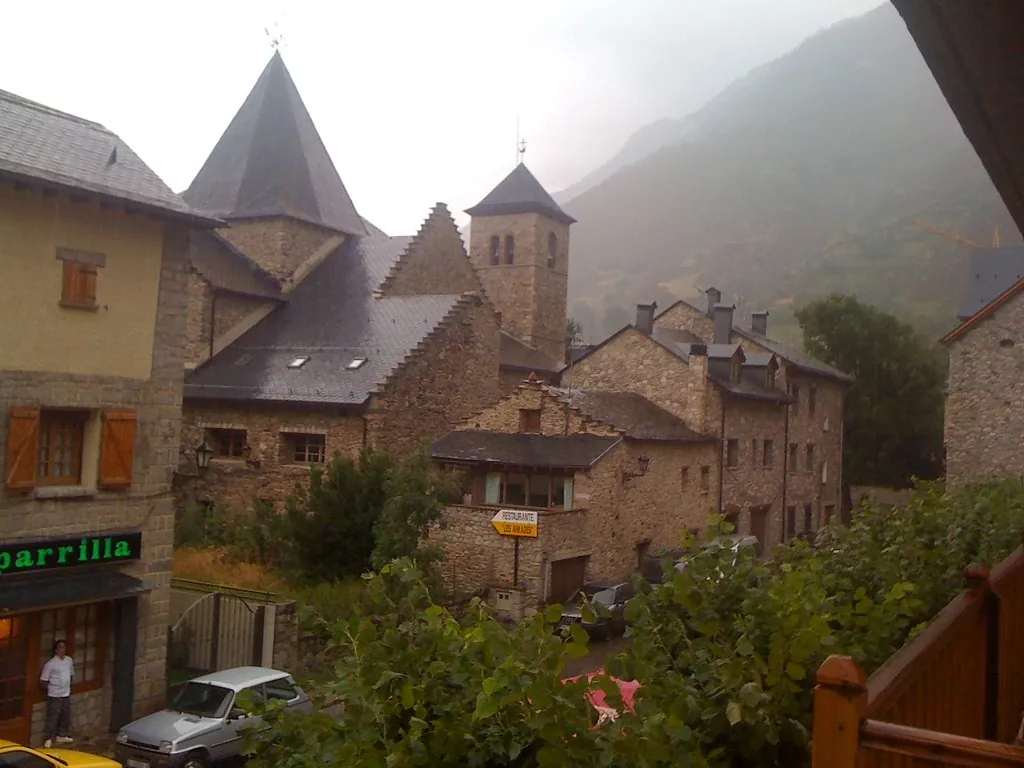
Graus often gets described in a way that doesn’t quite match reality. It’s called the capital of the Ribagorza region, which might suggest something more urban. Then you arrive, park, pass through a stone archway and find someone watering plants in a dressing gown.
There is more history here than first meets the eye. Nearby, King Ramiro I died during a medieval siege, and for centuries Graus held a strategic position between valleys. Traces of that past remain, especially in the old entrances that once formed part of defensive walls.
The clearest expression of it all is the Plaza Mayor. It’s an unusual space, irregular and almost pentagonal, framed by buildings with painted façades and covered walkways. When the market is on, the square fills quickly with stalls and overlapping conversations. Stand still for a while and the place starts to make sense. It’s less about what you see and more about how it moves.
Winter and the quiet business of black truffles
Something shifts in Graus during winter. People who seem to lead quiet, routine lives suddenly appear carrying small paper bags and heading into the town hall. Inside, one of the best-known black truffle markets in Aragón takes place.
No specialist knowledge is needed to grasp what’s going on. Watch how each truffle is weighed, how buyers study them, how little is said out loud. There is serious money involved, even if everything looks understated from the outside.
Ribagorza has been producing large quantities of truffle for years, and Graus has become one of the places where it circulates. If your visit coincides with a market day, it’s worth stepping in, even just out of curiosity. The atmosphere is shaped by growers and buyers rather than visitors, which is precisely what makes it interesting.
Climbing towards the Sierra de Grustán
Just behind the town, a path begins to climb towards the Sierra de Grustán. It isn’t an epic hike, though it’s far from a gentle stroll. The ascent makes itself felt.
The route passes through areas of low vegetation and near what were once small settlements, now abandoned. There’s a sense of gradual transition as the town drops away and the landscape opens out.
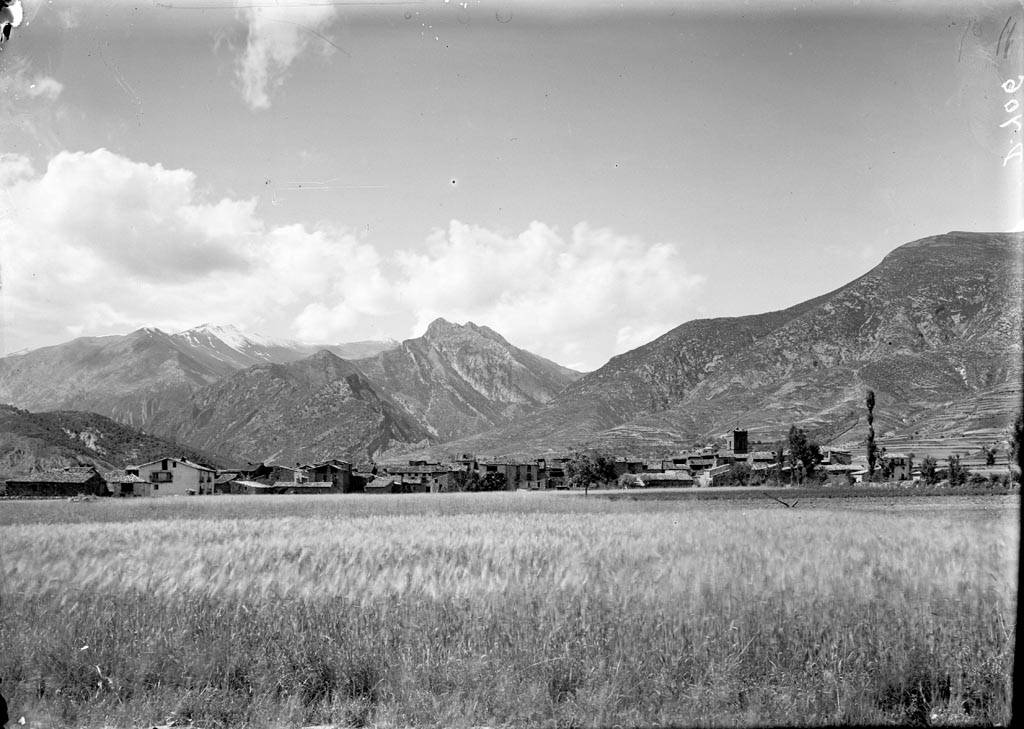
At the top, the effort pays off. The valley of the Ésera and Isábena rivers stretches out below, with Graus sitting compact in the middle, its bell tower rising above the rooftops. On clear days, there’s even a view of a Buddhist temple built by a community that arrived from the Himalayas on a nearby slope. It’s the sort of detail that surprises people, and it tends to come up in conversation with locals.
The basilica anchored to the rock
The defining silhouette of Graus belongs to the Basílica de la Virgen de la Peña. It clings directly to the rock above the old town, and reaching it involves climbing a long series of steps.
The appeal lies as much in the setting as in the building itself. From the top, the entire town opens out: the square, the rooftops, and the small cultivated plots that begin as soon as the houses end. It’s an easy place to pause and take in how compact everything is.
Towards sunset, the atmosphere shifts again. There are usually very few people around, and the contrast with the busier square below becomes clear. The noise fades, the space opens up, and the town feels different from this vantage point.
Eating without overthinking it
In Graus, one word comes up again and again: longaniza. There’s no need for complicated food discussions. If there’s a grill set up in the square during the market, the simplest move is to order a piece of sausage with bread. It’s the most direct way to understand why this product is well known across Aragón.
River trout also appears frequently, and in winter there are hearty dishes rooted in traditional pig slaughter practices. The cooking is straightforward, filling, and built for people who spend time outdoors.
Graus doesn’t work like a place where you tick off landmarks. It’s better approached slowly. Walk through the square, climb up to the basilica, linger a bit longer than planned. Conversations happen naturally, and the smell of the grill tends to follow you around.
Sometimes what stays with you about a place begins in moments like that, somewhere between the smoke, the voices, and the sense that nothing here is being staged for anyone.