Full Article
about Perarrua
Hide article Read full article
Late afternoon in a small Ribagorza village
At around five in the afternoon, as the sun begins to drop towards the west, the streets of Perarrúa settle into a soft half-shadow. The stone of the houses still holds the day’s warmth. If the breeze comes up from the valley, it carries the scent of dry earth and recently watered vegetable plots. A dog barks somewhere, a door closes, a car passes slowly along the nearby road.
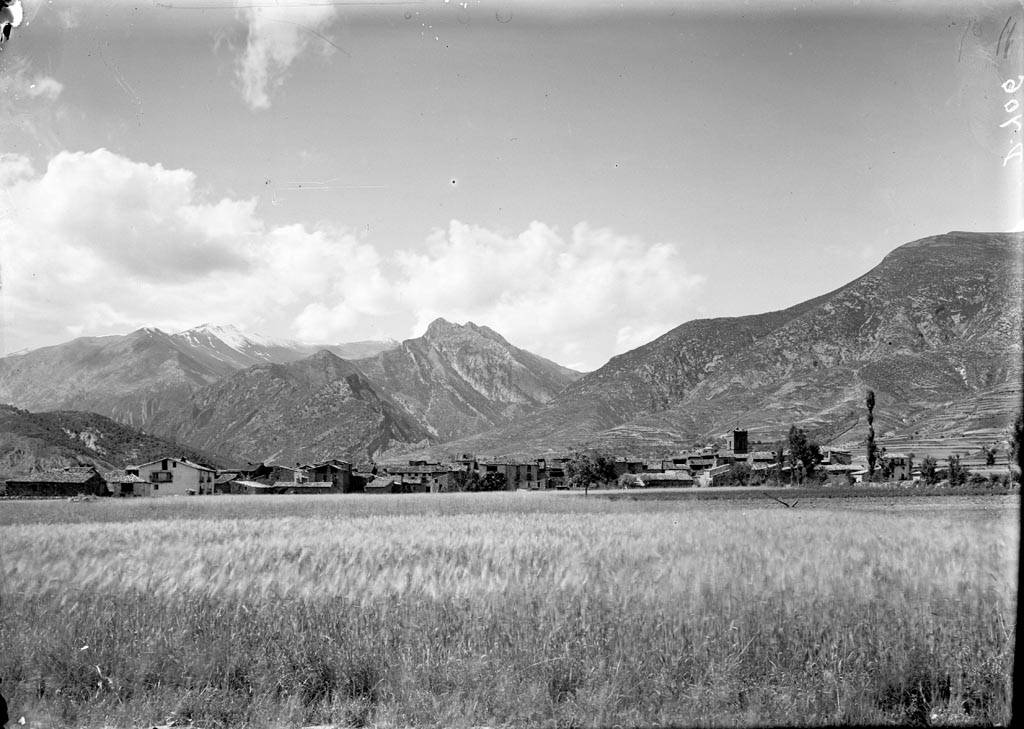
Perarrúa lies in the comarca of La Ribagorza, between Barbastro and Graus, in a landscape that is in transition. To the south stretches the Somontano, while to the north the valley of the Ésera begins to hint at the Pyrenees. From Huesca, the journey takes about an hour by car. The usual approach follows the river along a quiet road that cuts through cereal fields, scattered olive trees and occasional slopes planted with almond trees.
Stone, wood and the shape of daily life
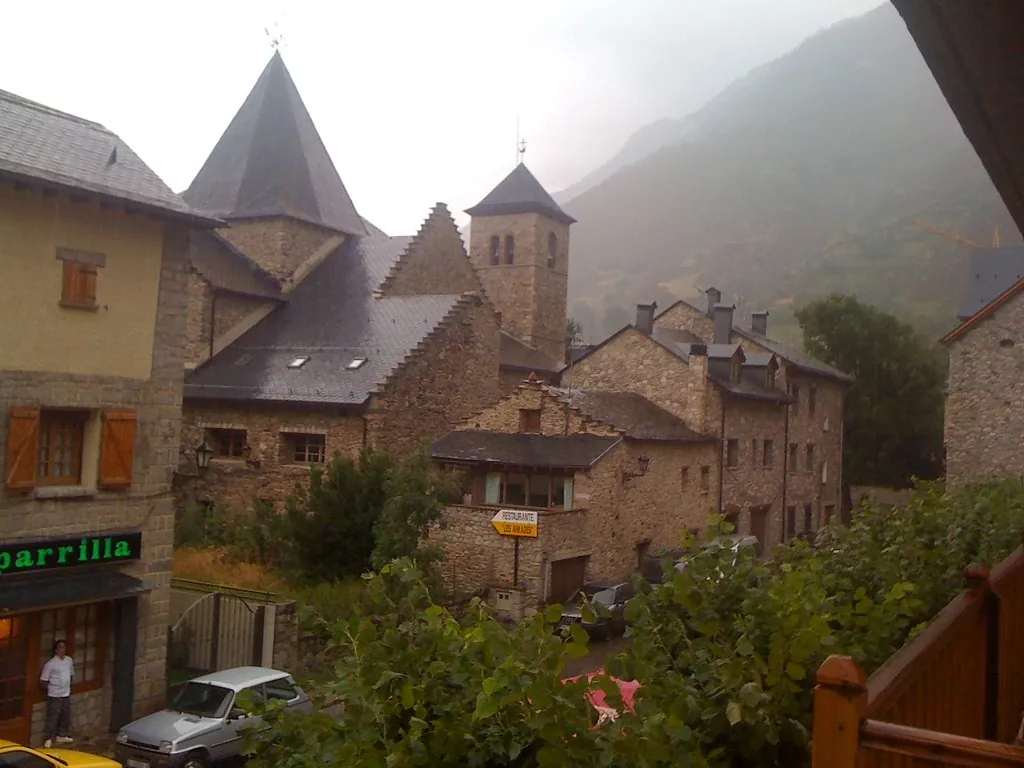
The village itself is small. Just a handful of streets cluster around the church before opening out towards orchards and animal enclosures. Stone dominates almost everything: thick walls, heavy wooden doors, simple balconies edged with wrought iron.
The parish church, traditionally dedicated to San Martín, stands at one of the central points of Perarrúa. It is not especially large, but its tower is easy to spot from the surrounding fields. In places of this size, the church often remains the focal point for many of the year’s celebrations.
A slow walk through the streets reveals traces of earlier times. Lintels carved with dates sit above doorways, old stables have been turned into storage spaces, and tools hang beneath the eaves. Some houses have been restored, while others retain the uneven, weathered look that stone takes on after more than a century of winters and summers.
Open land and the presence of the Ésera
The landscape around Perarrúa feels open. There are no immediate mountains or dense forests. Instead, there are agricultural plots and gentle rises from which the Ésera valley can be seen widening as it stretches southwards.
In spring, almond trees often blossom early, sometimes before the cold has fully lifted. By summer, the midday light is strong and there is little shade beyond the village itself, so walking is best done early or later in the day. The wind moves through dry grasses, and now and then the faint sound of cowbells drifts from a distant hillside.
Tracks lead out from the edges of the village towards fields, irrigation channels and small terraced plots. These are short walks rather than marked routes, with no formal tourist signage, but they are easy enough to follow if the village remains in sight as a reference point.
Quiet roads and nearby towns
Perarrúa is well placed for exploring this part of La Ribagorza, whether by car or by bicycle. A few kilometres away lies Graus, one of the historic towns of the area. Heading south, the landscape opens further around the reservoir of El Grado.
The secondary roads here are generally quiet for most of the year. In summer, the heat can be intense, so carrying water is sensible if planning to walk or cycle nearby. Within the village itself, services are limited and not everything is open at all times.
When the village fills again
As in many small villages, the permanent population of Perarrúa is modest during the winter months. In summer, the atmosphere changes. The patronal festivities dedicated to San Martín are usually held during the warmer months, and this is when people who have moved away return.
For a few days, the usual calm gives way to a livelier rhythm. Music in the square, long shared tables, children running between the houses. It is not an event designed to attract large numbers of visitors, but rather a gathering of those who maintain a connection to the village.
A place to pause on the way
Perarrúa does not take long to explore, but it works well as a quiet stop on a route through La Ribagorza. The best light often comes late in the afternoon, when the sun angles across the valley and the façades take on a soft golden tone.
In August, the heat can be strong by mid-afternoon, while outside the summer season the silence is almost complete. In return, there is something increasingly rare: a small village where the sounds of the countryside are still close at hand, and where time does not seem to move especially fast.